
From Trump’s era of spectacle to a socialist rebalancing — what the city’s next chapter might look like.
Why the Race Shook the Nation
This mayoral race wasn’t just about New York. It became a national battleground — because billions of dollars and elite players converged on it; because the ideological stakes felt existential. A socialist candidate threatened not just the local housing market or rent rolls, but the very architecture of a city that defines global finance, real estate, and ambition. The backers saw more than policy — they saw precedent.
That’s why so much was poured into Super-PACs, media attacks, and fear-mongering. Because if New York could pivot, what would that mean: for other cities? For national capital flows? The spectacle of New York wasn’t just local drama. It had become a battleground in a broader war over what cities — and society — are for.
New York did not crown Trump by accident. The towers, the tabloids, the myth of power — all reflected the city’s appetite for dominance, extraction, being bigger than the system itself. Trump’s triumph was less about him than the ecosystem he mirrored.
Then came Zohran Mamdani. Young. Muslim. The son of immigrants. Raised in Queens. A former foreclosure counselor turned labor organizer turned state assemblymember. Now the city’s mayor-elect. His campaign pitched housing as infrastructure, transit as a right, wages as dignity. No private jets. No tabloids. A different axis. Wikipedia+1
On November 4, 2025, New York turned. It elected Mamdani over Andrew Cuomo (independent) and Curtis Sliwa (Republican). The Associated Press called it at 9:34 p.m. ET. The city spoke: it opted not for spectacle, but for substance. Wikipedia+1
Who Is Mamdani?
Born in Kampala, Uganda, to Indian parents, transplanted to Queens at age seven. U.S. citizen since 2018. Foreclosure counselor. Labor organizer. Then elected to the State Assembly for Queens/Brooklyn (AD-36). A political upbringing rooted in justice, community, dignity—not empire, tabloid glitz, or extraction. Wikipedia
What He Ran On (And Why It Matters)
- Rent freeze on rent-stabilized units + building genuinely affordable housing. Wikipedia+1
- $30/hour citywide minimum wage. Wikipedia
- Fare-free buses and expanded public transit access. Wikipedia+1
- Universal childcare and public-run grocery provisions, funded by higher taxes on wealthy & corporations. Wikipedia+1
These are structural prescriptions. If the prior era whispered “growth at all costs,” this one asks: “What does it cost you just to live? And how do we fix it?”
The White House Meeting: A Moment of Symbolic Weight
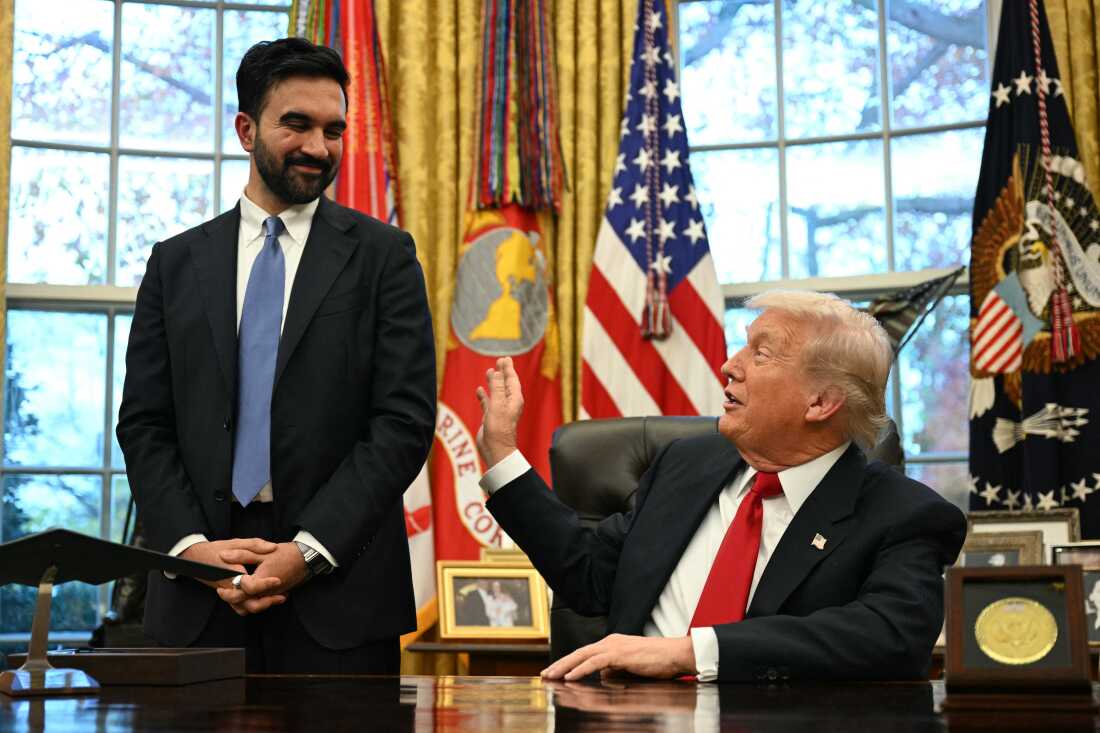
On Nov. 21, 2025 — just weeks after Mamdani’s win — he met Trump at the White House in the Oval Office. It was their first face-to-face after months of trading insults: Trump had framed Mamdani as a “communist” and threatened to pull federal funding; Mamdani had publicly called Trump a “fascist.” PBS+2The White House+2
But when cameras turned on, the posture changed — at least publicly. The meeting was “surprisingly cordial.” Trump praised Mamdani’s victory as a sign of strength; the two discussed affordability, economic security, and public safety. Trump later remarked they “agree on a lot more than I would have thought.” Vanity Fair+2PBS+2
Media outlets instantly framed the encounter as weird, symbolic — a moment where two political opposites met quietly in the same room. Some called it surreal. Others saw it as evidence the “establishment” might tolerate — or even try to co-opt — the threat represented by a socialist mayor in the world’s financial capital. Vanity Fair+2C-SPAN+2
The Swing, Not the Rupture
This isn’t a clean break. The mechanisms — capital, real estate, media — still loom. But for a moment, elected power shifted its axis. Instead of “How do we out-shine the competition?” we heard: “How do we out-serve a city?”
Because balance isn’t static. The spectacle that defined past decades will test this administration: budgets will strain, expectations balloon, the opposition circles. If Mamdani behaves like the organizer he once was, not a brand, maybe this pendulum will settle.
The Real Test — And the Larger Narrative
Free transit costs money. A $30 wage shifts markets. A rent freeze courts legal pressure. And behind it all: can governance stay grassroots in a global city when the old order is still breathing loud and heavy?
The White House meeting — the optics, the handshake, the “we agree more than you think” line — it added a layer to the story. Not a twist. A warning. A lens. Because when the world sees a socialist mayor walking into the same Oval Office as the buttoned-down president, the question becomes: Is the message containment — or accommodation?
This isn’t about whether socialism will “save” New York. It’s about whether New York can sustain a politics of belonging — when every institution around it expects performance, not belonging.
Because when New York changes, everything else listens.
 Anarchy Journal Constitutional