The $900 Billion That No One Voted For


A $900 Billion Decision With Little Public Scrutiny

The U.S. House of Representatives this week approved the annual defense policy bill — the National Defense Authorization Act (NDAA) — authorizing roughly $900 billion in Pentagon spending for fiscal year 2026. The measure passed with broad bipartisan support, continuing a streak that has now lasted more than six decades.

According to reporting from CBS News and Reuters, the bill cleared the House by a 312–112 vote, once again exceeding the administration’s initial budget request and reinforcing a familiar outcome: the Pentagon’s budget grows, regardless of party control or global conditions.

Despite the scale of the authorization — one of the largest federal expenditures approved annually — the vote generated limited sustained public debate. Media coverage focused largely on procedural elements, such as troop pay increases and geopolitical provisions, rather than the broader question of why military spending has become one of the few areas of government effectively insulated from public resistance.


What the Public Actually Thinks

Public opinion data paints a far more complicated picture than congressional voting patterns suggest.

Long-term polling by Gallup shows that Americans are not clamoring for ever-higher military budgets. In 2024, only about 29 % of respondents said the United States was spending too little on national defense, while the majority believed spending was either “about right” or “too high.”

When asked more directly about budget increases beyond Pentagon requests, opposition becomes even clearer. A Data for Progress survey found that 63 % of Americans opposed increasing military spending above the requested level, including majorities of both Democrats and Republicans.

The disconnect is difficult to ignore: voters across party lines express skepticism about increased military spending, yet Congress delivers it year after year with bipartisan consensus.


A Budget That Always Goes Up

The Pentagon budget has become one of the most consistent growth mechanisms in American governance.

Wars begin, and the budget rises. Wars end, and the budget rises. Economic downturns, inflation, and public health crises — none have reversed the trend. Even in years without newly declared conflicts, defense authorizations continue to expand.

According to the Peter G. Peterson Foundation, defense spending remains the single largest category of discretionary federal spending, often rivaling or exceeding all other discretionary priorities combined.

This growth occurs with remarkably little interrogation of outcomes. While most federal programs are subjected to cost-benefit scrutiny, defense spending is treated as inherently justified — a baseline necessity rather than a policy choice.



The Military-Industrial Complex: Structure, Not Conspiracy

President Dwight D. Eisenhower’s warning about the “military-industrial complex” was not a prediction of corruption so much as a diagnosis of incentives.

Today, more than half of Pentagon discretionary spending flows directly to private defense contractors, including Lockheed Martin, RTX (Raytheon), Boeing, General Dynamics, and Northrop Grumman.

These firms spend tens of millions of dollars annually on lobbying, shaping procurement priorities and legislative outcomes in Washington.

This is not a shadowy conspiracy — it is an openly functioning system. Defense spending sustains regional economies, fuels revolving-door careers between government and industry, and anchors think tanks and policy institutions whose incentives align with budget growth.

When peace is bad for business, conflict does not need to be declared to remain profitable.


If Not Defense, Then What?

This is where the numbers stop being abstract.

$900 billion is not just a defense budget — it is a statement of national priorities.

That sum could meaningfully expand healthcare access, address student debt, fund public housing initiatives, modernize infrastructure, or strengthen climate resilience programs. These are not fringe ideas; they are perennial public demands.

Yet unlike military spending, domestic investments are always conditional. They must be negotiated, trimmed, justified, and re-justified. Defense spending, by contrast, is treated as automatic — the one area of government where growth is assumed rather than debated.

What threat, exactly, requires permanent expansion?

The United States increasingly practices defense by spending rather than defense by strategy. Budgets grow while outcomes remain unclear, conflicts multiply, and interventions persist with little accountability for long-term consequences.


America Is the Pentagon Now

At some point, the distinction between institution and identity blurs.

The Pentagon is no longer just a department — it is an economic engine, a political stabilizer, and a defining feature of American global posture. Its budget reflects not only perceived threats abroad, but a domestic system built around permanent militarization.

When Congress passes another massive Pentagon authorization that the public never meaningfully demanded, it sends a clear message: defense is not merely a priority — it is the default.

America does not simply have a military budget.
America is organized around one.

The question democracy must eventually confront is not whether defense matters. It is whether a democracy can remain responsive when its largest annual decision is effectively pre-decided.

That answer won’t come from another bipartisan vote. It will come from whether the public insists on asking why the budget always grows — and who it is really for.

How modern media exploits cognitive bias and emotional tribalism

Modern propaganda doesn’t arrive wearing a uniform or marching behind a flag. It slips through screens wrapped in certainty, engineered outrage, and the subtle pleasure of belonging. It has evolved from posters and radio broadcasts into a precision-guided psychological instrument — one that understands human cognition better than many of us understand ourselves.

The old question — “How do they manipulate people?” — has a modern answer:
They don’t manipulate us in spite of how the mind works; they manipulate us because of it.

Propaganda is not powered by lies alone. It’s powered by the machinery of human bias.


The Mind Wants Simplicity, Power Wants Compliance

The human brain is a pattern-hungry organ. It hates uncertainty. It hates complexity. It rewards itself for reaching quick conclusions, even when those conclusions are wrong. Modern propaganda exploits this ancient wiring.

Cognitive shortcuts — heuristics — make survival faster. But in the information age, they become vulnerabilities.

  • Availability bias: the more something is repeated, the more “true” it feels.
  • Confirmation bias: we select information that flatters our worldview and ignore what threatens it.
  • Black-and-white thinking: nuance becomes uncomfortable, so we choose a side because sides feel safer than questions.

The corporate press, political operatives, and intelligence-adjacent media pipelines all understand one thing: A confused public is dangerous to power, but a certain public is easily controlled. Certainty is the product. Propaganda is the packaging.


Outrage Is a Business Model

Once, propaganda was a state-driven affair. Today, it’s a market.

Emotion is the cheapest fuel. Outrage the most renewable. Entire empires — cable news, social media platforms, political campaign networks — have built their fortunes on keeping the collective nervous system in fight-or-flight mode.

Anger boosts clicks. Fear extends watch-time. Tribalism keeps audiences loyal.

Our emotional circuitry — evolved for survival on an open savannah — was not designed to absorb 24/7 stimulation from institutions with quarterly earnings goals. Attention is monetized, but emotion is weaponized.

Propaganda is no longer about controlling a narrative.
It’s about creating one that the public cannot look away from.


Tribalism Isn’t a Bug — It’s the Operating System

Humans form tribes because they offer belonging. But in the modern era, belonging is manufactured. Propaganda leans heavily on identity, because identity determines loyalty.

We are encouraged to view politics as teams, not policies.
We are nudged to respond to stories as fans of a faction, not citizens.
We are trained to mistake performative allegiance for moral clarity.

This emotional tribalism creates a self-reinforcing ecosystem:

  1. Stories are framed to validate “our side.”
  2. The other side is dehumanized, mocked, or demonized.
  3. Facts become less important than the feeling of being correct.
  4. Propaganda does not need to persuade — it only needs to polarize.

A divided public is predictable. Predictability is profitable.
And profit keeps the propaganda machine humming.


Modern Media Doesn’t Report Reality — It Constructs It

The issue is not simply bias. Bias is human.
The issue is manufacture — the deliberate shaping of public perception to serve institutional goals.

We’ve seen this repeatedly:

  • Intelligence agencies quietly laundering narratives through sympathetic journalists.
  • Corporate advertisers influencing editorial decision-making.
  • Tech platforms algorithmically boosting content that increases dependence on the platform, not awareness in the world.
  • “Fact-checking” becoming less about truth and more about enforcing the preferred narrative frame.

In this environment, propaganda is not a fringe tactic.
It’s the default language of power.

Reality doesn’t break down in this system — it gets replaced.


Why the Propaganda Works: The Mind’s Need for Belonging, Safety, and Story

No matter how educated or skeptical we become, the mechanics of the human mind stay the same.

Propaganda works because:

  • We crave coherence. A simple story beats a true one.
  • We crave belonging. Being on a team beats being uncertain.
  • We crave order. Someone explaining the world beats admitting how chaotic it is.
  • We crave villains. It’s easier to fear an enemy than question a system.

The architects of modern propaganda don’t need to change our minds.
They just need to activate what’s already inside them.

The weapon is not the message.
The weapon is our psychology.


Breaking the Spell: Awareness as Resistance

If propaganda exploits cognitive bias, then the antidote begins with awareness of those biases. Not enlightenment. Not perfect objectivity. Just the willingness to notice the machinery at work.

If tribalism fuels propaganda, then solidarity outside the binary becomes a quiet act of rebellion.

If emotion is the lever, then slowing down — refusing the engineered urgency — becomes a tactic.

Truth is not served by choosing a side.
Truth is served by stepping outside the game.

Propaganda collapses when the public stops responding on autopilot.

The goal is not to become immune.
The goal is to become unmanipulable.


The psychology of propaganda is simple: power weaponizes the deepest impulses of the human mind — our fear, our certainty, our longing to belong — and sells them back to us as truth.

But once the mechanism is visible, it loses its magic.
Once the trick is known, it stops being a trick.

Seeing clearly has always been the first step of resistance.


From Trump’s era of spectacle to a socialist rebalancing — what the city’s next chapter might look like.


Why the Race Shook the Nation

This mayoral race wasn’t just about New York. It became a national battleground — because billions of dollars and elite players converged on it; because the ideological stakes felt existential. A socialist candidate threatened not just the local housing market or rent rolls, but the very architecture of a city that defines global finance, real estate, and ambition. The backers saw more than policy — they saw precedent.

That’s why so much was poured into Super-PACs, media attacks, and fear-mongering. Because if New York could pivot, what would that mean: for other cities? For national capital flows? The spectacle of New York wasn’t just local drama. It had become a battleground in a broader war over what cities — and society — are for.


New York did not crown Trump by accident. The towers, the tabloids, the myth of power — all reflected the city’s appetite for dominance, extraction, being bigger than the system itself. Trump’s triumph was less about him than the ecosystem he mirrored.

Then came Zohran Mamdani. Young. Muslim. The son of immigrants. Raised in Queens. A former foreclosure counselor turned labor organizer turned state assemblymember. Now the city’s mayor-elect. His campaign pitched housing as infrastructure, transit as a right, wages as dignity. No private jets. No tabloids. A different axis. Wikipedia+1

On November 4, 2025, New York turned. It elected Mamdani over Andrew Cuomo (independent) and Curtis Sliwa (Republican). The Associated Press called it at 9:34 p.m. ET. The city spoke: it opted not for spectacle, but for substance. Wikipedia+1


Who Is Mamdani?

Born in Kampala, Uganda, to Indian parents, transplanted to Queens at age seven. U.S. citizen since 2018. Foreclosure counselor. Labor organizer. Then elected to the State Assembly for Queens/Brooklyn (AD-36). A political upbringing rooted in justice, community, dignity—not empire, tabloid glitz, or extraction. Wikipedia


What He Ran On (And Why It Matters)

  • Rent freeze on rent-stabilized units + building genuinely affordable housing. Wikipedia+1
  • $30/hour citywide minimum wage. Wikipedia
  • Fare-free buses and expanded public transit access. Wikipedia+1
  • Universal childcare and public-run grocery provisions, funded by higher taxes on wealthy & corporations. Wikipedia+1

These are structural prescriptions. If the prior era whispered “growth at all costs,” this one asks: “What does it cost you just to live? And how do we fix it?”


The White House Meeting: A Moment of Symbolic Weight

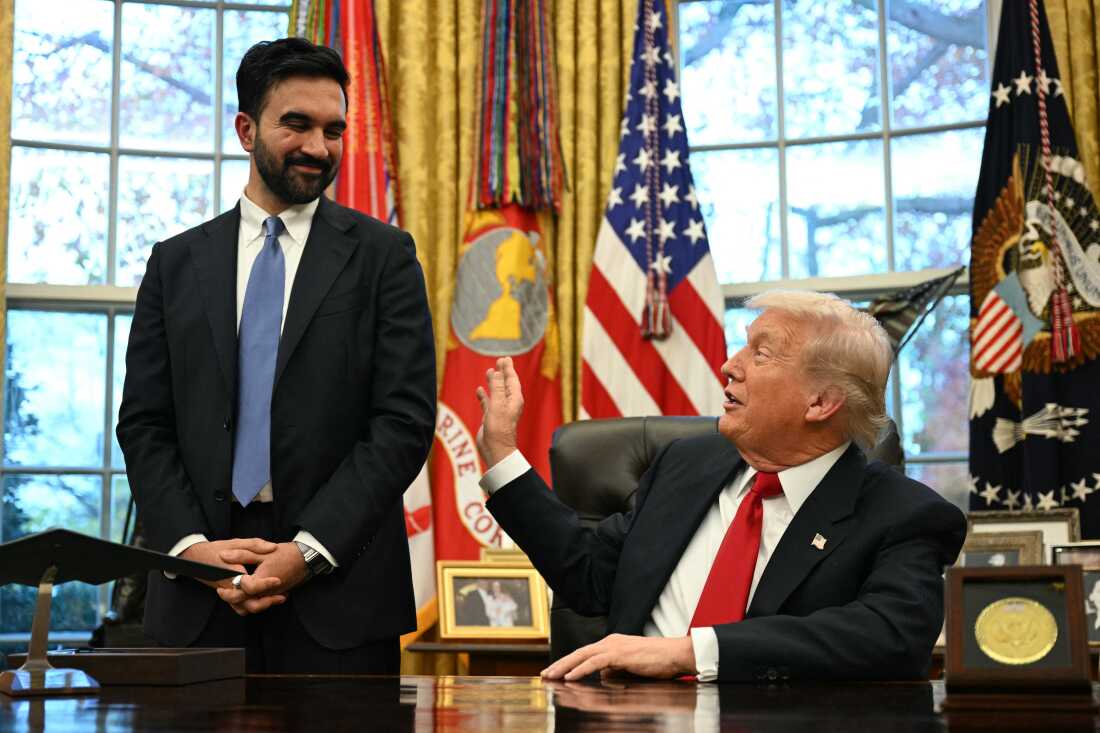
On Nov. 21, 2025 — just weeks after Mamdani’s win — he met Trump at the White House in the Oval Office. It was their first face-to-face after months of trading insults: Trump had framed Mamdani as a “communist” and threatened to pull federal funding; Mamdani had publicly called Trump a “fascist.” PBS+2The White House+2

But when cameras turned on, the posture changed — at least publicly. The meeting was “surprisingly cordial.” Trump praised Mamdani’s victory as a sign of strength; the two discussed affordability, economic security, and public safety. Trump later remarked they “agree on a lot more than I would have thought.” Vanity Fair+2PBS+2

Media outlets instantly framed the encounter as weird, symbolic — a moment where two political opposites met quietly in the same room. Some called it surreal. Others saw it as evidence the “establishment” might tolerate — or even try to co-opt — the threat represented by a socialist mayor in the world’s financial capital. Vanity Fair+2C-SPAN+2


The Swing, Not the Rupture

This isn’t a clean break. The mechanisms — capital, real estate, media — still loom. But for a moment, elected power shifted its axis. Instead of “How do we out-shine the competition?” we heard: “How do we out-serve a city?”

Because balance isn’t static. The spectacle that defined past decades will test this administration: budgets will strain, expectations balloon, the opposition circles. If Mamdani behaves like the organizer he once was, not a brand, maybe this pendulum will settle.


The Real Test — And the Larger Narrative

Free transit costs money. A $30 wage shifts markets. A rent freeze courts legal pressure. And behind it all: can governance stay grassroots in a global city when the old order is still breathing loud and heavy?

The White House meeting — the optics, the handshake, the “we agree more than you think” line — it added a layer to the story. Not a twist. A warning. A lens. Because when the world sees a socialist mayor walking into the same Oval Office as the buttoned-down president, the question becomes: Is the message containment — or accommodation?

This isn’t about whether socialism will “save” New York. It’s about whether New York can sustain a politics of belonging — when every institution around it expects performance, not belonging.

Because when New York changes, everything else listens.

What happens when what you want most is not growth, but relief from the shame of not being enough?

The Daily Grind That Isn’t Growth

You wake up early. You do the cold shower. You skip the sugar, push through the workout, and tick the boxes on your habit tracker. You’re doing all the right things.

But instead of feeling strong, you feel… hollow. Irritable. Tired in a way that no amount of achievement fixes.

This is discipline turned sour.

We praise self-discipline like a holy grail of self-improvement, but discipline without self-awareness can quietly morph into self-punishment. If we’re not careful, we use growth language to justify internal violence.

“If you are distressed by anything external, the pain is not due to the thing itself, but to your estimate of it.” — Marcus Aurelius

True Stoic discipline is about clarity and integrity, not white-knuckling our way through routines that no longer serve us. It’s about sovereignty, not suppression.

Photo by Tajmia Loiacono on Unsplash

Shame Disguised as Structure

Sometimes we’re not pursuing excellence; we’re fleeing inadequacy.

Behind a rigid structure often hides a fragile self-worth. We believe if we slip, we’ll lose everything. That rest equals regression. That easing up means failure.

This is not resilience. This is fear in a productivity costume.

“The game is not about becoming somebody, it’s about becoming nobody.” — Ram Dass

We are not machines. You cannot shame your way into wholeness. Discipline born from fear will always come at the cost of inner peace.

Photo by Krakograff Textures on Unsplash

Rethinking Strength: The Real Stoic Resilience

We often misunderstand Stoicism as emotional suppression or masochistic toughness. But real Stoicism is about discerning what is within our control — including the choice to care for our inner life.

Real strength is not forcing action — it’s aligning action with wisdom.

When discipline disconnects us from presence, it defeats its purpose.

“The curious paradox is that when I accept myself just as I am, then I can change.” — Carl Rogers

We are not here to grind ourselves into worthiness. The deepest change comes not from judgment, but from understanding.

The Biology of Burnout

Modern neuroscience shows us that how we treat ourselves biologically shapes how we show up mentally and emotionally.

Discipline that constantly triggers our stress response erodes our capacity to regulate, reflect, and recover. Over time, chronic cortisol dulls creativity, undermines motivation, and can even shrink brain regions tied to memory and empathy.

Self-compassion activates the brain’s caregiving system (increased oxytocin and decreased cortisol), creating a more sustainable motivation than self-criticism. — Gilbert, 2009

Sustainable change happens not through pressure, but through presence.

Returning to Yourself: The Discipline of Care

So, how do we tell the difference?

Ask: Is this action rooted in fear or care?

Discipline aligned with love feels sustainable, nourishing, and honest. Discipline rooted in fear feels brittle, exhausting, and empty.

“Be here now.” — Ram Dass

True discipline doesn’t beat you into shape. It meets you where you are and walks with you toward what matters.

You don’t need to push harder. You need to listen deeper. Let your structure be soft enough to bend, strong enough to hold you, and wise enough to know when to stop.

Photo by Jaida Stewart on Unsplash


Photo by Inggrid Koe on Unsplash

The Unseen Habit

I judge.
People. Situations. Myself.

It’s quick — reflexive. A smirk. A label. A silent narrative in my head.
Sometimes I catch it. Sometimes it slides right by, disguised as clarity or intelligence or “just being real.”

Lately, I’ve been thinking about the way judgment sneaks in. The way it steals connection. The way it shuts me down just as I’m trying to open up.


“When you judge another, you do not define them, you define yourself.” — Wayne Dyer


Judgment Is the Brain’s Shortcut

Here’s the thing: we’re wired to judge.

The default mode network in our brains lights up when we’re not focused — when we’re daydreaming, remembering, worrying. It loops us into self-referential thought, comparisons, fears, and projections. This is the architecture of judgment.

But it’s not just biology — it’s existential.


Until you make the unconscious conscious, it will direct your life and you will call it fate. — Carl Jung


Jung said we project the parts of ourselves we can’t face. That’s the shadow. So when I label someone as arrogant or fake, maybe I’m glimpsing something unresolved in me. Judgment becomes a mirror. A distorted one.


“It’s not things that upset us, but our judgment about things.” — Epictetus


It’s not the lateness — it’s the story I tell about what it means.
It’s not the failure — it’s the belief I should never fail.

Why It Feels Good to Judge (Even When It Hurts)

Judgment makes me feel like I know something.

Like I’m in control. It’s safer to judge than to feel.

I missed a goal I set? I rush to label myself “undisciplined” before anyone else can.

This is ego defense.


“Compassion is the radicalism of our time.” — Dalai Lama


Humanism reminds us that people need acceptance to grow. But judgment replaces understanding with control. It keeps others at a distance and keeps me in a loop of performance and critique.

Photo by Pawel Czerwinski on Unsplash

What We Lose When We Judge

Judgment disconnects.
From others. From ourselves.

It feels powerful in the moment, but it fractures trust. It turns people into characters in a play we’re writing. And when I’m in judgment mode, I can’t listen. I can’t learn. I can’t love.


“Hell is other people.” — Jean-Paul Sartre


But maybe the real hell is the lens we use to see them.

The Antidote: Awareness, Not Avoidance

So, how do we move forward?

Not by pretending we never judge.
But by noticing it, getting curious, and slowing down.


“Between stimulus and response, there is a space. In that space is our power to choose our response.”— Viktor Frankl


The Stoics called it prohairesis — the inner freedom to choose how we interpret and respond to life. That space is everything.

A Daily Practice in Unlearning

I still judge. But now I try to see it.
I question it. I sit with it. I breathe before I speak.

Sometimes I succeed. Sometimes I don’t.

But that’s the practice — replacing reaction with reflection.
Replacing condemnation with compassion.
Replacing the need to be right with the desire to see clearly.


“We’re all just walking each other home.”— Ram Dass


That hits differently now.

Maybe we walk each other home more easily when we stop narrating the journey and start sharing it.

Photo by Tegan Mierle on Unsplash

I write about the messy parts of being human — judgment, ego, awareness, and all the places we trip on our way to clarity.


If this piece made you pause or reflect, you can:

  • Leave a comment — what helps you catch yourself when you’re judging?
  • Follow me for more essays that blend Stoicism, spirituality, and human insight.