Posts Tagged ‘consciousness’


I want to write about this subject because, despite years of meditation, personal development, journaling, yoga, philosophy, and spirituality, when I get pressed, I still find myself acting out of ego.

I judge people. I think negatively. I feel bad. My mind races. I replay negative situations over and over. I get vulgar, angry, hostile, and negative.

Being older now, and having studied philosophy and spirituality for almost two decades, and consumed personal development content for twenty years, I know that this doesn’t make me inferior or unique — it makes me human. And I want to share this with others. It’s okay to be human. It’s okay to screw up. Negative events don’t define who we are.

Photo by Jeremy Yap on Unsplash

A negative outburst doesn’t define me. Doing the wrong thing doesn’t define me. Failing to practice what I preach doesn’t define me. It makes me a human being.

That’s why I study philosophy. It’s why I have a spirituality practice. It’s why I meditate. It’s why I study humanist personal development. It’s why I’m drawn to neuroscience.

We all struggle with these challenges, and I want to explore how ego-driven anger is something we all experience, especially in today’s world.

Photo by Dave Hoefler on Unsplash

The Hidden Role of Ego in Anger

The ego — the sense of self that fuels our need for validation, control, and superiority — often hides in plain sight. It shows up in negative judgments, reactive thoughts, and moments of anger. But it’s not always the loud, brash ego we imagine. Sometimes it’s the quiet voice that whispers, “I deserve better,” or “I’m right and they’re wrong,” feeding our emotions and judgments without us even realizing it.

“Your anger and annoyance are more detrimental to you than the things themselves which anger or annoy you,” — Marcus Aurelius

Philosophy: The Stoic and Taoist View of Ego

Stoicism teaches us to observe our emotions without judgment — to step back and recognize that we are not our anger. Taoism, on the other hand, encourages letting go of resistance and embracing the natural flow of life.

“Knowing others is intelligence; knowing yourself is true wisdom.”— Lao Tzu

Spirituality: Understanding Ego through Mindfulness

Spiritual practice, especially mindfulness, offers a direct experience of observing the ego. Buddhism teaches that anger arises from attachment to the self and from clinging to identity and righteousness.

“When we let go of the need to be ‘right,’ we allow the ego to dissolve on its own, like a drop of water evaporating in the sun.” — Thich Nhat Hanh

Photo by Mike Labrum on Unsplash

Intellect and Neuroscience: How the Brain Reinforces Ego

Science has begun to confirm what ancient philosophies intuited long ago. Our brain’s default mode network — active when we’re ruminating or imagining — fosters ego identity. The brain rewards validation and recognition, making it easy to get stuck in ego-based loops, even when we know better.

Humanism: Embracing Our Humanity

The humanist approach is rooted in self-compassion. We don’t grow by shaming ourselves — we grow by understanding and responding with care. To be human is to be imperfect.

“The curious paradox is that when I accept myself just as I am, then I can change.” — Carl Rogers

Ego Is a Messenger

Ego-based anger is part of the human condition — especially in a fast-paced, comparison-driven society. We don’t need to destroy our ego. We just need to recognize when it’s taking the wheel. That recognition alone is a kind of freedom.

Next time the anger hits, ask: “Is this my ego speaking?”
Pause. Breathe.
Try to let that moment of awareness be enough.
Photo by Fabrizio Chiagano on Unsplash


We’re so conditioned to believe that we are what we think.

That who we are is our mind, our thoughts, our emotions.

Even if we aren’t taught that by our; culture, our schools, our families, our communities; and we are; it is natural to assume that. The voice in our head. The streams of thoughts and perceptions and feelings must be who we are. If not that, then what?

What does it mean to be a human being?

If we are our thoughts, our mind, then how does our hair know to grow? How does our heart know to beat? How do our lungs know to breathe? We’re not consciously doing any of that or any of the million other things that our body does on auto pilot. Try to stop breathing and see what happens.

If we are our mind then what does that mean about our dreams?

Bad thoughts and negative emotions are a normal occurrence, but if we have a certain amount of both does that mean we’re a bad person?

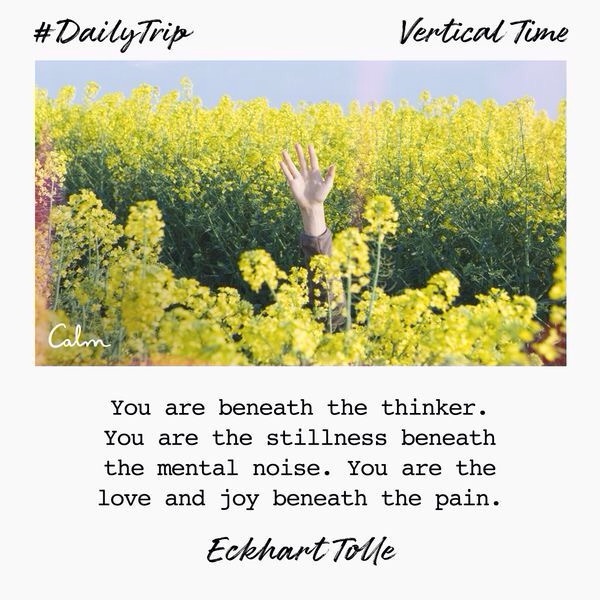
It was a wonderful and liberating experience when I learned that we are not our thoughts, that we are the being or the state of consciousness that recognizes our thoughts and emotions. I came across this concept from Eckhart Tolle. He isn’t the first or the last spirituality philosopher, he’s simply the one who’s message resonated and stuck with me for almost two decades now.

Wonderful and liberating, but not a miracle cure for all my ills. No such thing unfortunately. But to even get a sliver of space between by thoughts/emotions and my reaction to them was like coming up for air after almost drowning at sea.

Learning about something doesn’t equal mastery. One can know something beneficial but still do the opposite, detrimental action out of habit. I think that’s the norm actually. It certainly has been for me on my spiritual path and personal development journey.

However, it is a big help on the bad days to know that the negative thoughts are happening to me and not from me or because of me. Couple that with the classic advice of; this too shall pass, and you’ve got a one two punch to get through the tough times just a smidge easier than before.

A meditation practice helps me process and incorporate self improvement knowledge better than just passive information consumption. A journaling practice helps me embed the personal development knowledge even further. Yet I still have much work to do, many miles to go. At times, I’m still a dog chasing it’s tail.

But we all have to walk our own path. Eckhart’s teaching help take some of the self imposed pressure off, as well as the pressure our cultures forces upon us. The pressure of more more more. Do more, say more, take more, buy more.

Our culture gives us a lot to think about. Information overload is the fitting term for it. Information overload is the expressway to burnout. I’ve had textbook burnout a few times in my life. Each time it was Eckhart’s teachings that helped me find my way back to myself.

What is myself? Who am I? What was I finding my way back to? My thoughts? My emotions? My perceptions? My past? My life situation? No, none of those things.

Then who am I? How did I find myself?

By cultivating my inner awareness and spaciousness. Those are the portals to connecting with our essence, our being. We’re human beings. We’re being human.

By getting still, silent, paying attention to one’s breath or inner energy field in specific areas of the body; we can connect with our consciousness, our essence, our being.

I am so happy and grateful that I was able to realize what I am and connect with it. I still aspire to connect with my true self more frequently as thoughts, perceptions, and emotions still swallow me up from time to time. But practice makes progress. And if there’s one things I’m not getting tired of practicing, it’s remembering that I am not my thoughts and emotions, I am the awareness that witnesses them.

Namaste

Live long enough and you’ll eventually ask yourself internally or out loud; “Why am I like this?”

The rational answer sans emotional baggage and personal history is…habits.

We are a product of our habits. Habits being repeated actions. Our most repeated actions. We are what we repeatedly do, without exception.

Habits by their nature, are unconscious. The purpose of forming habits is to be able to do them with minimal or no thought. That’s how they stick for better AND for worse.

New Years Resolutions are the most popular, socially accepted, tradition of bringing conscious awareness to our habits. For the first couple of weeks every year people become aware of and focus on their eating habits, drinking habits, social habits, exercise habits, leisure time habits, relationship habits, etc.

It’s also a meme that people drop off of their resolutions within days or maybe weeks the beginning of the new year. Planet Fitness’ profitability is dependent on people signing up, dropping off, but not canceling their membership.

However the act of the new years resolution is a proper formula for change. At least for the beginning portion of change. One can’t change without being aware change is needed. Again, habits are by their nature unconscious. We have to bring awareness to our habits to change them for better AND for worse.

Our lives aren’t just dominated by our habits, our lives are our habits. Whatever our individual life constitutes as normal is made normal by the habitual actions we take every hour of everyday or every week of every month of every year of our lives.

Awareness is the way out. I know I’ve had to spend a lot of mental energy on building new habits in pretty much every area of my life. Naturally there was/is emotional baggage attached to them. We’re all human beings after all. We’re not productivity or efficiency machines no matter how much capitalism wants us to be.

It’s a marathon not a sprint.

Some of the new years resolutions I stuck to last year, literally didn’t become habitualized until December. Because habits don’t form in a couple of days or a couple of weeks no matter how impatient we may be.

We may have to work to make a living but our life’s work is the work of making our life. As long as we’re alive, we can dedicate the time, energy, focus, and consistency to improving our lives based on our own criteria for what brings us consistent joy and fulfillment. And we can’t do that unconsciously with one off actions.