Posts Tagged ‘philosophy’

It can be hard to focus on what we can control or influence when we have a harder time distinguishing between the two. Generations raised on movies, television, and social media have been socially conditioned to have egos the size of the Grand Canyon.
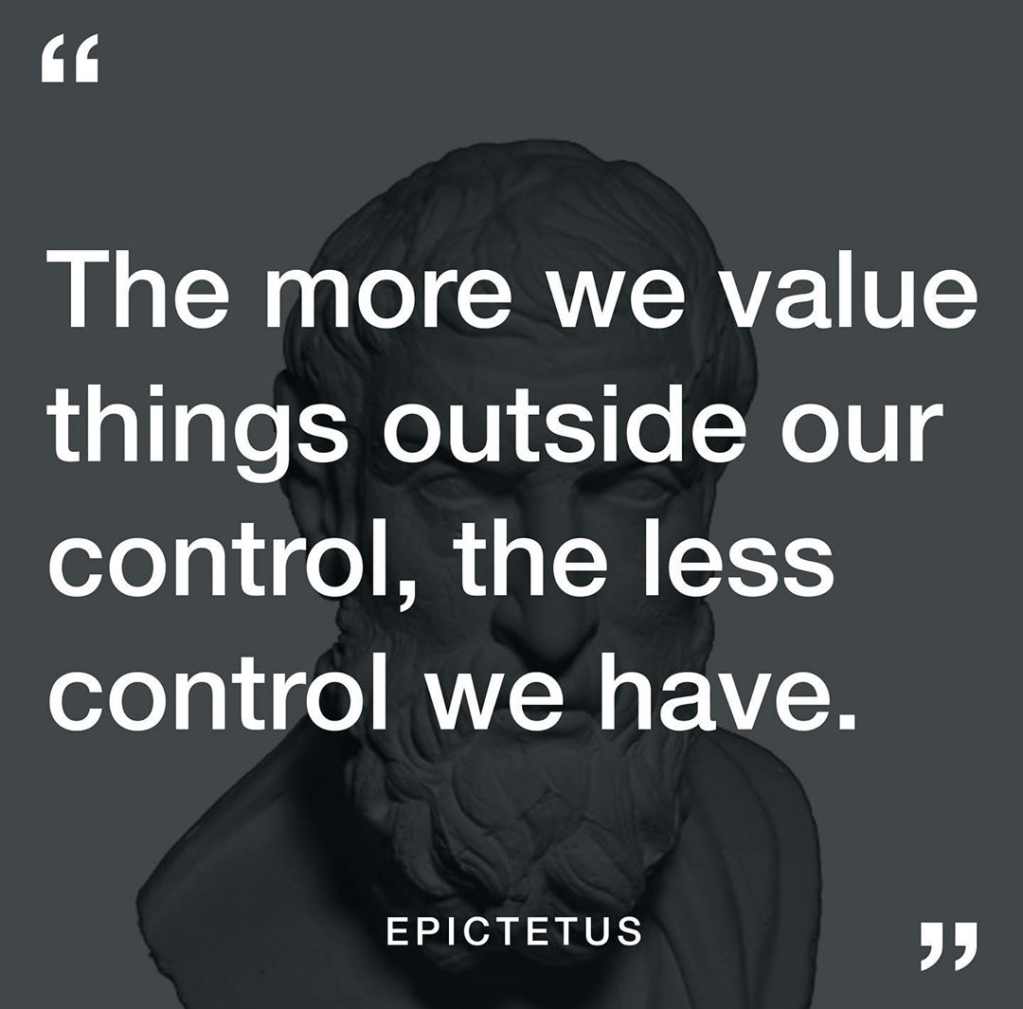
It often takes some negative external event to pop or at least penetrate the illusion that we are the center of the universe, we are the main character surrounded by NPCs, and/or we can’t always get what we want, when we want it, how we want it.

ā€œThe world breaks everyone and afterward many are strong in the broken places. But those who will not break it kills.ā€ Ernest Hemingway – A Farewell to Arms

I know for me it is a regular battle of focusing on things I have no control over whatsoever, realizing it, and changing my focus to something more productive or beneficial. But nothing in life of substance is a one and done. No magic pills to take or magic wands to wave.

It’s human nature to focus on things outside of our immediate control in order to survive. What is going on in our environment around us is outside of our control. But how we maneuver within it to live to fight another day, is in our control. So we evolved with an outward focus rather than an inward focus.

So we constantly have to fight ourselves to prioritize what is pragmatic.

So much suffering comes from time and attention that turns into emotion spent on things completely outside of our control.

Equally or perhaps more frustrating for me has been the knowledge of this and still failing to execute properly. Identifying what is within my control, focusing on it, and still failing to take right action.

Awareness is the way out, but it still takes action to get there.

Recognizing and placing proportional value on what we directly have control over is necessary for peace of mind and quality of life.

Taking appropriate action consistently, habitually, that is a whole other ball of wax. But one can spend a lifetime chasing their own tail without the awareness of the difference between what we control and what we don’t.

One must take the time to genuinely think and write about this. I feel like with this issue deep thought and mediation are not enough. Our thoughts on this must be transcribed somehow to make a good faith attempt at attain wisdom here.

Luckily, choosing to make time, think deeply, meditate, write/journal, and reflection are all things we can control.

One thing at a time.

One choice at a time.

I think there is value there.

Control. It’s human nature to want to control things. It makes us feel safe. It makes us feel powerful. It makes us feel better. Certainly better than feeling in danger, weak, or confused.

We seem to want more and more control as time goes on. Our institutions want more control over its citizenry. Every year there seems to be more and more attempts at censorship on social media. Always for the greater good right?

The road to hell is paved with good intentions.

We have so little control over what happens to us and around us, to really think about it is scary. That’s why it’s so much easier for the masses to not think about it. Not only do we not think about it, we deny it. We deny it and try to force control on the external world and ourselves. Always for the greater good right?

The road to hell is paved with good intentions.

Trying to turn the world into an ever expanding safe space is as misguided as it is wasteful.

It is hard, if not impossible to accept how little of our lives we actually control without some kind of philosophy or spirituality practice, or in my case, both. Stoic philosophy and the spiritual teachings of Alan Watts have been tremendously helpful for me in letting go.

Focusing on what I can control, letting go of what I can’t.

Easier said than done of course, just like everything else in life.

My mind seems to drift into mental movies about possible future events and possible future outcomes that stir up my emotions with the velocity of a jet engine. I was never taught to think like that, or feel like that. Not directly, I suppose. So where does that way of thinking and feeling come from?

I’ve lived enough life, met enough people, to know that not only am I not alone in that way of thinking and feeling but that way of thinking and feeling is the norm.

I’ve also lived long enough to know that what is considered normal is insane.

Insanity wrapped in social acceptability.

Studying stoic philosophy, listening to Alan Watt’s speeches (preferably with some video playing to compliment his words) helps calm my mind with perspective, and ease my emotions with wisdom. Breaking vicious circles inherited through nature and nurture, and in a way, restoring child like ease and wonder towards life and the world…until the next challenge presents itself. And those don’t take too long to show up. If we’re alive, we’re facing challenges.

Anxiety comes about because we want to control the uncontrollable. We would prefer to not have challenges but that is not how life operates so we get anxious about it. And why wouldn’t we? Did we ask to be born? Did we ask for a series of never ending challenges sporadically spaced out from the time we are born until the time we die? Absolutely not. Who would?

At least we are fortunate enough to be alive at a time when the knowledge and wisdom of the greatest thinkers in the history of the world is so accessible with such little effort. So we have to tools to better address our so called problems.

It is natural to forget. It is natural to be anxious. Philosophy and spirituality practices help us to remember.

Judging seems to be a default setting in humans.

It’s not just easy, it’s as natural and normal as breathing.

I know I have been guilty of judging others negatively, but what I was actually doing was projecting negative thoughts about my own flaws onto them. And I’m not accessing my long term memory when I think of examples of this.

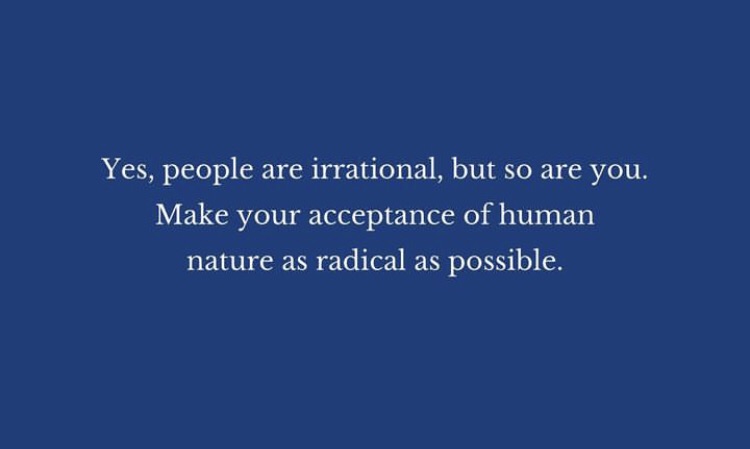
I’m not sure if becoming more accepting of human nature comes with age or with experience. I just know that as I’ve gotten older, and had more experience interacting with more and more people, I am (slowly) becoming more accepting of the fact that to be human is to be irrational.

I think that if we all take a minute to look back on some of our decisions in just our recent past, we’ll find the actions of an irrational person.

Studying philosophy has helped me with this. Reading books by Robert Greene has specifically helped me with this a lot in recent years.

To accept our human nature, is to be forgiving, to have empathy.

We need more of a lot of things in this world, but empathy, that is something that a majority of us can agree upon. Something free, simple, within all of our ability to control and influence.

Having more compassion for myself and empathy for others is an evergreen new years resolution for me. Being more aware and accepting of the irrationality of human nature has helped provide fuel for my ability to empathize to grow.

One of the first audio books I ever rented from my local library was Don’t Sweat the Small Stuff and It’s All Small Stuff by Richard Carlson. I had a bad habit of turning molehills into mountains. Of turning little things into big things. Of taking serious, things which were meant to be taken lightly.

Through nature or nurture, I inherited this habit from my parents. Both of them, up until they both passed away; dramatized insignificant day to day happenings in their personal lives and the events of the world around them. So frequently and with such fervor, that it short circuited my internal ability to distinguish between the important and the irrelevant while judging each in a negatively passive aggressive manner.

I was in my twenties when I had a roommate who told me that my priorities and way of seeing the world were totally out of whack. That I focused my time and attention on things that I had no control over and/or had nothing to do with me.

Around that same time is when I got more serious about a regular-daily meditation practice. That was likely a new years resolution around that time when I first downloaded the Calm app.

When this prompt popped up on one of my recent Daily Calm meditations, it brought back a flood of memory pieces from the times spent listening to that audiobook during my commutes in and around Chicago. The concept of don’t sweat the small stuff is modern wrapping paper placed on the gift of traditional philosophy.

I wasn’t ready to implement and habitualize the concept back then. Because it was just touching on the edges of philosophies like stoicism and taoism. I didn’t need to dip my toes in philosophy and spirituality, I needed to dive head first into the deep end. Because my head was already drowning in constant thoughts and negative emotions.

Flushing the negative judgements of myself and others with the pressure washer of philosophy and the cleansing waters of a spirituality practice were what I needed then, and what is helping me so much, now.

But some people need to just dip there toes in. Change is hard. Paradigms die hard. Perception shifts are slow. The modern personal development/self help genre is built on the foundation philosophy.

So do check out some non fiction self help books, audio books, podcasts, YouTube videos, etc if you need help. Modern people, language, examples and stories will be a necessary ingredient for many people. Since ageism applies to concepts as well as people in the world we live in.

Whatever works, whatever helps.

ā€œBetween stimulus and response there is a space. In that space is our power to choose our response. In our response lies our growth and our freedom.ā€

It would be nice to say that I had an awakening or an epiphany that changed the way I lived forever all at once.

The older I get, the more I feel like that isn’t how change works.

I’ve had, what I thought were life changing epiphanies, repeatedly. Life changing visions, repeatedly. Life changing moments, repeatedly. I thought after X or Y happened to me that I would live differently from that point onward.

Habits always win out however. Choices, actions done repeatedly make our lives.

The concept of Stimulus-Space-Response was a concept I first learned from a rented audio book by Stephen Covey. He was telling the story of Holocaust survivor Dr. Victor Frankl.

Learning about that concept I can still remember thinking, in the library I was listening to the audiobook in; that this was going to change my life from that point on.

I thought my depression, laziness, anxieties would all be instantly and forever changed now that I knew that there was a space between stimulus and response.

I get to choose how I respond?! I can cultivate and grow that space?!! Surely this will change my life immediately. I will only make good choices now. I will only do right actions.

The older I get, the more I feel like that isn’t how change works.

But learning about Stimulus-Space-Response is one of the closest things I’ve ever experienced to an epiphany that stuck. I suppose a more apt metaphor would be that of a seed being planted. A seed of lasting change was planted that day.

Stephen Covey also used farming as an analogy for change and for life. I may have planted the seed(s) for growth, but I failed to tend to the soil properly with patience and persistence. Then the harvest was nothing.

It is a great concept that more people should know about. The knowledge that we can choose what happens to us no matter what happens. Because we have the ability to think, perceive, and assign meaning in our brain. Unlike most animals.

I think most people are unaware of this. I know I was. I think most people think that to live, is to live reactively. Just reacting to whatever happens to us and around us whether good, bad, or indifferent.

But we can choose to stop, breath, think, and choose.

It’s no magic pill, no such thing of course. But it can help. It helps me.