


The challenge of maintaining awareness of our thoughts is a fundamental aspect of human experience. Our minds are hardwired to think and become lost in thought streams constantly.
However, awareness of our thoughts and the ability to open our minds is crucial for personal growth and mental well-being. By revisiting this concept, we can continually remind ourselves of its importance and strive to live more consciously.
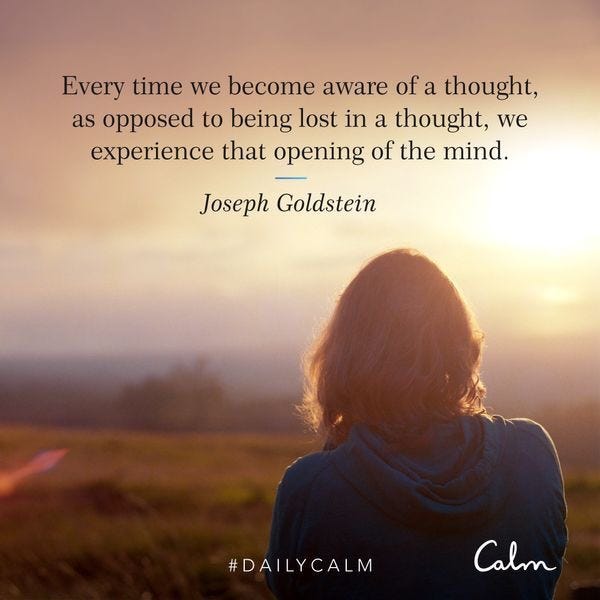
Many, if not most, people are completely identified with their thoughts and emotions. Despite meditating and studying philosophy and spirituality for ten years, I still slip into identification with my thoughts and emotions. I have often found myself dragged into petty thoughts and judgmental emotions.
Even though I take multiple actions habitually to counteract negativity such as:
- reading philosophy
- meditating
- journaling
- taking mood support supplements
- doing yoga
- walking outside
- getting around eight hours of sleep
- hydrating
- drinking herbal tea
- lifting weights
- eating healthy meals
- watching self-improvement videos on YouTube
- listening to binaural beats
- limiting screen time
I still constantly identify with my thoughts, emotions, and life situations.
Becoming aware of our thoughts, breaking free from identifying with them, and opening up the mind are important subjects to me. Worth coming back to again and again. Because it is an inner fight we all must wage again and again if we are to live a life of inner peace.
Typically, awareness of our thoughts is not the norm — automatic thoughts usually dominate. In cognitive psychology, automatic thoughts are rapid, often unconscious assumptions or conclusions that arise in response to a situation or stimuli. They appear without conscious effort and are usually brief, immediate interpretations of an event, often with a negative bias.
“Thoughts are like clouds in the sky. Sometimes it’s clear, sometimes it’s cloudy. But don’t get attached to the clouds.” — Thich Nhat Hanh
Automatic thoughts often lead to runaway thoughts, which are longer and more intense versions of automatic thoughts. A consistent double dose of automatic and runaway thoughts can likely result in cognitive distortions, confirmation biases, and intense emotional triggers.
Observing social media and the modern world, it seems more people are easily triggered when their confirmation bias, built on cognitive distortions, is challenged or broken. A clear example is the state of America after a presidential election.

“It is not what happens to you that troubles you, but your judgment about what happens.” — Epictetus
Identifying with our thoughts means being consumed by them. Our true selves get swallowed up and erased due to constant states of stress, anxiety, disappointment, depression, and anger. We can’t escape fight-or-flight survival mode if we are constantly pulled into the rushing stream of automatic and runaway thoughts.
We must continuously choose to be aware and detach from our thought streams because our thoughts never stop. Our minds are thinking machines, but they do not define who we are. We are not our minds. We are not our thoughts. We are not our emotions. We must constantly cultivate awareness and remind ourselves of this truth.

Practical ways to practice awareness include mindfulness, which involves being fully focused on the present moment. Deep breathing exercises and guided meditations have also significantly helped me in my ongoing effort to increase awareness in my life. Journaling is beneficial as well, provided you consistently write and periodically review past entries to observe your patterns and progress.
Cultivating awareness of our thoughts while remaining detached from them can create an opening in the mind. The more we expand that opening with healthy practices like mindfulness, yoga, journaling, meditation, and studying philosophy and spirituality, the better we become at utilizing that inner space.
This helps us avoid reacting automatically to stimuli like an animal and instead respond thoughtfully and consciously. By embracing these practices, we can strive to live with greater mindfulness and peace, continually growing and evolving in our journey of self-awareness.
 Anarchy Journal Constitutional