Posts Tagged ‘health’


Photo by Raychel Sanner on Unsplash

False Certainty, True Harm


“We suffer more often in imagination than in reality.” — Seneca


The mind means well. It wants to protect us. But often, it does so by spinning tales of potential harm, pain, or failure — stories it believes we need to prepare for. Overthinking pretends to be a strategy, but more often it becomes a trap.

In the Stoic view, most of our suffering comes not from events themselves, but from the way we imagine them. The modern mind has become a kind of forecast factory — working overtime to predict every possible outcome, especially the worst ones. But like most factories running at full tilt, it produces far more than we need, and the excess begins to pollute us.

The problem isn’t that we think. It’s that we over-believe our thoughts. The forecast becomes our weather, even when the sky outside is clear.

Mistaking the Mind for the Moment


“The mind creates the abyss, the heart crosses it.” — Nisargadatta Maharaj


Overthinking separates us from presence. It convinces us that safety lives somewhere in the future, if only we can think hard enough to find it.

But presence isn’t found through analysis. It’s found through attention.

Spiritual teachers — from Buddhism to Taoism to Eckhart Tolle — remind us that the mind is a beautiful servant but a dangerous master. It wants to protect us by forecasting the future. But in doing so, it keeps us from living now.

The forecast factory churns because we’ve forgotten how to just beCaught in imagined futures, we lose the grounded truth of the present. And the irony is, presence is the only place peace can ever exist.

The Fear of Getting It Wrong


“When we are no longer able to change a situation, we are challenged to change ourselves.” — Viktor Frankl


Many of us learned to tie our worth to performance. To being right. To being ready. And so the mind took that lesson and ran with it.

Overthinking becomes a form of self-validation — if I anticipate every possible outcome, I’ll never be caught off guard. But that drive for control is rooted in fear. It implies: If I mess up, I’ll lose something… maybe even love.

Catastrophizing is often the mind’s way of bracing for emotional pain. But in doing so, it reaffirms the belief that we are only safe when we’re perfect, prepared, or pleasing.

Humanism reminds us that we are valuable even when we’re uncertain. Even when we don’t have all the answers.

Self-worth is not the reward for perfect forecasting. It’s the quiet truth we can return to when we stop trying to earn it.

Photo by Jack Finnigan on Unsplash

The Brain’s Bias Toward Stormy Skies


“The brain is like Velcro for bad experiences but Teflon for good ones.” — Rick Hanson


Our brains are not wired for happiness — they’re wired for survival. And survival meant staying alert to danger. That’s why the brain’s default is to scan for threats, to replay past pain, and to imagine worst-case scenarios.

The forecast factory is built into our biology.

Overthinking activates the default mode network (DMN) — the part of the brain involved in self-referential thought. When we’re stuck in loops, DMN activity is high. This also correlates with increased cortisol levels and reduced capacity for presence.

In other words, it’s not just emotional — it’s chemical. The good news is that practices like mindfulness, breathwork, and cognitive reframing can quiet the factory floor. We don’t have to shut it down completely. We just have to stop believing every storm warning it issues.

Choosing the Forecast You Live In


“The future is not something we enter. The future is something we create.” — Leonard Sweet


You can’t always stop the forecast factory. But you can learn to recognize its patterns.

You can pause when the machinery starts whirring. You can ask: Is this thought true? Helpful? Necessary? You can interrupt the loop before it becomes a storm cloud.

Start small:
• Name the thought.
• Notice the emotion.
• Choose not to follow it.

This is a quiet form of liberation, not through control, but through choice.

When we stop trying to protect ourselves with overthinking, we make space to protect ourselves with presence. And in that presence, we reconnect with something deeper than prediction:

We remember who we are — beyond the storm.


Letting go of the need to be seen and finding meaning in the quiet rhythm of effort itself, through philosophy, neuroscience, and humanism.


Photo by Andriy Babchiy on Unsplash

“Ambition means tying your well-being to what other people say or do… Sanity means tying it to your own actions.” — Marcus Aurelius


There’s a strange kind of emptiness that follows a finished goal.

You get the job. You finish the project. You hear the applause or see the number climb. For a moment, it feels like something lands.

But then — it slips. The satisfaction fades. And if you’ve been chasing validation, all you’re left with is the hunger to chase again.

We’re conditioned to seek proof of progress in visible things: titles, stats, recognition, metrics, reactions. However, Stoic philosophy reminds us that our true well-being doesn’t reside in outcomes — it resides in effort. In how we show up. In what we choose to honor when no one’s looking.

When that becomes your compass, everything changes.

What happens when we release the need to prove? What’s left?

Only the work.
The process.
The way we carry ourselves in the doing.

In that space, something shifts. We start to realize that meaning isn’t found in the spotlight — it’s found in the quiet repetition of things that matter.


“When you do things from your soul, you feel a river moving in you, a joy.” — Rumi


Some things aren’t meant to be broadcast.
Not because they aren’t beautiful, but because they’re sacred.

Spiritual presence lives in that space where actions are offered without needing to be seen. A moment of stillness. A generous thought. A quiet act of integrity.

There’s a depth to these choices that goes beyond performance. They are not proof of anything. They’re simply expressions of alignment.

  • We don’t meditate so someone can say “good job.”
  • We don’t help a stranger to be praised.
  • We don’t breathe deeply to hit a streak counter.

We do these things because they reconnect us with something quieter, something truer. A self that isn’t striving, but simply being.

Eckhart Tolle calls this the power of presence — when you’re no longer lost in the story of who you’re supposed to be, but grounded in who you already are. And from that place, even the smallest gesture carries weight.

There’s a kind of devotion that doesn’t need display. And often, it’s the most powerful kind.


Photo by USGS on Unsplash

“The best portion of a good man’s life is his little, nameless, unremembered acts of kindness and love.” — William Wordsworth


So much of what keeps the world turning never makes it into the headlines.

  • The parent showing up tired but present.
  • The teacher staying late to prep tomorrow’s lesson.
  • The artist creating work that no one may ever see.
  • The friend checking in, just because.

There’s no algorithm that rewards these things. No standing ovation. No trending hashtag. And yet, they matter deeply.

In a culture obsessed with visibility, we forget that the most essential work is often invisible. Humanism reminds us that dignity doesn’t require an audience.

A life can be meaningful even if it’s quiet. Even if it never goes viral.

We measure so much — productivity, engagement, efficiency — but the soul of our lives lives in what can’t be measured. In decency. In effort without ego. In the decision to care, when you could have looked away.

Maybe we’re not here to prove anything. Maybe we’re here to contribute something.

Even if it’s small. Even if it’s unseen.
Even if no one ever says thank you.


“Flow is being completely involved in the activity for its own sake.” — Mihaly Csikszentmihalyi


Your brain is built for the process.

That’s the twist most people miss. Dopamine, the chemical we associate with pleasure, doesn’t just spike when we achieve something — it’s released during pursuit. The engagement. The immersion. The rhythm of showing up and making progress.

This is why the climb often feels better than the arrival.

When we focus only on results — on outcomes and metrics — we’re reinforcing an inherently unstable loop. The satisfaction is temporary. The goalpost moves.

But when we anchor into the act itself — writing, building, learning, practicing — our brain responds differently. We experience continuity. Identity. Momentum.

Decades of research in motivational psychology (like Self-Determination Theory) show that we thrive on intrinsic motivation — when we feel autonomy, mastery, and purpose. And those feelings don’t come from external proof. They come from doing the thing.

Even flow states — the most rewarding mental state we can access — only arise when we’re deeply immersed in the process, not the outcome. That immersion is the real reward.


“The more you chase dopamine highs, the less pleasure you derive from them. Sustainable happiness comes from meaning, not novelty.” — Anna Lembke, MD


It turns out your brain doesn’t crave the win. It craves the work.

Photo by Wil Stewart on Unsplash

“The reward for good work is more work.” — Tom Sachs


So much of life is framed as a means to an end.

  • Do the thing, get the reward.
  • Work hard, earn rest.
  • Prove yourself, be seen.

But what if the work is the reward?
What if the doing matters, even when it leads nowhere obvious?
What if the meaning lives in the process, not in the prize?

When you strip away the need for proof, something softer comes forward. A quiet kind of clarity. You begin to notice the satisfaction of being honest in your effort. You begin to feel the steadiness that comes from consistency. You stop waiting to arrive and start appreciating how you move.

And that’s where it changes.
That’s where you realize: you’re already in it.
Already living the thing you thought would come later.

There’s no final applause. No ultimate validation. Just another day to show up, to stay aligned, to keep doing what matters — even if no one claps.

That’s enough.
It always has been.
And if you keep showing up, it always will be.


The system breaks us, then sells us pills.

They tell us it’s a personal failing. That anxiety is a chemical imbalance. That depression is a genetic curse. That burnout is solved with resilience. But look around: the conditions that feed this crisis are man-made.

“Doctors … argue that chronic stress, stemming from social problems such as financial distress, racism, and poor working conditions, is a key driver of mental health issues.”The Guardian


We work longer hours for less pay. We doomscroll through endless cycles of bad news and empty distraction. We spend more time isolated in front of glowing screens than in human connection. The pressure is relentless—engineered to keep us consuming, competing, and collapsing.

“About one in four American adults suffers from a diagnosable mental disorder in a given year, and one in ten will suffer from a depressive illness, such as major depression or bipolar disorder.”Johns Hopkins–derived data


And just when we break, they offer us a fix. Not by changing the system—but by medicalizing our despair. Big Pharma has turned misery into a trillion-dollar market. Antidepressant prescriptions keep climbing. ADHD meds are at record highs. Anti-anxiety pills sell like candy. And yet, rates of suicide, loneliness, and mental illness are higher than ever.

“In 2020, 20.3% of adults had received any mental-health treatment in the past 12 months, including 16.5% who had taken prescription medication for their mental health.”CDC

“Today, a full fourth of U.S. women are on antidepressants.”KevinMD / Harvard Health


This isn’t healing—it’s management. Profitable management. The more the machine grinds us down, the more pills they can sell us to function well enough to keep serving the machine. It’s a cycle of extraction: from our labor, our attention, and now our very psychology.

“The monthly antidepressant dispensing rate for females ages 12–17 surged 129.6% from March 2020 onward compared with beforehand.”University of Michigan study in Pediatrics


None of this denies that meds can help. But let’s be clear: the crisis isn’t random. It’s not just “in our heads.” It’s the direct product of an economy built on overwork, digital isolation, and engineered anxiety. A society where meaning is stripped down to productivity, and hope is marketed back to us in capsules.

“Despite a significant rise in mental-health awareness and treatment … mental-health conditions are worsening. Suicide rates have increased by 30% since 2000, and nearly one-third of adults report symptoms of depression or anxiety.”Time

“Between 1999 and 2022, antidepressant-related overdose deaths climbed; in 2022, there were 5,863 overdoses—comparable to heroin overdose deaths that same year.”The Guardian


The mental health crisis wasn’t an accident. It was manufactured. And the ones cashing in are the same ones who built the conditions that broke us.

Wisdom is Resistance. Truth Over Tribalism.


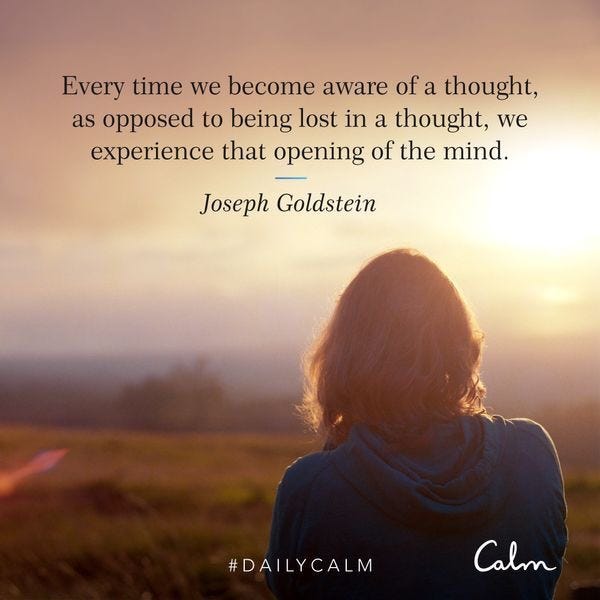
The challenge of maintaining awareness of our thoughts is a fundamental aspect of human experience. Our minds are hardwired to think and become lost in thought streams constantly.

However, awareness of our thoughts and the ability to open our minds is crucial for personal growth and mental well-being. By revisiting this concept, we can continually remind ourselves of its importance and strive to live more consciously.


Many, if not most, people are completely identified with their thoughts and emotions. Despite meditating and studying philosophy and spirituality for ten years, I still slip into identification with my thoughts and emotions. I have often found myself dragged into petty thoughts and judgmental emotions.

Even though I take multiple actions habitually to counteract negativity such as:

  • reading philosophy
  • meditating
  • journaling
  • taking mood support supplements
  • doing yoga
  • walking outside
  • getting around eight hours of sleep
  • hydrating
  • drinking herbal tea
  • lifting weights
  • eating healthy meals
  • watching self-improvement videos on YouTube
  • listening to binaural beats
  • limiting screen time

I still constantly identify with my thoughts, emotions, and life situations.

Becoming aware of our thoughts, breaking free from identifying with them, and opening up the mind are important subjects to me. Worth coming back to again and again. Because it is an inner fight we all must wage again and again if we are to live a life of inner peace.

Typically, awareness of our thoughts is not the norm — automatic thoughts usually dominate. In cognitive psychology, automatic thoughts are rapid, often unconscious assumptions or conclusions that arise in response to a situation or stimuli. They appear without conscious effort and are usually brief, immediate interpretations of an event, often with a negative bias.

“Thoughts are like clouds in the sky. Sometimes it’s clear, sometimes it’s cloudy. But don’t get attached to the clouds.” — Thich Nhat Hanh

Automatic thoughts often lead to runaway thoughts, which are longer and more intense versions of automatic thoughts. A consistent double dose of automatic and runaway thoughts can likely result in cognitive distortions, confirmation biases, and intense emotional triggers.

Observing social media and the modern world, it seems more people are easily triggered when their confirmation bias, built on cognitive distortions, is challenged or broken. A clear example is the state of America after a presidential election.


Photo by Dan Crile on Unsplash

“It is not what happens to you that troubles you, but your judgment about what happens.” — Epictetus


Identifying with our thoughts means being consumed by them. Our true selves get swallowed up and erased due to constant states of stress, anxiety, disappointment, depression, and anger. We can’t escape fight-or-flight survival mode if we are constantly pulled into the rushing stream of automatic and runaway thoughts.

We must continuously choose to be aware and detach from our thought streams because our thoughts never stop. Our minds are thinking machines, but they do not define who we are. We are not our minds. We are not our thoughts. We are not our emotions. We must constantly cultivate awareness and remind ourselves of this truth.

Photo by Bahadır on Unsplash

Practical ways to practice awareness include mindfulness, which involves being fully focused on the present moment. Deep breathing exercises and guided meditations have also significantly helped me in my ongoing effort to increase awareness in my life. Journaling is beneficial as well, provided you consistently write and periodically review past entries to observe your patterns and progress.

Cultivating awareness of our thoughts while remaining detached from them can create an opening in the mind. The more we expand that opening with healthy practices like mindfulness, yoga, journaling, meditation, and studying philosophy and spirituality, the better we become at utilizing that inner space.

This helps us avoid reacting automatically to stimuli like an animal and instead respond thoughtfully and consciously. By embracing these practices, we can strive to live with greater mindfulness and peace, continually growing and evolving in our journey of self-awareness.

How Hustle Culture Masks Wage Stagnation and Serves the System That Exploits Us


“If you just work harder, you’ll make it.”
That’s the lie. That’s the scam.

We’ve been sold a fantasy of upward mobility that depends not on policy, fairness, or collective progress, but on our willingness to self-destruct in the name of ambition. Hustle culture tells us that success is just a matter of willpower. Wake up earlier. Grind longer. Outwork everyone. Sleep less. Want it more.

Meanwhile, corporations rake in record profits. Wages flatline. Healthcare, housing, and higher education become luxury items. But you? You’re still thinking it’s your fault.

Let’s pull back the curtain.


Hustle Culture Is Corporate Propaganda

Productivity influencers. 5AM club bros. “No days off” as a flex.

This isn’t just personal ambition — it’s been industrialized. We’re encouraged to track every breath, stack habits, bullet-journal our burnout, and turn our identities into brands. This isn’t motivation. It’s manipulation.

By reframing overwork as a virtue, the system turns our exhaustion into a badge of honor. You’re not supposed to question why you have to hustle this hard just to survive. You’re just supposed to optimize better.


Productivity Went Up — Wages Did Not

Since 1979, worker productivity in the U.S. has risen by more than 60%. But hourly wages? Up only about 17%. Where did the gains go? Straight into the hands of shareholders, executives, and the asset-owning class.

You’ve probably felt it. Working longer hours just to keep up. Side hustles becoming lifelines. And still, rent rises faster than your paycheck. It’s not laziness. It’s a rigged game.

📊 From 1979 to 2020, U.S. productivity grew 61.8% while hourly pay rose just 17.5%.Economic Policy Institute

Hustle culture isn’t closing the gap. It’s hiding it.


Burnout Isn’t a Personal Failure

Internalized capitalism teaches us to equate self-worth with output. When we feel overwhelmed, we don’t blame the system — we blame ourselves.

But the exhaustion isn’t a bug. It’s the feature.

We’ve been taught that if we feel burned out, we just need better time management. A better planner. A better morning routine. We keep trying to fix the machine — when the problem is that we’re not machines at all.

“You are not lazy, unmotivated, or stuck. After years of living in survival mode, you are exhausted. There is a difference.” — Nedra Glover Tawwab


The Scam Serves Power

There’s a reason hustle culture has been monetized and weaponized by the very systems profiting off your labor.

Big Tech sells you productivity tools. Influencers push affiliate codes for morning journals and nootropics. Employers glorify “passion” to justify unpaid overtime. Gig apps track your every second. Even rest has been turned into another thing to optimize.

The more exhausted you are, the less likely you are to resist. The scam isn’t just psychological — it’s strategic.


Opting Out Is the First Step

Quiet quitting. Labor strikes. The rise of “lazy girl jobs.” These are signals of something deeper — a refusal to keep feeding a system that only takes.

We don’t need to hustle harder. We need to stop normalizing a world where burnout is inevitable, and survival is treated like success.

Stop optimizing. Start organizing.
The system is broken — not you.


anarchyroll presents

Anarchy Journal Constitutional
☯ Wisdom is Resistance | ∞ Truth Over Tribalism


🎬 Scroll-Friendly Version
This article was reimagined as a visual essay — watch the reel below.

@anarchyroll_

The productivity scam is working. We hustle, they profit. This isn’t about success. It’s about survival. Visual essay by @anarchyroll ☯️ Wisdom is Resistance 🗞 anarchyjc.com #burnout #hustleculture #productivityscam #visualessay #anarchyroll

♬ Apocalypse – Alex From Space

📡 Follow anarchyroll across platforms for more visual essays, short-form truth, and independent, gonzo journalism-inspired writing:

📽️ TikTok: @anarchyroll_
📷 Instagram: @anarchyroll
🐤 X / Twitter: @anarchyroll
🧵 Threads: @anarchyroll
🔵 Bluesky: @anarchyroll