Archive for the ‘Stimulus Space Response’ Category

I found it to be a tangible sign of progression on my path that I stopped be as internally triggered by external reality not matching up with what I wanted, expected or hoped for.

Have a achieved zen? HA! We all need goals to chase.

Maybe it’s just part of growing older and accumulating more life experience that teaches us, whether we like it or not, that external reality is going to do what external reality is going to do and the best we can do is attempt to influence it then completely let go/detach from there.

I have gotten better at that.

There is a balance there too.

One can give up altogether. Stop trying.

Giving up control is good. Giving up altogether is bad.

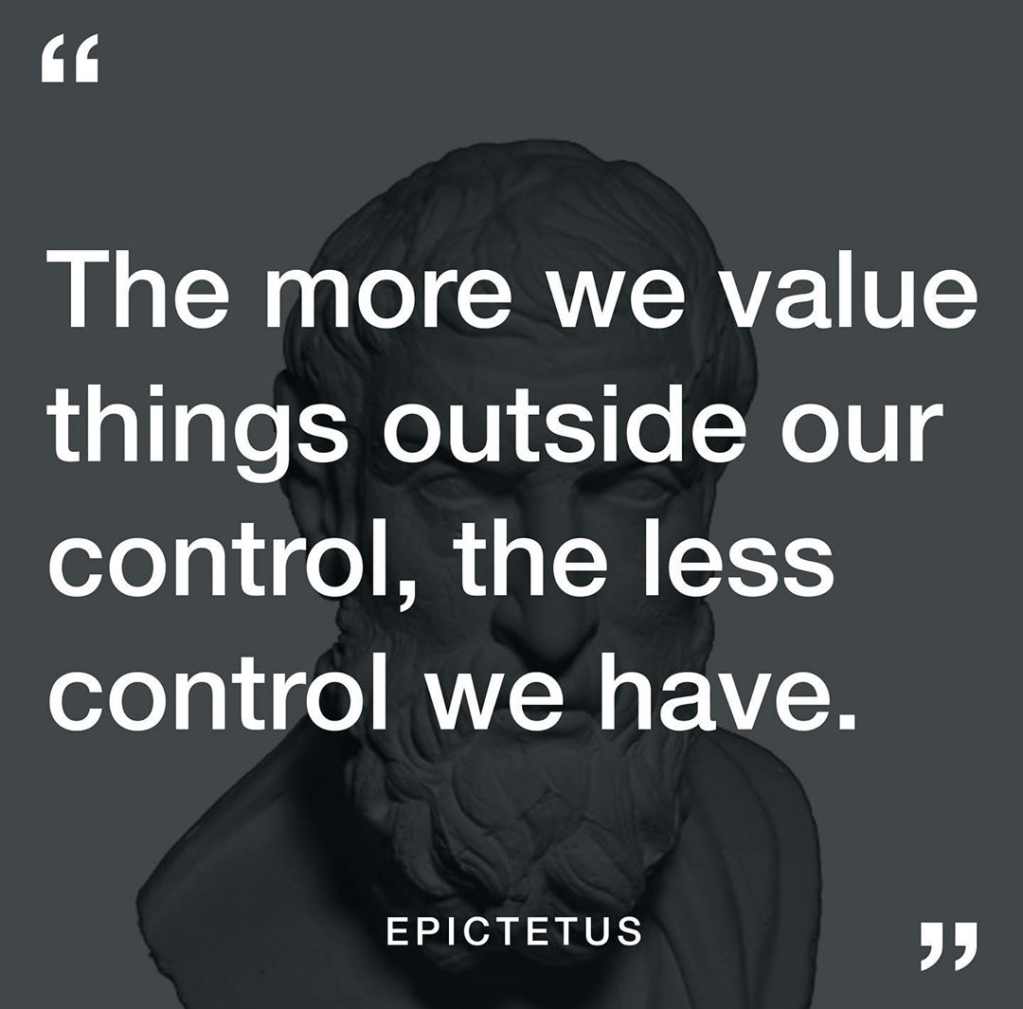
Identifying what is in our control and what is not is a pillar of stoicism. It is one of the things that initially drew me to the ancient philosophy that has helped so many people for so many thousands of years.

I remember in the depths of my depression turning to personal development/self help books. In my case, audiobooks. My education in America taught me to hate learning. I hated reading. I would learn to unlearn to paradigm of hating learning, slowly, over time. Renting audiobooks from my local library was a big step in that direction.

One of the first authors that drew my attention was the late great Stephen Covey and his iconic book The Seven Habits of Highly Effective People. A book I recommend to everyone that is capable of reading or listening to audiobooks.

More than his book were his speeches and interviews. Regardless of the material he preached, he had an amazing voice and a magnetic presence.

In his book and his talks he talked about two circles. The Circle of Control and the Circle of Concern. As one might guess, the circle of control is very small and the circle of concern is very big. Yet the attention we pay to each is often inversely proportional. I know it was for me when I first learned about the terms. I know that learning about those terms or any terms is in no way a cure all.

So it still takes constant effort over a decade and a half after first learning about what I have direct control over and what I have no control over. I’ve studied stoicism through reading, listening to podcast, and watching videos for almost a decade now. No one thing magically makes my shortcomings or predispositions disappear.

But I am as grateful or more grateful for the progress I’ve made in this area of my life than anything that has ever happened to me or anything I have ever done. Because putting my focus, energy, and effort towards things outside of my control has been a source of tremendous suffering for me. Life experience has shown me it is a great source of suffering for many if not most of the people I have ever met.

Meditation, stoicism, journaling, theanine, ashwaghanda have all helped me calm my mind, slow my thought streams down at least enough to realize I am in the witness and not a passenger.

Things happen.

I can choose to put my focus, energy, and effort into accomplishing a goal regardless of size or scope and then when I have done all that I am capable of doing to the best of my ability at that time…I can choose to let go and then I can choose to accept what is.

It is as it is…

Laughter is good for the soul.

Genuine, deep, belly laughter is the way to inner peace.

Not nervous laughter or polite laughter or doing the physical, literal equivalent of typing lol at the end of every line of a text message or DM.

Laughter that makes your whole body move…thats the good stuff.

ā€œa merry heart really does a spirit, soul and body good like medicineā€ Proverbs 17:22

It’s easy to forget how good laughter is for us. So easy, it’s natural.

During bouts of depression or even just a string of bad days, when something struck my funny bone it was like the parting of the Red Sea.

Living life makes us forget, laughter helps us to remember.

Real laughter has aftershocks like an earthquake.

Our breathing changes, our muscles tense then relax, we feel aligned and at peace. A temporary state of ecstasy we wish we could bottle and take on demand.

Real laughter bonds and creates memories with people and events.

It feels great, it’s spontaneous, unpredictable, unreproducible as much as we may want and may try. We try to replicate the experience early and often. But it’s different each time, a little less than the real thing.

We all wish we could capture it, bottle it, put it in a pill, pump it to our veins.

Laughter is pure. It’s a reflex. It’s involuntary.

It feels great…just lovely.

I just had a belly laugh that inspired me to write. I saw a clip online from something I used to watch as a kid. I laughed so hard if someone was walking on the sidewalk outside I’d be surprised if they couldn’t hear me.

I laughed so hard I started swearing for no reason.

I laughed so hard that a half hour later my body still felt different.

What a wonderful part of life. What a piece of simple, practical magic.

Let laughter be thy medicine, medicine thy laughter.

It can be hard to focus on what we can control or influence when we have a harder time distinguishing between the two. Generations raised on movies, television, and social media have been socially conditioned to have egos the size of the Grand Canyon.

It often takes some negative external event to pop or at least penetrate the illusion that we are the center of the universe, we are the main character surrounded by NPCs, and/or we can’t always get what we want, when we want it, how we want it.

ā€œThe world breaks everyone and afterward many are strong in the broken places. But those who will not break it kills.ā€ Ernest Hemingway – A Farewell to Arms

I know for me it is a regular battle of focusing on things I have no control over whatsoever, realizing it, and changing my focus to something more productive or beneficial. But nothing in life of substance is a one and done. No magic pills to take or magic wands to wave.

It’s human nature to focus on things outside of our immediate control in order to survive. What is going on in our environment around us is outside of our control. But how we maneuver within it to live to fight another day, is in our control. So we evolved with an outward focus rather than an inward focus.

So we constantly have to fight ourselves to prioritize what is pragmatic.

So much suffering comes from time and attention that turns into emotion spent on things completely outside of our control.

Equally or perhaps more frustrating for me has been the knowledge of this and still failing to execute properly. Identifying what is within my control, focusing on it, and still failing to take right action.

Awareness is the way out, but it still takes action to get there.

Recognizing and placing proportional value on what we directly have control over is necessary for peace of mind and quality of life.

Taking appropriate action consistently, habitually, that is a whole other ball of wax. But one can spend a lifetime chasing their own tail without the awareness of the difference between what we control and what we don’t.

One must take the time to genuinely think and write about this. I feel like with this issue deep thought and mediation are not enough. Our thoughts on this must be transcribed somehow to make a good faith attempt at attain wisdom here.

Luckily, choosing to make time, think deeply, meditate, write/journal, and reflection are all things we can control.

One thing at a time.

One choice at a time.

I think there is value there.

I’ve been a premium subscriber to Lumosity (brain games app) on and off for a decade now. I find it helpful. The older I get the more I realize my brain can use all the help it can get. Real, imagined, or placebo I don’t care. Don’t tell me about the labor pains just show me the baby.

I would use it reasonably consistently here and there then drop off. I would subscribe to the premium version when there was a sale on Cyber Monday or on New Year’s Day something like that. I’d start and stop and start and stop. I’d unsubscribe and resubscribe. Does this cycle sound familiar or relatable?

I never confused it as a magic pill for a bulletproof brain. I just knew myself enough to know that I’ve done enough detrimental work on my brain that a brain training app could at least serve as a beneficial use of time.

It has helped me at least a little. But what made it finally stick, just in the last year, was when I dropped the expectation of it helping my brain and doubled down on it helping me structure my time/daily schedule.

I realized that the value of just going through the motions, even half heartedly, provided as much value to me as putting full effort into using the app. How? Consistency.

I found that for me, the consistency of using the app everyday, without exception, even if I picked the quickest, easiest games, without enthusiasm or even a quarter of my concentration, did more for me that applying myself fully to the game once or twice a week and then forgetting about it for stretches of time.

As I did that more and more, and built up more and more streaks, a funny thing happened…my scores in all the games went up. I set my personal best records in all the games I played consistently. How? Consistency. I didn’t half ass it every time I opened the app.

But I did some of the times. When I was busy, feeling burned out, hungover, melancholy, distracted, multitasking, etc I still would take the time each day to open the app, and play the five games required to warrant completion and a little graphic at the end showing how many days I had completed my brain training consecutively.

There were however plenty of times where I was motivated, concentrated, caffeinated, enthusiastic and excited to play the games and try to beat my previous best score, to make up for a poor performance from yesterday and/or because I felt training extra memory or attention games would help me at an upcoming event.

This isn’t a paid ad for Lumosity (I wish) because it’s not about the particulate it’s about the general. It’s about doing the thing consistently. It’s about doing it every day, even half assed. Because if we do something everyday, half heartedness is inevitable but so is doing our best and so is doing better than we perceive we are capable of.

How?

Consistency.

I came across the word rumination randomly and it immediately stood out and stayed in the forefront of my mind. I knew the word, I felt it strike a chord, but I didn’t immediately know the definition off the top of my head. So I looked up the definition online.

Rumination – a deep or considered thought about something. The action or process of thinking deeply about something.

Sounded right, looked right, made sense, then I saw a tab below with the definition from the American Psychiatric Association.

Rumination – a cycle of negative thinking. Rumination involves repetitive thinking or dwelling on negative feelings and distress and their causes and consequences.

Ouch, that one struck a chord and cut deep. It’s human nature to want to deny that we can be categorized as a type. If I was at a different stage in my personal journey, I would deny, gaslight, change the subject, and refuse to acknowledge.

But I am who I am, and I am where I am. Rumination has been a norm, a standard for me. As a creative/artistic type, it comes with the territory. Artists are sensitive. Overly sensitive compared to the average Joe/Jane. We are more sensitive to both the highs and the lows, the positives and the negatives in life at both the micro and macro levels.

You can’t spell rut without rumination.

Ruts are built on a foundation of rumination. Ruts are funded by rumination. Ruts are mentored by rumination. Rumination holds fundraisers and provides endowments for ruts. You show me a human being in a rut and I’ll show you a human being dealing with rumination.

Repetitive thoughts? Is there another kind?

Dwelling is as natural for humans as blinking. From the boomer who still talks about their glory days playing sports in school to the teenager still heartbroken a year after getting dumped. The self fulfilling prophecies of rumination are the dark side examples of the law of attraction.

I feel like rumination should be used as regularly as the words stress, fear, anxiety, and depression in regards to mental/emotional health concerns.

When we can label something, our awareness of it immediately grows exponentially. What we can’t describe due to our naivetĆ© makes us feel more alone and detrimentally unique. Like we’re the first to experience what we’re going through.

Meditation followed by affirmation practice(s) can help first break the cycle of counter productive thinking with present moment awareness, then replace them with beneficial thoughts and visualizations. Philosophy study can teach us that people have been experiencing the same mental/emotional issues that we’re dealing with for thousands of years and provide wisdom based guidance.

I also think it is not just important, but imperative, to pair these sedentary practices with physical exercise. I was doing physical exercise regularly for years before my meditation and philosophy practices. Weight training, yoga, machine based cardio, and nature trail walks/hikes (when the weather allows it) make up my regiment that I whole heartedly endorse for all humans.

But regardless of order and regardless of which one someone is already doing, it is equally important to train the body, the mind, and the spirit. All are connected. Healthier body, healthier mind, healthier spirit. Stronger body, stronger mind, stronger spirit.

Holistic approach is the best approach always.