
Archive for the ‘Stimulus Space Response’ Category

Stop and smell the roses.

Stopping and taking a deep breath is more pragmatic and less cliché.

It is human nature to dwell on the negatives and focus on the outcome/result. This tendency robs us of so much positive potential.

Things could always be worse. Modern technology emphasizes how much better things could be as a foundation for trying to sell us things. But that technology also allows us to see how worse off we could be compared to millions or in some cases, billions of other people.

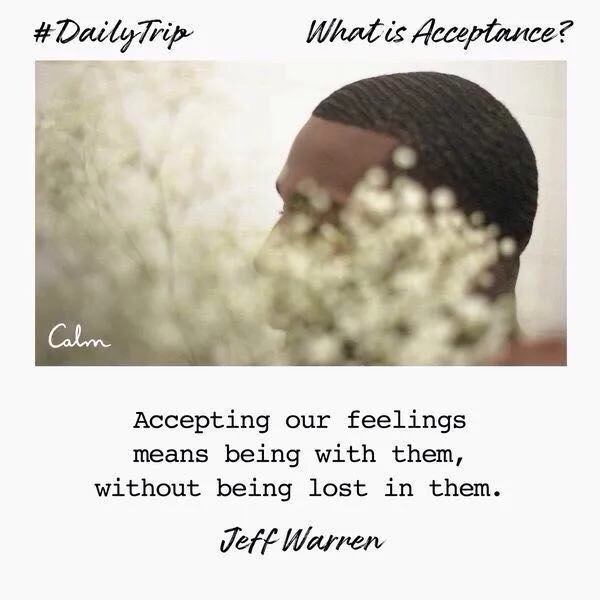
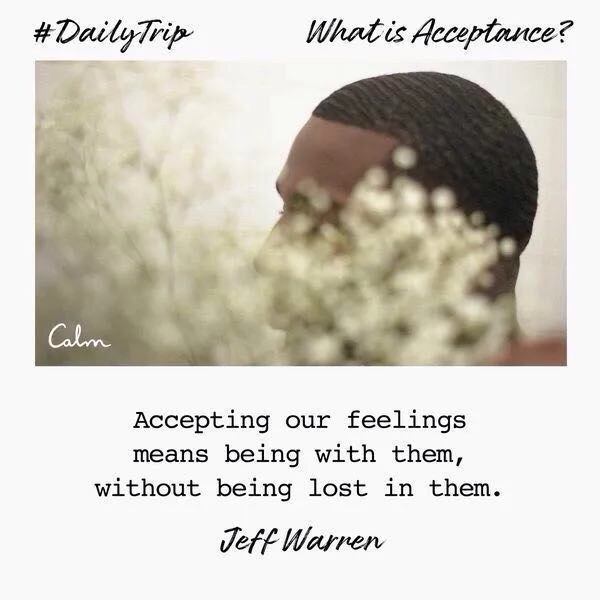
Others having it worse doesn’t invalidate our problems or our feelings. Power positivity becomes toxic when it tries to make us feel bad about feeling bad. But just because we feel bad in a moment, doesn’t mean we have to make that negative feeling our dominate personality trait.

In some of my darker moments, it has been of real help and real value to look back and see how far I’ve come in my life journey. Some of the accomplishments, some of the fun times, some of the rewarding experiences, some of my day to day habits that were once long term goals.

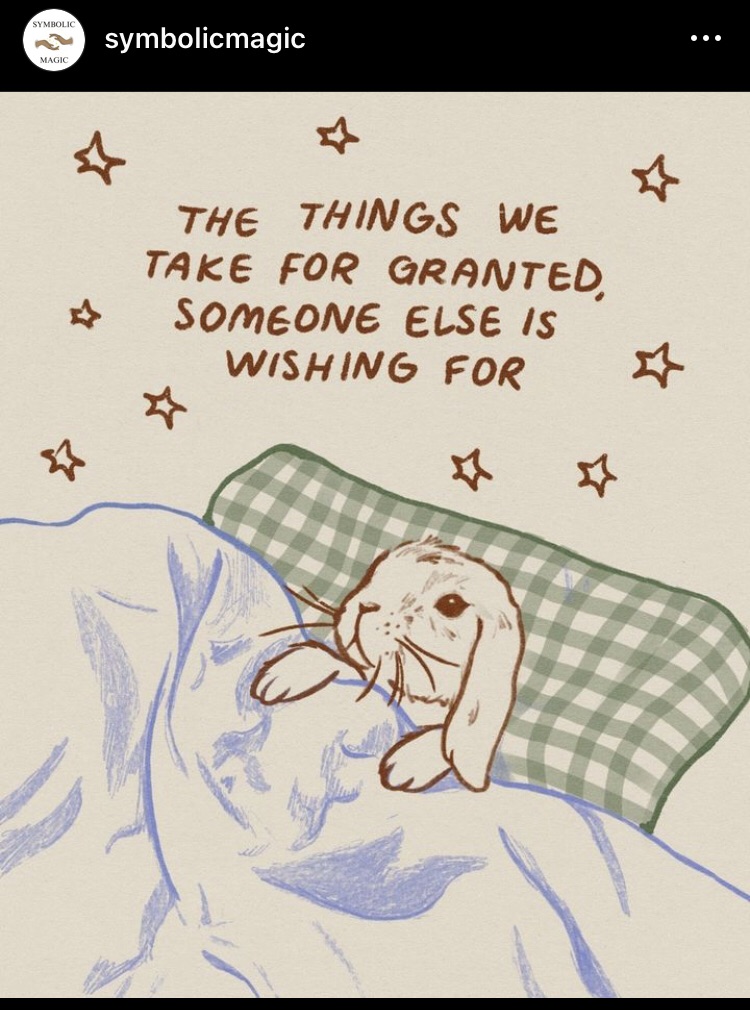
It’s human nature to take things for granted once we get used to them. Meditation and mindfulness practice has helped me with this. Present moment awareness and gratitude go with meditation like peanut butter and jelly. Breaking the cycle of constant thinking, dis-identifying with any negative emotions, being able to be grateful for who I am and for what I have are small wins each time I meditate.
Philosophy has probably helped me more with this particular aspect of life. A study of philosophy is a study of human history. Stoicism in particular has helped me greatly when I slid into poverty. Shifting my focus from what is outside of my control to what is within my control. But also comparing the ancient world to the modern world, one can’t help but feel grateful for many of the pleasantries and technologies that were unimaginable in the from the eras of Aristotle and Marcus Aurelius to the days of Friedrich Nietzsche.

Electricity, indoor plumbing, refrigeration, clean cold drinking water, access to a variety of fresh foods year round, climate controlled shelter. Those basic amenities are still to this day foreign luxuries to many people in the world.

It is not just easy, it is natural to take things for granted when we are used to them. We face many challenges each day and night. Being human isn’t easy. But we face and handle external challenges as best we are able to. So perhaps we can internally challenge ourselves; to swap out taking some of the basics in life that we take for granted, with gratitude.

List out a few of those things to be grateful for. Either in internally, out loud, or on paper and before long, one has an affirmation practice going. Keep that affirmation practice going, keep actively being aware of all the things we have to be grateful for, and a weird thing happens…we start to have more and more to be grateful for.


Modern culture, built on a foundation of a capitalist paradigm, is about, more…always. Infinite growth on a planet of finite resources.

Media and entertainment as we know it in any form, was built by, in the service of advertising. What is the purpose of advertising? To inform, persuade, and remind. Information and reminders have long since exited the chat.

Persuasion. Advertising’s purpose is persuasion in the modern world. For each small business, non profit, and NGO one can point to that use advertising for the greater good, there are literally thousands of examples of advertising persuading people that they need more, more, more…always.

More things, more experiences, more goods, more services, more products, more placements, more, more, more…always.

If our eyes or our ears are open there is some entity using some form of media to persuade us that what we have and/or who we are isn’t enough, we need more, more, more…always.

We are expected to do more, be more, buy more, say more. Keeping up with the Jones’ is a full time job that like many real jobs, doesn’t pay enough to stay out of debt.

Being human can be hard enough. Modern life seems to get more and more complex year to year. Sometimes we’re not going to be our best self. That’s not only okay, it’s normal.

Optimal isn’t always optimal regardless of what the caucasian male with a podcast universe would have us believe. Hustle culture creates a thousand burn out victims for every one that achieves a measurable external success by trading away a minimum of two thirds of their life.

We can’t thrive if we don’t survive. Some days just doing enough to survive isn’t just fine or good enough…it’s literally all there is. A dead entity can’t optimize, it can only decay.

Enough is greater than more. Enough is optimal.

Those who always want more will never have enough and will always try to convince those with enough that they need more.

There’s nothing wrong with goals. There’s nothing wrong with growing, evolving, striving or achieving. There is value and maybe even necessity in metaphorically always moving forward and towards.

It is also becoming more and more of a necessity in an optimal obsessed world to remember that we can’t strive if we don’t survive.

Surviving comes first, always.

It’s already hard to not identify with our emotions, without our culture ruthlessly exploiting our emotions perpetually professionally.

We’re never taught that we are not our thoughts, we are not our emotions. It’s usually the opposite or taught nothing at all. Figure it out as you go. On the job training. Job in this case being…being.

I’ve been meditating for over ten years, I’ve been studying spirituality for longer, journaling longer than that. I’ve been regularly studying stoicism seven years, started studying other philosophies on a regular basis four years ago…and negative emotions can still take me for a ride like a teenager in puberty.

Life may be simple, but easy? I don’t know about that one. The older I get, the more experiences I have, the more people I meet, it seems like living is hard.

If one were to say life is easy, they would at least agree that our emotions don’t add to the simplicity or ease of life. I feel confident in the determination that it is our emotions that are the primary sources of many of the difficulties and complexities of our collective and individual existence.

Are the things that happen to us hard and complex, or is it our emotional reactions that make them so?

Are the events of our life hard and complex, or is it our thoughts that make them so?

Detaching those two questions from spirituality teachers and gurus is worthwhile for all secular types. To be honest, most religious people I know would be wise to ask those questions regularly. I need to ask myself those questions more often, and I already had a couple of instances this week where I was asking myself those questions repeatedly.

Breathing, following the breath with our attention, walking, stretching, laughing can all help detach ourselves from the grip of our thinking mind and emotional reactions.

No one things is gonna make us go from A to Zen as if a magic wand was waved in front of our face.

But awareness is the way out.

It’s not just easy to get lost in our thoughts and emotions, it’s normal…it’s natural.

And if it was normal for us to get lost in productive thought streams and positive emotional reactions, then we’d be living in a utopia…and have you seen the news lately?

It’s natural to want to be externally successful at what we do.

In the era of social media, that desire is exploited and gaslit at historic levels

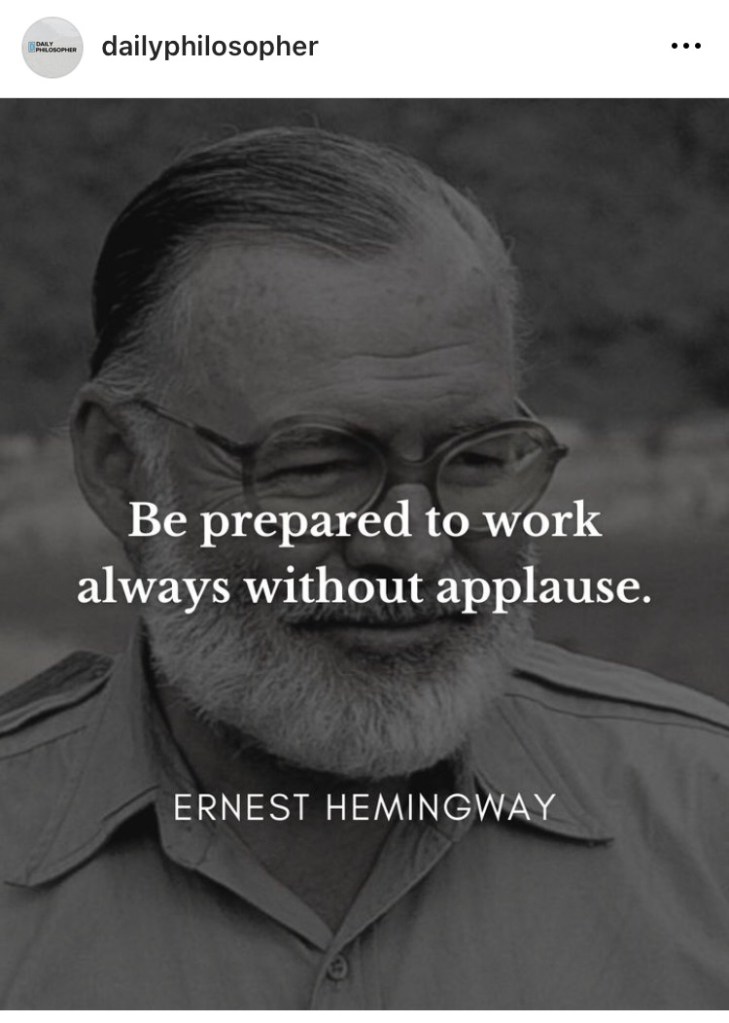
I find the Hemingway quote, “be prepared to work always without applause” to be as close to the perfect piece of life advice as there is. It’s not negative. It’s not cynical. It’s honest. It’s fair. It’s objective. It’s true.

I’ve also always liked the term passion project.

Doing creative/artistic work is hard and there is no objective standard of quality.

Personal taste is not up for debate.

So how do we know if we’re good? How do we know if we’re successful? How do we know if we’re on the right path? Capitalist controlled cultures would point to money, fame, influence, clout, etc. Does that mean those are the only good creatives?

Perfectionism is the trap we put ourselves in to shield from external judgement. Not only from external criticism but from external success, and lack thereof.

If we’re creating from our ego, we need the success. It’s not about the work, it’s about the result. It’s not about the journey, it’s about the destination. It’s not about the depth, it’s about the shallow features. It’s not about what’s real, it’s about the facade. It’s not about originality, it’s about clap trap zeitgeist.

Get those numbers up, so they can be used as a pillars of humble brags and how to listicles. How can I monetize this? Monetize what? ANYTHING! EVERYTHING!

The work is the win. Creating is the purpose. It’s so much better when we come from that place. Because then we’re not chasing. We’re not selling. We’re creating. We’re contributing. We’re being authentic. We’re being real. We are being.

Like sweat in our eyes, water in our ears, oil on our skin.

How much of what we think and perceive about ourselves internally and the external world are beneficial vs detrimental?

This was something I asked myself a lot last year. At the time I was using the terms productive vs counter productive. I found myself asking how much of my thoughts, perceptions, feelings, and actions were/are productive vs counter productive?

It’s a question we all need to ask ourselves. The data on depression, anxiety, stress, negativity, mental health, etc all keeps going in the wrong direction. I personally believe much of that has to do with late stage capitalism and being forced to participate regardless of our physical, mental, or emotional health.

That is an external reason. Internally however, we do need to take responsibility for our the way we think, perceive, feel, and act. At least at a 51/49 split.

I’m still doing the work of changing myself for the better based on my own standards, my own goals, and what works for me. It came as a surprise, whether it should have or not, that I was not doing what works for me in multiple areas of my life.

We all have our issues. We all have experienced trauma. The world breaks everybody. But I found myself day after day, noticing detrimental habits of thought, perception, and action. And when I would think; “why am I like this” or “why do I do this?” The answer has yet to be one of external blame. The answer has also yet to be a singular thing.

It’s layers of emotional reactivity to events, situations, and challenges that I developed unconscious responses to. A stimulus happened and I reacted unconsciously and built layers of detrimental thoughts, perceptions, feelings, and actions as my response(s).

I dug a hole for myself. I fell underwater. I got lost in darkness.

Meditation, journaling, philosophy have all helped me little by little to dig out, swim to the shore, and walk towards the light.

Little by little, day by day, one choice at a time.

Then a slip up happens. A mistake repeated. Then comes the challenge of not beating myself further down into the hole underwater in the darkness. The habit of making a bad situation worse with negative emotional reactivity.

The habit of having a detrimental perception of myself. That for me has been maybe the most consistent challenge. That was the eye opener. How much of my self talk was negative. How I was my own worst enemy and critic.

And why? For doing what? I wasn’t hurting anyone else. I wasn’t causing harm or misfortune to bystanders or people in my life. But I would berate myself like I was being paid handsomely to do it. Why?

The habit of negative emotional reactivity. Unconscious negative reactions to minor situations. Making a mountain out of a molehill. Detrimental perceptions.

Cultivating the space between stimulus and response with meditation, journaling, philosophy, and spirituality practices has been the yin to the aforementioned yang. The white to the black. The silence to the sound. The beneficial to the detrimental.