
Posts Tagged ‘economics’

eanda logo
ajclogo2By @anarchyroll

Few people, whether real or fictional, are as synonymous with America’s version of capatilsm as Gordon Gekko in the movie Wall Street.

“Greed is good” are words to live by for the people who try to fill the hole in the soul with copious amounts of money by any means necessary. That quote is the foundation of type of free market capitalism that brought about the 2008 Great Recession.

That economic collapse should was a very very big, very very loud, very very painful sign that we as a society have allowed greed to get out of control. It is one of the seven deadly sins for a reason. Wall Street and unregulated capitalism have transformed greed into the deadliest sin. Able to negatively impact the entire developed world with greedy actions of a relatively small percentage of the global population.

One of the ripple effects of the Great Recession has been the mainstream populous rise of what a generation ago would have been considered a fringe presidential candidate. Bernie Sanders through passionate speeches and a lifetime of walking the talk has risen like a phoenix.

Another ripple effect has been that greed is no longer good enough for the top 20% – .01%. The rich get richer no longer is a substantial enough metaphor. How do I know this? How can I be sure of this?

The fact that the real life person who inspired the fictional icon Gordon Gekko is publically endorsing Democratic Socialist Bernie Sanders for President.

maxresdefault

How can the inspiration for the phrase Greed is Good be endorsing a socialist for president? Because the unregulated greed thanks to the Clinton and Bush administrations has become something beyond excess and gluttony.


eanda logo

By @anarchyroll

America’s identity is its middle class. What makes America different than every other country that has come before it? The economic middle class…..guns, and obesity.

For real tho, it’s the middle class. We invented it. Before the United States of America there was no middle class. There was rich and there was poor.

What the middle class literally is, as well as what it metaphorically represents are both why people immigrate from all over the world, not just from the third world, to be in America. A country with an economic ladder for all people who work hard as opposed to caste systems? That concept is worth risking life and limb to millions of people each year. Legally and illegally people want into America.

Freedom/democracy is great too, but what good is freedom if you’re poor? What good is living if you live under literal oppression or economic oppression where there is only the super rich and the super poor? America, the land of opportunity; where ordinary people can simply work hard and be rewarded monetarily in a manner that enables not just animalistic survival, but also comfort, upward social mobility, and land ownership.

The socioeconomic middle class is Americana. Baseball, apple pie, barbecues, two week vacations, two car garage homes with a white picket fence. The images created by those words are the America middle class; the great reward for all born or adopted citizens who buy into the concept of American exceptionalism by giving their blood, sweat, and tears to a job for the middle two quarters of their life.

Without a middle class, America has no true identity. Freedom? Democracy? Those both existed before America. Flags? Bald eagles? Sports? White people oppressing minorities? Those all existed before America too believe it or not.
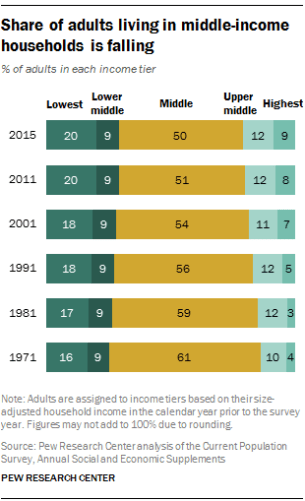
pew11

There is a saying; Don’t tell me about the labor pains just show me the baby.

One can look at that chart and say there are still plenty of people in the middle class. One can point to the people who have improved their income status over the past ten to forty years. Both are valid points. There is still a middle class in America and people have moved economically upward out of the middle.

Want another valid point? Both democratic and republican presidential candidates are dedicating equal time to talk about the erosion of the middle class. In this polarized political era, for both sides, to completely agree on a non national security/terrorism issue?

How can the erosion of the middle class be immune from political party polarization? Sure they’ll disagree on how to fix it, but to be in complete agreement of the present moment problem? Sounds like what happens when a person reaches a midlife crisis. And a midlife crisis is nothing more than an identity crisis.

The erosion of the middle class is America’s identity crisis.

Are we a caste system? Are we an oligarchy? Are we a republic? Can our economic and political systems ACTUALLY co exist? Should we just buy a sports car?

The real questions always start with Who/What/When/Where/Why and How?

Who; has benefited from the erosion of the middle class?
What; exactly has been happening over the past thirty years to lead to this erosion?
When; was the middle class the most robust?
Where; specifically did the wealth lost by the middle class go?
Why; was the middle class so vibrant at its peak?
How; can the economic principles of then be adapted to modern time?

If one asks these questions, and does a few basic Google searches, the answers become pretty obvious pretty fast. But the answers to these questions don’t actually require searching the internet do they? Deep down inside, we all already know what’s been happening. We know where the middle classes’ money has gone. We know whose benefiting from the loss of the middle class. We would like to tell ourselves we don’t know why because we want to see and believe the best in people.

Have you heard the phrase, the rich get richer and the poor get poorer?

How about; All is fair in love and war.

Class War has been the new Cold War for about thirty years, which wouldn’t ya know, is about how long the Cold War has been over, and is how long the middle class has been eroding.

eanda logoajclogo2

by @anarchyroll
10/6/2014

The biggest Initial Public Offering (IPO) in the history of the New York Stock Exchange occurred recently.

Have you heard of Alibaba? Had you heard about Alibaba before last month? Have you already forgotten about Alibaba after it didn’t carry over to a fresh news cycle? When someone mentioned it to me last month, all I thought of was the Beastie Boys song.

What is Alibaba?

  • Google, Amazon, PayPal and eBay all rolled into one
  • A wholesale marketplace; Alibaba is the middleman the connects retailers/sellers directly to customers/buyers
  • Alibaba is the top dog in the largest e-commerce market in the world

How did Alibaba become the biggest IPO ever?

  • Capitalizing on the Chinese consumers’ desires to shop online, for cheap, with trustworthy retailers/merchants
  • 80% of China’s e-commerce is done through Alibaba
  • Domination of the world’s largest growing market paired with international expansion has Wall Street drooling

So China’s biggest internet cash cow has gone public on stock market. Yahoo is the biggest American company to directly benefit from Alibaba’s IPO success as the two are very  much in bed together, on the level, and in public NOT under the table. In fact, Yahoo has benefited so much from Alibaba’s success there is talk of them investing in and/or acquiring Snapchat.

What are potential problems with Alibaba?

  • It’s Chinese, the communist government/central bank could throw a monkey wrench into the mix at any time, and already has
  • The stock being bought isn’t actual stock in the company, but in their Cayman Islands shell corporation
  • Is Alibaba-Mania a product of a new Dot Com Bubble? The question is worth asking.

Should you go out and buy as much Alibaba stock as you can afford? Well, if you’re a good investor, you should always asked yourself; what would Warren Buffett do?

As with most IPOs, if you weren’t ahead of the curve or a fan of the band before they were cool, the ship has mostly sailed on this one. What I find personally noteworthy about Alibaba, is everyone I know who invests and is well off because of it, wants nothing to do with Alibaba. Why? They all say the same thing; the Chinese government. How much is the government involved with Alibaba? How much influence do they have? How much transparency is there and how much of that can actually be trusted?

When the Head of the FBI goes on 60 Minutes and openly talks about the Chinese military attempting to cyber attack the US economy, one should be very cautious about investing in the Cayman Islands shell company of a Chinese internet marketplace with direct ties to the Chinese government.

eanda logoajclogo2

by @anarchyroll
8/14/2014

Can a nuclear bomb be repackaged and sold as anything other than a weapon of mass destruction?

Countries that have the bomb, like the United States, claim they can be used as weapons of peace. Peace via the threat of destroying the world hanging over the head of anyone who dares to cross the boss.

Derivatives were at the core of the financial collapse of the global economy in 2008. Warren Buffet; America’s greatest living investor, has publicly stated he stays far away from them. With those two unremovable stains, it is no wonder why JP Morgan and Goldman Sachs are trying to rebrand derivatives.

Derivatives are the tool or instrument most used by big banks and hedge funds that turns Wall Street and the finance sector of the American economy into a casino on steroids. Until derivatives are regulated (they are completely unregulated presently) then Wall Street will, like a degenerate gambler, continue rolling the dice as often as possible, at the highest stakes possible.

Using money to make money has been described as The American Way by many CEO’s who have taken their respective companies public. If that is an acceptable definition of The American Way, then there is nothing more patriotic than using derivatives to make money.

One of the many problems with derivatives is that it uses nothing real, tangible that can be held and felt in the real world. The only thing a derivative is used for, is to make money in the finance sector. The finance sector of any economy is meant to help build wealth for the masses. Derivatives are a tool used by finance sector insiders, for finance sector insiders. Derivatives are purposefully complex and confusing, in many cases beyond any verbal explanation.

Attempting to rebrand derivatives under the umbrella of Alternative Mutual Funds, shows exactly why the finance sector of America’s economy needs to be strictly and tightly regulated this side of the 2008 collapse. They know how dangerous and damaging derivatives have been in the past, and rather than allow transparency and regulation, Wall Street is trying to sweep them under a rug, and try to tell people that the rug is a self-sustaining money tree.


eanda logoajclogo2

by @anarchyroll
7/26/2014

If you don’t know who Warren Buffett is, all you need to know is that he’s the greatest living investor in the history of the American stock market(s). In the world of finance he’s the Michael Jordan, Muhammad Ali, Wayne Gretzky, and Babe Ruth. He is the man and has nothing resembling an equal.

Warren Buffett has also become the conscience of the finance sector the American economy.

This is evidenced by his refusal to put his wealth of wealth into commercial securities and derivatives. Whereas all other big banks, hedge funds, and trading houses can’t get enough of either.

In a recent issues of TIME magazine, Buffett called all commercial securities “weapons of mass destruction.”

Commercial mortgage-backed securities (CMBS) and derivatives were two primary instruments in the 2008 global economic meltdown, the worst economic collapse since The Great Depression.

Warren Buffett invests the old-fashioned way, when investing was investing. CMBS and derivatives are the tools that have turned Wall Street into a casino on steroids. CMBS and derivatives are the dice, the global economy is the table, the chips that big banks and hedge funds are playing with are the liquid assets of the global economy. Are the craps and gambling metaphors coming across clearly enough?

After all of the pain and devastation that derivatives trading has done to the global economy, there is certainly a strong case to be made that they should be done away with completely. But in the spirit of baby steps and pragmatism, how about we start with at least putting some kind, any kind of regulation on derivatives trading?

If commercial securities and derivatives aren’t good enough for the greatest living investor in America, perhaps it is best that we all steer clear of them. If someone with literally billions of dollars to burn doesn’t want to touch them, why would any person dependent on a robust 401k to be able to retire at 65 want their limited assets intertwined with the same investment instruments that collapsed the global economy barely a half decade ago?
