Posts Tagged ‘economy’


How Economic Crises Become Engines of Wealth and Power Consolidation

Economic crises tend to arrive with a familiar explanation. A housing bubble bursts, a banking system destabilizes, a pandemic disrupts global supply chains, or inflation spirals beyond expectations. The details differ, but the public narrative usually converges on the same conclusion: the outcome was unavoidable, and no one could have reasonably predicted it.

But the aftermath tends to follow a far more consistent pattern than the causes. Large financial institutions stabilize or expand, political power becomes more centralized, and wealth shifts upward while broad segments of the population absorb long-term losses. After the volatility fades, recovery is not evenly distributed. It reliably flows toward institutions that were already closest to capital, credit, and political leverage.

That asymmetry raises a question that does not depend on conspiracy or intent. It depends only on repetition: why do economic crises so consistently produce the same winners and losers?

The focus here is not whether crises are secretly engineered in advance. The more grounded question is why existing systems appear structurally capable of converting instability into consolidation, often regardless of what triggered the instability in the first place.


The Myth of the Unpredictable Crisis

Economic crises are typically framed as unpredictable shocks, yet the historical record often shows sustained warnings before major breakdowns. Analysts, regulators, and even insiders frequently identify systemic risks long before they materialize, though these warnings rarely alter behavior while conditions remain profitable.

The 2008 Financial Crisis illustrates this clearly. In the years leading up to the collapse, U.S. household debt rose to roughly 130% of disposable income, while the housing market became increasingly dependent on subprime lending and complex financial derivatives. When the system unraveled, more than 8 million Americans lost their homes through foreclosure.

Journalist Matt Taibbi has repeatedly emphasized a structural imbalance in how risk is handled in these systems: gains remain concentrated during expansion, while losses are dispersed broadly once failure occurs. That pattern is not an accident of timing. It is a consequence of incentives that reward risk-taking during growth phases and shift costs outward during collapse.


Disaster Creates Opportunity

Crises do not only expose weaknesses in systems; they expand what becomes politically and economically possible. During stable periods, major structural changes face resistance from public scrutiny, regulatory friction, and institutional inertia. During crises, that resistance weakens as urgency compresses decision-making timelines.

Author Naomi Klein described this dynamic as “disaster capitalism,” a pattern in which shock conditions create openings for rapid restructuring that would otherwise face significant opposition. The mechanism does not require centralized coordination. It requires only urgency combined with unequal capacity to act.

In moments of disruption, institutions with speed, capital access, and political influence are able to shape outcomes while broader populations are focused on immediate survival. The result is not always deliberate design, but it is consistently asymmetric advantage.


The Wealth Transfer Machine: 2008 and Its Aftermath

The post-2008 recovery provides one of the clearest modern examples of crisis-driven consolidation. Between 2007 and 2011, U.S. home prices fell by roughly 30% nationally, wiping out trillions in household wealth. At the same time, foreclosure filings affected over 4 million properties in the United States, with peak annual filings exceeding one million.

While households absorbed the losses, financial institutions stabilized through coordinated intervention. The Troubled Asset Relief Program (TARP) authorized $700 billion in potential support for banks and financial institutions, preventing systemic collapse while stabilizing major actors in the financial sector.

In practical terms, collapse functions as a pricing mechanism: it converts widespread financial distress into discounted access for actors with liquidity.

In the years that followed, institutional investors expanded significantly into housing markets. Firms such as BlackRock and other large asset managers helped drive large-scale acquisitions of distressed single-family homes, converting portions of owner-occupied housing stock into long-term rental portfolios. What appeared as market recovery functioned simultaneously as a restructuring of ownership.

This is where abstraction becomes structure. Crises do not merely erase wealth; they reorganize it under conditions where liquidity determines who can acquire and who must exit.


Pandemic Shock and Small Business Collapse

A similar pattern emerged during the economic disruption caused by the COVID-19 pandemic. In the United States, more than 200,000 small businesses were estimated to have closed permanently in 2020 alone, with many more experiencing prolonged revenue losses that weakened long-term viability.

At the same time, large corporations expanded market dominance. Between March 2020 and mid-2021, the combined wealth of U.S. billionaires increased by over $1.5 trillion, even as unemployment peaked above 14% during the early phase of the downturn.

Government stabilization programs such as the Paycheck Protection Program (PPP), which distributed over $800 billion in loans and aid, helped prevent a deeper collapse. However, reporting and subsequent analysis showed that a disproportionate share of larger or better-connected firms accessed relief funding more effectively than smaller independent operators.

The result was economic disruption at the bottom and accelerated accumulation at the top, operating in the same timeframe.

The result was not only economic disruption but structural consolidation. Large retailers, technology platforms, and logistics networks increased market share while many local businesses disappeared permanently, reducing competitive diversity in multiple sectors.


Manufacturing Consent During Crisis

Economic crises are also narrative events. Public perception during instability is shaped by uncertainty, fear, and reliance on official interpretation. Under these conditions, narratives that might otherwise face scrutiny often become dominant by default.

Political theorist Noam Chomsky has argued that power operates not only through coercion but through the management of public consent. In crisis conditions, the acceptable range of discourse often narrows, and alternative interpretations are more easily dismissed as destabilizing or irresponsible.

Journalist Glenn Greenwald has repeatedly pointed out that emergency frameworks tend to outlast their original justification. Temporary expansions of authority frequently become embedded into long-term governance structures, particularly when they are normalized during periods of collective uncertainty.

The result is a feedback loop: crisis reduces scrutiny, and reduced scrutiny allows structural changes that persist long after the emergency fades.


Progress for Whom?

Across different crises and time periods, certain patterns repeat. Markets recover, but unevenly. Institutions stabilize, but often at larger scale than before. Wealth rebounds, but increasingly concentrates within systems that already held disproportionate influence.

This leads to a final set of questions that avoids speculation and focuses instead on outcomes. Who gained ownership of distressed assets? Who expanded market share during periods of contraction? Who received public stabilization or institutional protection? And who absorbed the long-term costs of adjustment?

These are not rhetorical questions in the abstract. They are measurable outcomes that appear consistently across multiple economic disruptions. The concern is not that crises are identical in cause, but that they are often similar in effect.

If economic systems repeatedly translate instability into consolidation, then crises are not external interruptions to the system. They may be one of the mechanisms through which the system reorganizes itself.

The defining issue, then, is not whether crises will occur. It is whether the structure of modern economies systematically channels those crises toward concentrated ownership, centralized control, and unequal recovery.

And if that pattern holds, the next downturn will not simply test the resilience of the system. It will once again reveal who the system is built to serve.

How Hustle Culture Masks Wage Stagnation and Serves the System That Exploits Us


“If you just work harder, you’ll make it.”
That’s the lie. That’s the scam.

We’ve been sold a fantasy of upward mobility that depends not on policy, fairness, or collective progress, but on our willingness to self-destruct in the name of ambition. Hustle culture tells us that success is just a matter of willpower. Wake up earlier. Grind longer. Outwork everyone. Sleep less. Want it more.

Meanwhile, corporations rake in record profits. Wages flatline. Healthcare, housing, and higher education become luxury items. But you? You’re still thinking it’s your fault.

Let’s pull back the curtain.


Hustle Culture Is Corporate Propaganda

Productivity influencers. 5AM club bros. “No days off” as a flex.

This isn’t just personal ambition — it’s been industrialized. We’re encouraged to track every breath, stack habits, bullet-journal our burnout, and turn our identities into brands. This isn’t motivation. It’s manipulation.

By reframing overwork as a virtue, the system turns our exhaustion into a badge of honor. You’re not supposed to question why you have to hustle this hard just to survive. You’re just supposed to optimize better.


Productivity Went Up — Wages Did Not

Since 1979, worker productivity in the U.S. has risen by more than 60%. But hourly wages? Up only about 17%. Where did the gains go? Straight into the hands of shareholders, executives, and the asset-owning class.

You’ve probably felt it. Working longer hours just to keep up. Side hustles becoming lifelines. And still, rent rises faster than your paycheck. It’s not laziness. It’s a rigged game.

📊 From 1979 to 2020, U.S. productivity grew 61.8% while hourly pay rose just 17.5%.Economic Policy Institute

Hustle culture isn’t closing the gap. It’s hiding it.


Burnout Isn’t a Personal Failure

Internalized capitalism teaches us to equate self-worth with output. When we feel overwhelmed, we don’t blame the system — we blame ourselves.

But the exhaustion isn’t a bug. It’s the feature.

We’ve been taught that if we feel burned out, we just need better time management. A better planner. A better morning routine. We keep trying to fix the machine — when the problem is that we’re not machines at all.

“You are not lazy, unmotivated, or stuck. After years of living in survival mode, you are exhausted. There is a difference.” — Nedra Glover Tawwab


The Scam Serves Power

There’s a reason hustle culture has been monetized and weaponized by the very systems profiting off your labor.

Big Tech sells you productivity tools. Influencers push affiliate codes for morning journals and nootropics. Employers glorify “passion” to justify unpaid overtime. Gig apps track your every second. Even rest has been turned into another thing to optimize.

The more exhausted you are, the less likely you are to resist. The scam isn’t just psychological — it’s strategic.


Opting Out Is the First Step

Quiet quitting. Labor strikes. The rise of “lazy girl jobs.” These are signals of something deeper — a refusal to keep feeding a system that only takes.

We don’t need to hustle harder. We need to stop normalizing a world where burnout is inevitable, and survival is treated like success.

Stop optimizing. Start organizing.
The system is broken — not you.


anarchyroll presents

Anarchy Journal Constitutional
☯ Wisdom is Resistance | ∞ Truth Over Tribalism


🎬 Scroll-Friendly Version
This article was reimagined as a visual essay — watch the reel below.

@anarchyroll_

The productivity scam is working. We hustle, they profit. This isn’t about success. It’s about survival. Visual essay by @anarchyroll ☯️ Wisdom is Resistance 🗞 anarchyjc.com #burnout #hustleculture #productivityscam #visualessay #anarchyroll

♬ Apocalypse – Alex From Space

📡 Follow anarchyroll across platforms for more visual essays, short-form truth, and independent, gonzo journalism-inspired writing:

📽️ TikTok: @anarchyroll_
📷 Instagram: @anarchyroll
🐤 X / Twitter: @anarchyroll
🧵 Threads: @anarchyroll
🔵 Bluesky: @anarchyroll

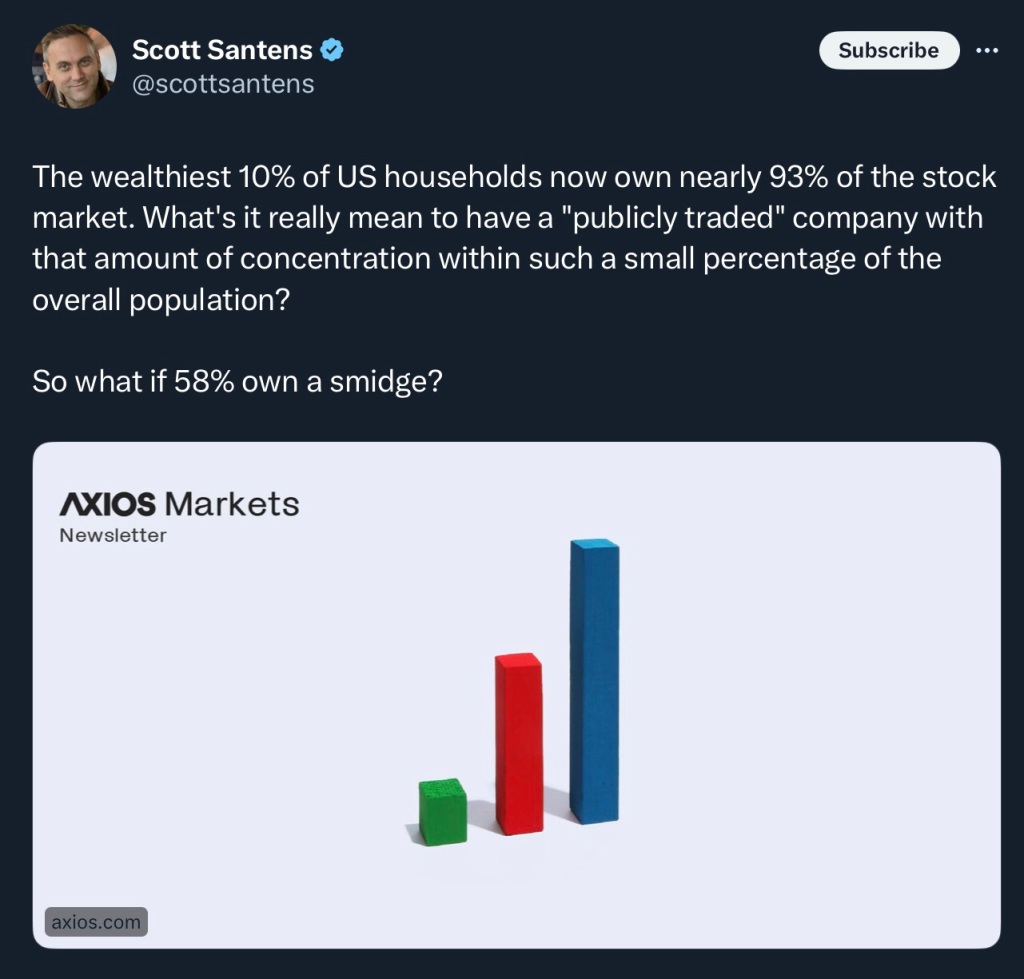
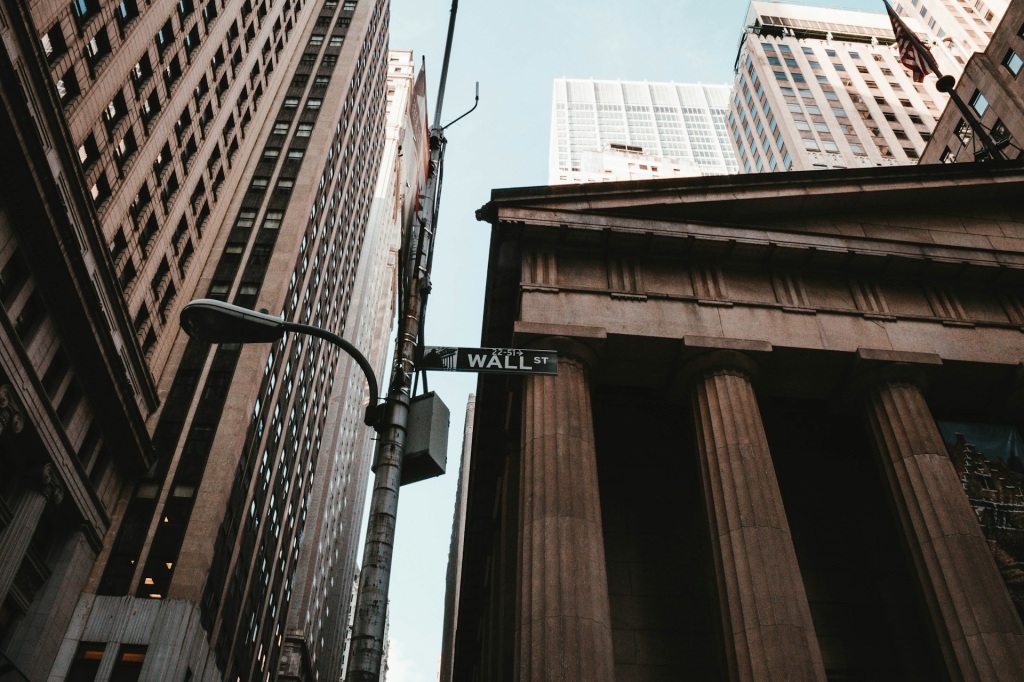
What is the stock market? A central marketplace to buy and sell stock. The NYSE dates back to 1792. It was likely never explicitly stated that it’s a private club. Because of the term publicly traded company, many people probably assume the public interest is being served or that the stock exchange is a public place. It is not.

10% of the populated owns nearly 93% of the stock market. As the late, great George Carlin used to say “it’s a big club, and you ain’t in it”.

10% of the population…wow, and the government gave them how much bailout money in 2008?

I wonder how the public could have benefited from that money? Healthcare, pot hole repair, college debt forgiveness, homeless sheltering, food banks, community gardens, jobs programs, etc. But that’s going into fantasy land. A fantasy where the rich don’t get richer.

Is there a middle ground where the poor don’t have to get poorer?

It is something to see so much data and evidence pile up that America is living in a capitalist controlled oligarchy. The illusion of direct democracy fades for all but the heavily propagandized. Unfortunately the heavily propagandized is still the majority of the civilian population of America.

The evidence of that fact shows up every election season. Red vs blue, republicans vs democrats, neighbor vs neighbor. Tribalism weaponized to keep the unwashed masses fighting amongst themselves rather than looking upwards and their oppressors.

That third parties are still relegated to joke status because the duopoly has people convinced lock, stock, and barrel that they need to vote between the lesser of two evils OR ELSE, is also really something to behold every election season.

How many billions need to be spent on war and corporate welfare each year before something changes? Is there a number? Is there a flash point? Is there a turning point? Do we as a people have it in us?

It is easier to just get by. Take less and be lead. Settle on the sidelines and complain through small talk or comment sections.

However, it is also getting harder to deny reality. Even in a time of compounding misinformation and infinite propaganda, a study that shows that 10% own 93% of the stock market comes out. The same stock market that is used by every mainstream news source as the indicator of whether the economy is doing good or bad for the whole country.

So if 10% are doing good we’re all doing good? No. But every news anchor and every politician in America talks about how good or bad the economy is doing based on how the stock market is doing. So what does it mean if the stock market is doing good, 10% of the population are doing good, the media and politicians all in unison say we are doing good as a whole, but the vast majority are experiencing the toughest times of the past century?

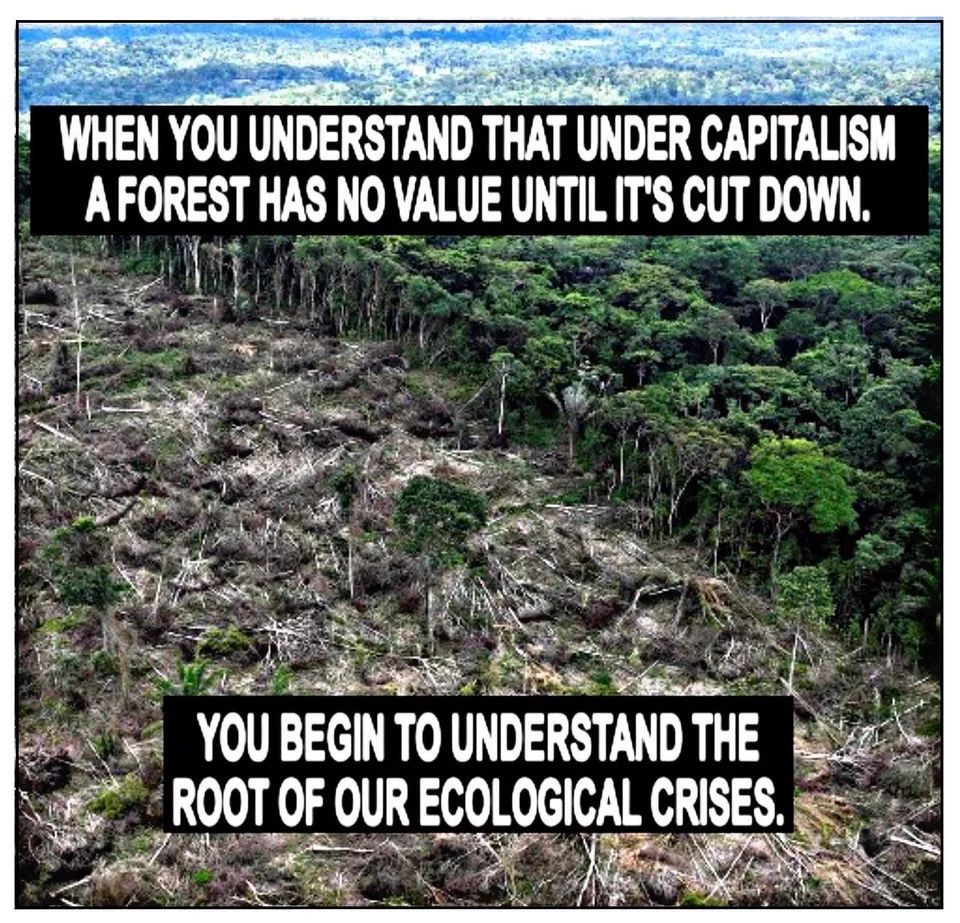
Why does it seem like climate change is only getting worse?

Why do the institutions, organizations, and countries that can have the greatest impact only pay lip service to combatting climate change?

Why is that even regular everyday people who aren’t skeptics seem apathetic to the prospects of positively reversing climate change?

Capitalism.

Profit motive > anything & everything

Until the many are able to unite against the few, things are only moving in one direction.

Getting people to understand that countries and cultures that are completely identified with capitalism are not going to change positively because the changes required to change would require a temporary loss in profits in large amounts for large quantities of current beneficiaries of the capitalist system.

And we know how we human can justify doing the wrong thing if it benefits us. Every human being has done it at some point in their life. An action either on purpose or on accident that negatively impacts another person or thing. But we believe we’re a good person, we didn’t mean it, we deserve better, etc.

Just scale that up to that of communities, countries, civilizations and corporations.

An aspect of human nature that works in our favor on tackling climate change is the inner drive humans have to help each other. You see it all the time when disaster strikes. There are always helpers. People helping people.

There is no benefit to losing faith in humanity. There are enough of us who want to help each other on a mass scale by helping the planet. There are enough people on the wrong side of capitalist policies to unite and drive change forward. That is where my hope lays.

Homeownership, a foundation of the economic middle class, a trademark of the American Dream.

So many capitalist bootlickers, who confuse having a comma in their bank account with their class status, love to point to the stock market as a sign of how well the American economy is doing.

We humans love to feel smart and in control.

The modern American economy, this side of The Great Recession is drastically more complex and out of control of the average consumer and worker regardless of if they’re in false class solidarity with the 1%.

Record homelessness means the system is a failed, broken disgrace.

Tent cities becoming an established norm across the country means the American Dream has become a living nightmare.

But it is hard to care about others when we are so busy just trying to keep our heads above water. Trying to make enough to keep ourselves warm, fed, and dry leaves little time or energy to help those who have already fallen through the cracks.

It would just be nice if we stopped lying to ourselves about it. But that would mean a drastic, immediate change in human nature. I’m guess BlackRock will get out of the real estate business before that happens.