Posts Tagged ‘mental health’

How can we trust ourselves if we’ve made so many mistakes and/or repeated many of the same mistakes over a long period of time?

A simple question, without an easy answer. As is life.

It can be made more complicated after one begins their self improvement/personal development journey. Learning about concepts like imposter syndrome, self sabotage, the ego, the pain body, and our shadow self.

Psychology, philosophy, and spirituality can seem so overwhelming at times that many throw their hands up and dismiss them altogether. They throw the baby out with the bath water. Life can be hard and complicated enough. Life seems to get more difficult and complex with each passing year with more and more technological integration into daily life.

Self compassion is a good first step towards self trust. Self trust, seems to me, to be a middle ground, on the path towards self love.

Mistake repetition has been one of the most maddening aspects of life for me. No one’s fault but my own. Zero percent external blame. Not nature nor nurture. Yet I have repeated so many mistakes over the course of my life, it has been enough, at times; for me to throw my arms up in the air, say it is what it is, and live helpless and blameless to the whims of the universe.

But I choose not to. Repeatedly.

Self acceptance is a precursor to self compassion. I am not perfect. Nobody is. Don’t let the photo filters and video edits fool you, nobody is perfect, not even close.

The fact that so many humans feel the deep seeded need to portray a perfect image outward to people they don’t know and will never meet speaks volumes to how imperfect we all are.

Change is the only constant. Which means that there is a constant changing of variables happening, in every conceivable aspect of ourselves, and the world we are living in, that we can’t ever come close to always being right or doing the right thing. We can try. We have to try. What else is there? Giving up, doing nothing. I tried those. I found those to be mentally and emotionally cannibalistic paradigms.

So we start small. Very small. What’s below baby steps? That, there, do that. One at a time. We can identify what we have direct, immediate control of. Put all focus, energy, and effort towards those things. Then our circle of influence expands, by keeping small promises to ourselves. That is what Stephen Covey believed and preached, very successfully, for a very long time. I have found that paradigm to be true for me.

To learn to trust oneself begins with small steps but is no small undertaking. All big things have small beginnings. How we do the little things is how we do everything. From that point of view, trusting oneself truly is learning how to live.

Living in the present moment sounds so simple, too simple perhaps. If it was easy for people to be present, rather than identified with their thoughts, emotions, and/or memories, the world we live in would be unrecognizable.

Our past makes us who we are. What led us to this very moment in time? Our past. For better and for worse. The good, the bad, and the ugly.

Our past choices became habits became patterns became the way we lived our lives. Many people live life unaware of this fact and even more are unaware that we can choose.

Meditation has been a life saver for me. Those close to me have heard me say that many times by now. Meditation helped me break the hold of identifying with my thoughts, my emotions, and as Eckhart Tolle says; my life situation.

We are not our thoughts, we are not our emotions, we are not our life situation.

What a wonderful concept. A moment of internal liberation. If only it was a one time, permanent fixing, magic pill, cure all. Meditation is not a magic cure all. Nothing is. The discovery that I am not my thoughts, I am not my emotions, I am not my past trauma was the beginning of awareness.

Awareness is the way out. Becoming aware was the first step, of the first day, of the rest of my life.

Step by step, day by day. One thing at a time. One choice at a time. That is how we live in the present moment. That is how we live for our future self that we would like to become. That is how we separate ourselves from our past, our trauma, our inapplicable teachings, our perceptions that no longer serve us, our old ways of doing things.

It’s just like most things in life; simple NOT easy.

Sure we can try, but what happens if we fail? What happens if we don’t try? What happens if we succeed? What happens if we sabotage ourself? What happens if we give up? We happens if we achieve mastery? What happens if we try, try, try again and nothing external changes?

First, gratitude. Always, gratitude. Gratitude is gravity. Gratitude is glue. Gratitude is what you lay the foundation on top of.

Then…

Step by step, day by day. One thing at a time. One choice at a time. We choose, to do what we can, with what we have, to the extent we are capable of doing.

Change is hard, change is slow, change can be painful. If the opposite were true, the world we live in would be unrecognizable.

So we have to forgive ourself. We have to accept ourself. We have to love ourself. We have to support ourself. We have to cheer on ourself. We have to champion ourself. Life can be hard enough. Change is made harder if we are hard on ourself.

Simple NOT easy.

It can seem overwhelming. It can seem insurmountable. It can seem impossible. That’s why we do things of this nature;

Step by step, day by day. One thing at a time. One choice at a time. One breath at a time.We choose, to do what we can, with what we have, to the extent we are capable of doing.

That is how we live in the present moment. That is how we live for our future self that we would like to become. That is how we separate ourselves from our past, our trauma, our inapplicable teachings, our perceptions that no longer serve us, our old ways of doing things.

Simple NOT easy.

Worth a try.

Our lives are dyed by the color of our thoughts.

We focus on what we look at.

We get what we focus on.

We are what we repeatedly do.

Trying to create and cultivate space between what happens to us, and our thoughts and emotions regarding what happens to us can be very hard. And certainly is not the default state of doing things for human beings.

They’re called snap judgements for a reason.

In the blink of an eye.

We’ll react with fervent emotion, containing very little, if any, rational thought.

But of course, in the moment of choice, we don’t just think, we know we’re right. We feel it. We don’t know it. We feel it.

Which is more powerful a thought or a feeling?

Which is more influential?

What was the world like during the vast majority of human history before rational thought?

Of course we construct the world through the paradigm of our emotions. Our emotions predate language by at least 100,000 years and rational thought by around 300,000 years.

We evolved to construct the world with our emotions. It is the norm to construct the world with our emotions. We are emotional creatures.

The modern world is one of logic and reason. At least it is officially, on the table, for appearances, in public. But living life is a private matter. Emotions and feelings rule the day for the vast majority of people. If it were the other way around the world would be incomprehensibly different.

So we must have more compassion and empathy for ourselves AND others.

I have found maintaining self compassion and empathy towards others to be a challenge despite large quantities of meditation practice and spirituality study. Negativity and selfishness seem to be increasingly amplified and glorified in the western world. I wonder why that is? Put another log on the fire.

Is it in our nature to be compassionate and empathetic? I believe so. I believe it is, barely, in our nature. Just enough that it can be cultivated, expanded, and spread around in the spirit of emotional contagion.

I know there are, have been, and likely will be plenty of days where I will need to give myself compassion and empathy. Living can be hard and complex.

That means that others need it to. Some more than others. I know I’ll have to develop my ability to extend compassion and empathy. But it’s a challenge worth taking on and conquering. It is a good fight to take on and win.

Because compassion and empathy are good things. Two things we need more of for ourselves. Two things this world needs more of from us.

I found it to be a tangible sign of progression on my path that I stopped be as internally triggered by external reality not matching up with what I wanted, expected or hoped for.

Have a achieved zen? HA! We all need goals to chase.

Maybe it’s just part of growing older and accumulating more life experience that teaches us, whether we like it or not, that external reality is going to do what external reality is going to do and the best we can do is attempt to influence it then completely let go/detach from there.

I have gotten better at that.

There is a balance there too.

One can give up altogether. Stop trying.

Giving up control is good. Giving up altogether is bad.

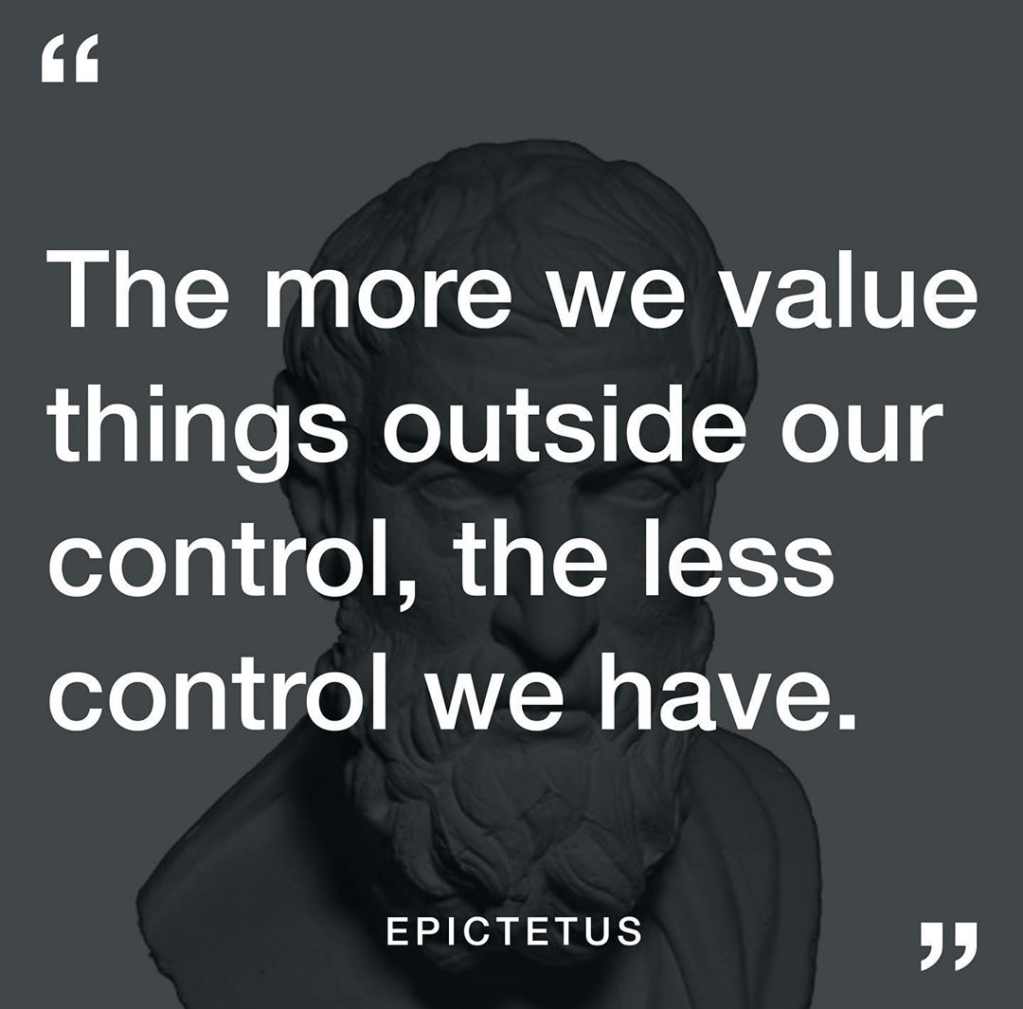
Identifying what is in our control and what is not is a pillar of stoicism. It is one of the things that initially drew me to the ancient philosophy that has helped so many people for so many thousands of years.

I remember in the depths of my depression turning to personal development/self help books. In my case, audiobooks. My education in America taught me to hate learning. I hated reading. I would learn to unlearn to paradigm of hating learning, slowly, over time. Renting audiobooks from my local library was a big step in that direction.

One of the first authors that drew my attention was the late great Stephen Covey and his iconic book The Seven Habits of Highly Effective People. A book I recommend to everyone that is capable of reading or listening to audiobooks.

More than his book were his speeches and interviews. Regardless of the material he preached, he had an amazing voice and a magnetic presence.

In his book and his talks he talked about two circles. The Circle of Control and the Circle of Concern. As one might guess, the circle of control is very small and the circle of concern is very big. Yet the attention we pay to each is often inversely proportional. I know it was for me when I first learned about the terms. I know that learning about those terms or any terms is in no way a cure all.

So it still takes constant effort over a decade and a half after first learning about what I have direct control over and what I have no control over. I’ve studied stoicism through reading, listening to podcast, and watching videos for almost a decade now. No one thing magically makes my shortcomings or predispositions disappear.

But I am as grateful or more grateful for the progress I’ve made in this area of my life than anything that has ever happened to me or anything I have ever done. Because putting my focus, energy, and effort towards things outside of my control has been a source of tremendous suffering for me. Life experience has shown me it is a great source of suffering for many if not most of the people I have ever met.

Meditation, stoicism, journaling, theanine, ashwaghanda have all helped me calm my mind, slow my thought streams down at least enough to realize I am in the witness and not a passenger.

Things happen.

I can choose to put my focus, energy, and effort into accomplishing a goal regardless of size or scope and then when I have done all that I am capable of doing to the best of my ability at that time…I can choose to let go and then I can choose to accept what is.

It is as it is…

It can be hard to focus on what we can control or influence when we have a harder time distinguishing between the two. Generations raised on movies, television, and social media have been socially conditioned to have egos the size of the Grand Canyon.

It often takes some negative external event to pop or at least penetrate the illusion that we are the center of the universe, we are the main character surrounded by NPCs, and/or we can’t always get what we want, when we want it, how we want it.

ā€œThe world breaks everyone and afterward many are strong in the broken places. But those who will not break it kills.ā€ Ernest Hemingway – A Farewell to Arms

I know for me it is a regular battle of focusing on things I have no control over whatsoever, realizing it, and changing my focus to something more productive or beneficial. But nothing in life of substance is a one and done. No magic pills to take or magic wands to wave.

It’s human nature to focus on things outside of our immediate control in order to survive. What is going on in our environment around us is outside of our control. But how we maneuver within it to live to fight another day, is in our control. So we evolved with an outward focus rather than an inward focus.

So we constantly have to fight ourselves to prioritize what is pragmatic.

So much suffering comes from time and attention that turns into emotion spent on things completely outside of our control.

Equally or perhaps more frustrating for me has been the knowledge of this and still failing to execute properly. Identifying what is within my control, focusing on it, and still failing to take right action.

Awareness is the way out, but it still takes action to get there.

Recognizing and placing proportional value on what we directly have control over is necessary for peace of mind and quality of life.

Taking appropriate action consistently, habitually, that is a whole other ball of wax. But one can spend a lifetime chasing their own tail without the awareness of the difference between what we control and what we don’t.

One must take the time to genuinely think and write about this. I feel like with this issue deep thought and mediation are not enough. Our thoughts on this must be transcribed somehow to make a good faith attempt at attain wisdom here.

Luckily, choosing to make time, think deeply, meditate, write/journal, and reflection are all things we can control.

One thing at a time.

One choice at a time.

I think there is value there.