Posts Tagged ‘psychology’

I’ve been a premium subscriber to Lumosity (brain games app) on and off for a decade now. I find it helpful. The older I get the more I realize my brain can use all the help it can get. Real, imagined, or placebo I don’t care. Don’t tell me about the labor pains just show me the baby.
I would use it reasonably consistently here and there then drop off. I would subscribe to the premium version when there was a sale on Cyber Monday or on New Year’s Day something like that. I’d start and stop and start and stop. I’d unsubscribe and resubscribe. Does this cycle sound familiar or relatable?

I never confused it as a magic pill for a bulletproof brain. I just knew myself enough to know that I’ve done enough detrimental work on my brain that a brain training app could at least serve as a beneficial use of time.

It has helped me at least a little. But what made it finally stick, just in the last year, was when I dropped the expectation of it helping my brain and doubled down on it helping me structure my time/daily schedule.

I realized that the value of just going through the motions, even half heartedly, provided as much value to me as putting full effort into using the app. How? Consistency.
I found that for me, the consistency of using the app everyday, without exception, even if I picked the quickest, easiest games, without enthusiasm or even a quarter of my concentration, did more for me that applying myself fully to the game once or twice a week and then forgetting about it for stretches of time.

As I did that more and more, and built up more and more streaks, a funny thing happened
my scores in all the games went up. I set my personal best records in all the games I played consistently. How? Consistency. I didn’t half ass it every time I opened the app.

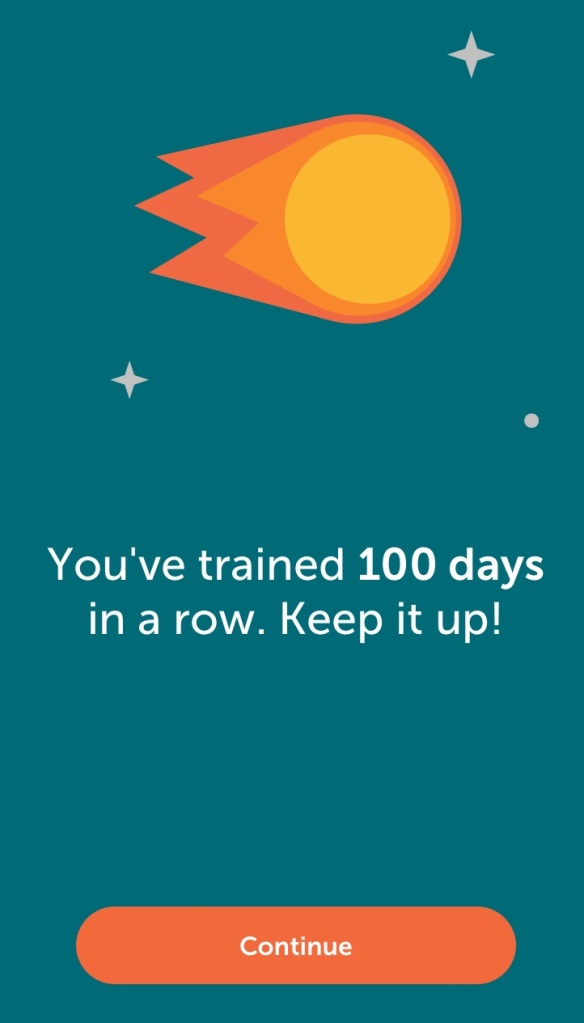
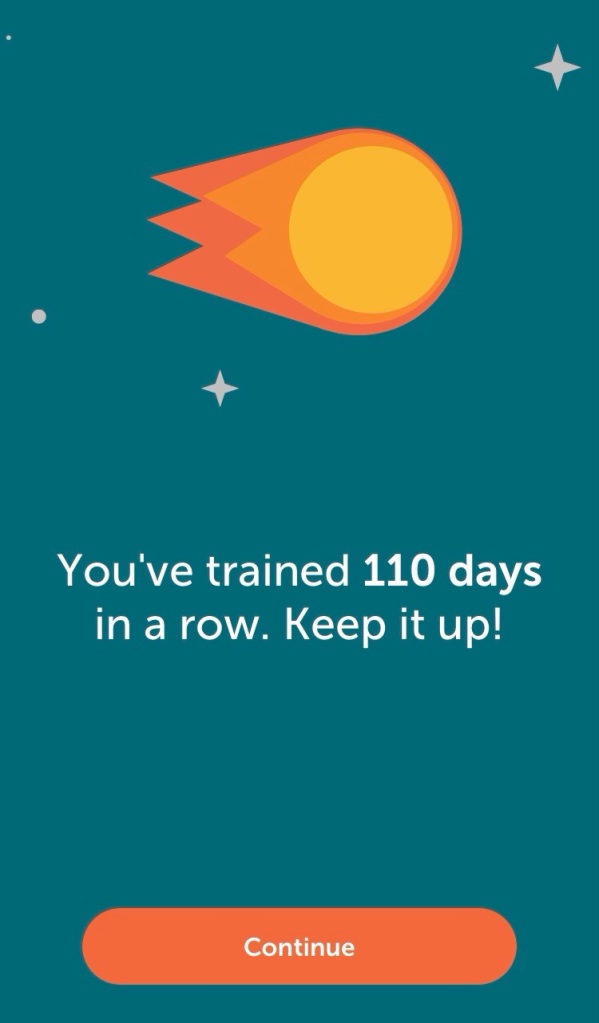
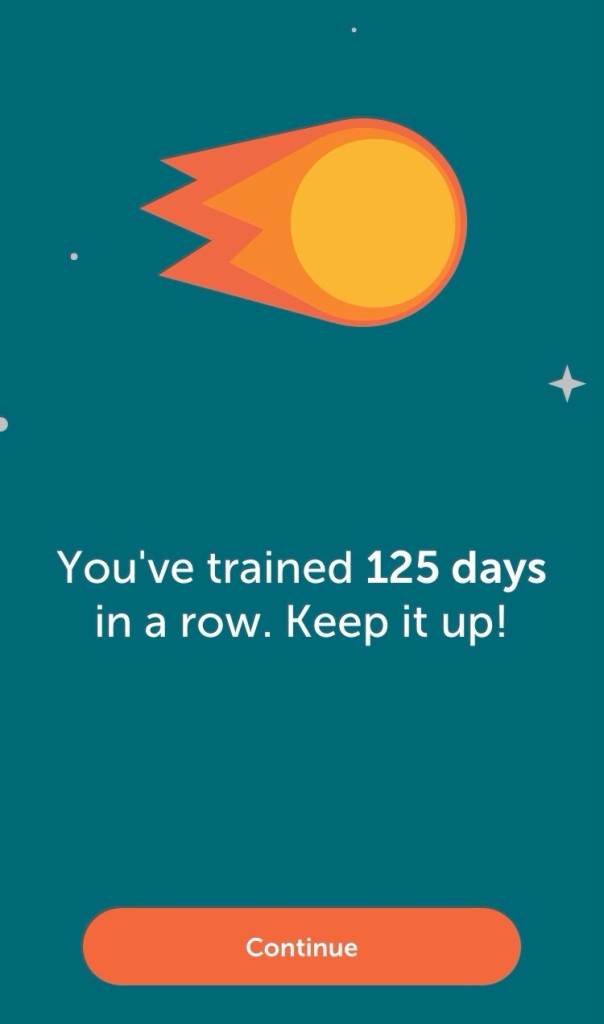
But I did some of the times. When I was busy, feeling burned out, hungover, melancholy, distracted, multitasking, etc I still would take the time each day to open the app, and play the five games required to warrant completion and a little graphic at the end showing how many days I had completed my brain training consecutively.

There were however plenty of times where I was motivated, concentrated, caffeinated, enthusiastic and excited to play the games and try to beat my previous best score, to make up for a poor performance from yesterday and/or because I felt training extra memory or attention games would help me at an upcoming event.

This isn’t a paid ad for Lumosity (I wish) because it’s not about the particulate it’s about the general. It’s about doing the thing consistently. It’s about doing it every day, even half assed. Because if we do something everyday, half heartedness is inevitable but so is doing our best and so is doing better than we perceive we are capable of.

How?

Consistency.
I came across the word rumination randomly and it immediately stood out and stayed in the forefront of my mind. I knew the word, I felt it strike a chord, but I didn’t immediately know the definition off the top of my head. So I looked up the definition online.

Rumination – a deep or considered thought about something. The action or process of thinking deeply about something.

Sounded right, looked right, made sense, then I saw a tab below with the definition from the American Psychiatric Association.

Rumination – a cycle of negative thinking. Rumination involves repetitive thinking or dwelling on negative feelings and distress and their causes and consequences.

Ouch, that one struck a chord and cut deep. It’s human nature to want to deny that we can be categorized as a type. If I was at a different stage in my personal journey, I would deny, gaslight, change the subject, and refuse to acknowledge.

But I am who I am, and I am where I am. Rumination has been a norm, a standard for me. As a creative/artistic type, it comes with the territory. Artists are sensitive. Overly sensitive compared to the average Joe/Jane. We are more sensitive to both the highs and the lows, the positives and the negatives in life at both the micro and macro levels.

You can’t spell rut without rumination.

Ruts are built on a foundation of rumination. Ruts are funded by rumination. Ruts are mentored by rumination. Rumination holds fundraisers and provides endowments for ruts. You show me a human being in a rut and I’ll show you a human being dealing with rumination.

Repetitive thoughts? Is there another kind?

Dwelling is as natural for humans as blinking. From the boomer who still talks about their glory days playing sports in school to the teenager still heartbroken a year after getting dumped. The self fulfilling prophecies of rumination are the dark side examples of the law of attraction.

I feel like rumination should be used as regularly as the words stress, fear, anxiety, and depression in regards to mental/emotional health concerns.

When we can label something, our awareness of it immediately grows exponentially. What we can’t describe due to our naivetĂ© makes us feel more alone and detrimentally unique. Like we’re the first to experience what we’re going through.

Meditation followed by affirmation practice(s) can help first break the cycle of counter productive thinking with present moment awareness, then replace them with beneficial thoughts and visualizations. Philosophy study can teach us that people have been experiencing the same mental/emotional issues that we’re dealing with for thousands of years and provide wisdom based guidance.

I also think it is not just important, but imperative, to pair these sedentary practices with physical exercise. I was doing physical exercise regularly for years before my meditation and philosophy practices. Weight training, yoga, machine based cardio, and nature trail walks/hikes (when the weather allows it) make up my regiment that I whole heartedly endorse for all humans.

But regardless of order and regardless of which one someone is already doing, it is equally important to train the body, the mind, and the spirit. All are connected. Healthier body, healthier mind, healthier spirit. Stronger body, stronger mind, stronger spirit.

Holistic approach is the best approach always.

Stop and smell the roses.

Stopping and taking a deep breath is more pragmatic and less cliché.

It is human nature to dwell on the negatives and focus on the outcome/result. This tendency robs us of so much positive potential.

Things could always be worse. Modern technology emphasizes how much better things could be as a foundation for trying to sell us things. But that technology also allows us to see how worse off we could be compared to millions or in some cases, billions of other people.

Others having it worse doesn’t invalidate our problems or our feelings. Power positivity becomes toxic when it tries to make us feel bad about feeling bad. But just because we feel bad in a moment, doesn’t mean we have to make that negative feeling our dominate personality trait.

In some of my darker moments, it has been of real help and real value to look back and see how far I’ve come in my life journey. Some of the accomplishments, some of the fun times, some of the rewarding experiences, some of my day to day habits that were once long term goals.

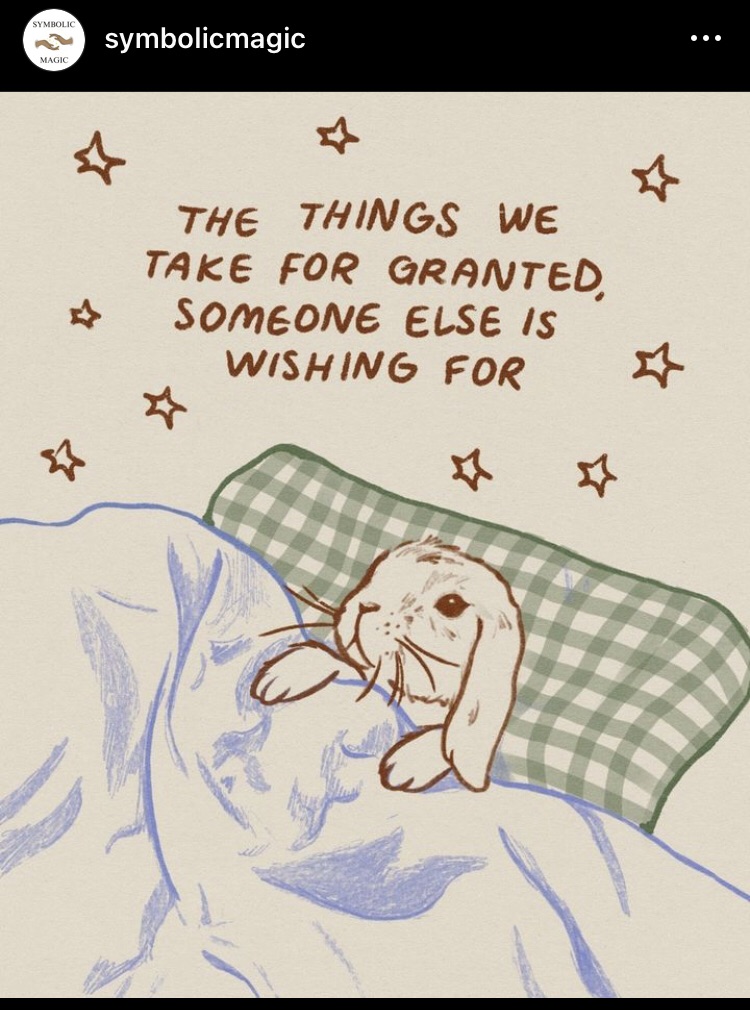
It’s human nature to take things for granted once we get used to them. Meditation and mindfulness practice has helped me with this. Present moment awareness and gratitude go with meditation like peanut butter and jelly. Breaking the cycle of constant thinking, dis-identifying with any negative emotions, being able to be grateful for who I am and for what I have are small wins each time I meditate.

Philosophy has probably helped me more with this particular aspect of life. A study of philosophy is a study of human history. Stoicism in particular has helped me greatly when I slid into poverty. Shifting my focus from what is outside of my control to what is within my control. But also comparing the ancient world to the modern world, one can’t help but feel grateful for many of the pleasantries and technologies that were unimaginable in the from the eras of Aristotle and Marcus Aurelius to the days of Friedrich Nietzsche.

Electricity, indoor plumbing, refrigeration, clean cold drinking water, access to a variety of fresh foods year round, climate controlled shelter. Those basic amenities are still to this day foreign luxuries to many people in the world.

It is not just easy, it is natural to take things for granted when we are used to them. We face many challenges each day and night. Being human isn’t easy. But we face and handle external challenges as best we are able to. So perhaps we can internally challenge ourselves; to swap out taking some of the basics in life that we take for granted, with gratitude.

List out a few of those things to be grateful for. Either in internally, out loud, or on paper and before long, one has an affirmation practice going. Keep that affirmation practice going, keep actively being aware of all the things we have to be grateful for, and a weird thing happens
we start to have more and more to be grateful for.

Modern culture, built on a foundation of a capitalist paradigm, is about, more
always. Infinite growth on a planet of finite resources.

Media and entertainment as we know it in any form, was built by, in the service of advertising. What is the purpose of advertising? To inform, persuade, and remind. Information and reminders have long since exited the chat.

Persuasion. Advertising’s purpose is persuasion in the modern world. For each small business, non profit, and NGO one can point to that use advertising for the greater good, there are literally thousands of examples of advertising persuading people that they need more, more, more
always.

More things, more experiences, more goods, more services, more products, more placements, more, more, more
always.

If our eyes or our ears are open there is some entity using some form of media to persuade us that what we have and/or who we are isn’t enough, we need more, more, more
always.

We are expected to do more, be more, buy more, say more. Keeping up with the Jones’ is a full time job that like many real jobs, doesn’t pay enough to stay out of debt.

Being human can be hard enough. Modern life seems to get more and more complex year to year. Sometimes we’re not going to be our best self. That’s not only okay, it’s normal.

Optimal isn’t always optimal regardless of what the caucasian male with a podcast universe would have us believe. Hustle culture creates a thousand burn out victims for every one that achieves a measurable external success by trading away a minimum of two thirds of their life.

We can’t thrive if we don’t survive. Some days just doing enough to survive isn’t just fine or good enough
it’s literally all there is. A dead entity can’t optimize, it can only decay.

Enough is greater than more. Enough is optimal.

Those who always want more will never have enough and will always try to convince those with enough that they need more.

There’s nothing wrong with goals. There’s nothing wrong with growing, evolving, striving or achieving. There is value and maybe even necessity in metaphorically always moving forward and towards.

It is also becoming more and more of a necessity in an optimal obsessed world to remember that we can’t strive if we don’t survive.

Surviving comes first, always.

It’s natural to want to be externally successful at what we do.

In the era of social media, that desire is exploited and gaslit at historic levels

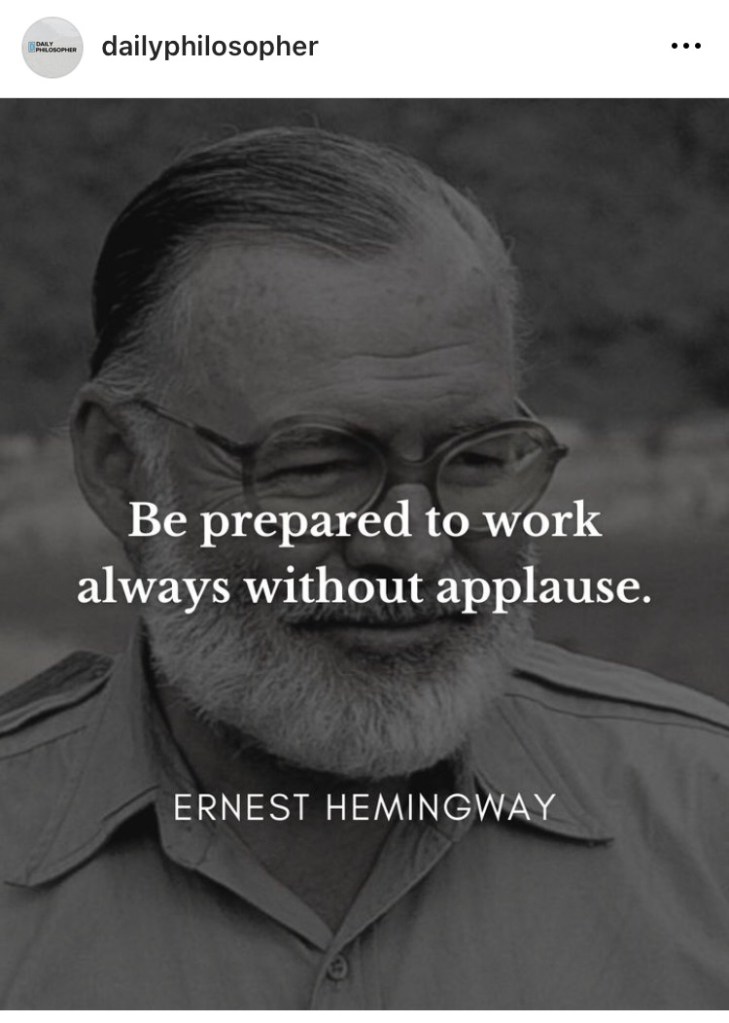
I find the Hemingway quote, “be prepared to work always without applause” to be as close to the perfect piece of life advice as there is. It’s not negative. It’s not cynical. It’s honest. It’s fair. It’s objective. It’s true.

I’ve also always liked the term passion project.

Doing creative/artistic work is hard and there is no objective standard of quality.

Personal taste is not up for debate.

So how do we know if we’re good? How do we know if we’re successful? How do we know if we’re on the right path? Capitalist controlled cultures would point to money, fame, influence, clout, etc. Does that mean those are the only good creatives?

Perfectionism is the trap we put ourselves in to shield from external judgement. Not only from external criticism but from external success, and lack thereof.

If we’re creating from our ego, we need the success. It’s not about the work, it’s about the result. It’s not about the journey, it’s about the destination. It’s not about the depth, it’s about the shallow features. It’s not about what’s real, it’s about the facade. It’s not about originality, it’s about clap trap zeitgeist.

Get those numbers up, so they can be used as a pillars of humble brags and how to listicles. How can I monetize this? Monetize what? ANYTHING! EVERYTHING!

The work is the win. Creating is the purpose. It’s so much better when we come from that place. Because then we’re not chasing. We’re not selling. We’re creating. We’re contributing. We’re being authentic. We’re being real. We are being.