


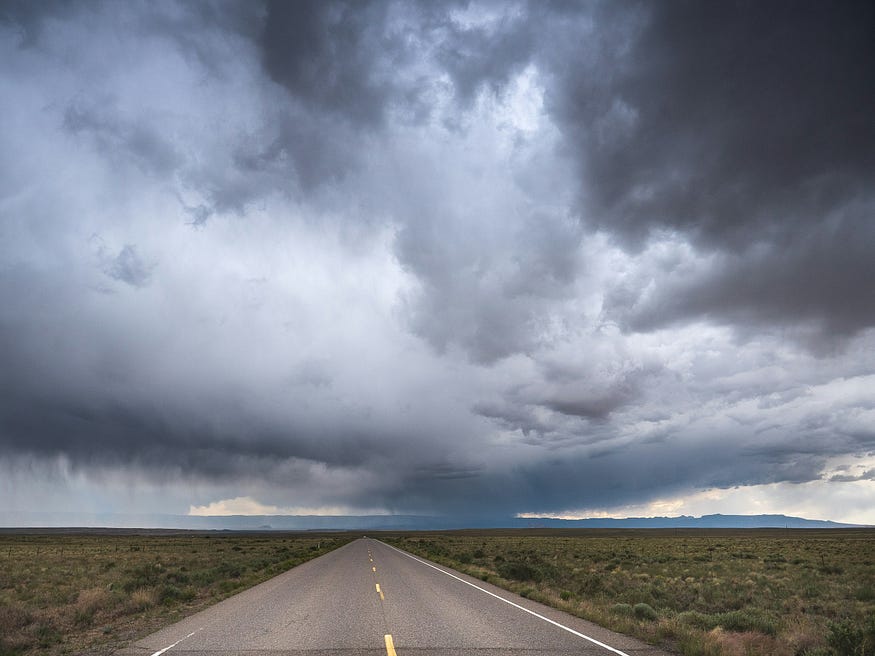
False Certainty, True Harm
“We suffer more often in imagination than in reality.” — Seneca
The mind means well. It wants to protect us. But often, it does so by spinning tales of potential harm, pain, or failure — stories it believes we need to prepare for. Overthinking pretends to be a strategy, but more often it becomes a trap.
In the Stoic view, most of our suffering comes not from events themselves, but from the way we imagine them. The modern mind has become a kind of forecast factory — working overtime to predict every possible outcome, especially the worst ones. But like most factories running at full tilt, it produces far more than we need, and the excess begins to pollute us.
The problem isn’t that we think. It’s that we over-believe our thoughts. The forecast becomes our weather, even when the sky outside is clear.
Mistaking the Mind for the Moment
“The mind creates the abyss, the heart crosses it.” — Nisargadatta Maharaj
Overthinking separates us from presence. It convinces us that safety lives somewhere in the future, if only we can think hard enough to find it.
But presence isn’t found through analysis. It’s found through attention.
Spiritual teachers — from Buddhism to Taoism to Eckhart Tolle — remind us that the mind is a beautiful servant but a dangerous master. It wants to protect us by forecasting the future. But in doing so, it keeps us from living now.
The forecast factory churns because we’ve forgotten how to just be. Caught in imagined futures, we lose the grounded truth of the present. And the irony is, presence is the only place peace can ever exist.
The Fear of Getting It Wrong
“When we are no longer able to change a situation, we are challenged to change ourselves.” — Viktor Frankl
Many of us learned to tie our worth to performance. To being right. To being ready. And so the mind took that lesson and ran with it.
Overthinking becomes a form of self-validation — if I anticipate every possible outcome, I’ll never be caught off guard. But that drive for control is rooted in fear. It implies: If I mess up, I’ll lose something… maybe even love.
Catastrophizing is often the mind’s way of bracing for emotional pain. But in doing so, it reaffirms the belief that we are only safe when we’re perfect, prepared, or pleasing.
Humanism reminds us that we are valuable even when we’re uncertain. Even when we don’t have all the answers.
Self-worth is not the reward for perfect forecasting. It’s the quiet truth we can return to when we stop trying to earn it.

The Brain’s Bias Toward Stormy Skies
“The brain is like Velcro for bad experiences but Teflon for good ones.” — Rick Hanson
Our brains are not wired for happiness — they’re wired for survival. And survival meant staying alert to danger. That’s why the brain’s default is to scan for threats, to replay past pain, and to imagine worst-case scenarios.
The forecast factory is built into our biology.
Overthinking activates the default mode network (DMN) — the part of the brain involved in self-referential thought. When we’re stuck in loops, DMN activity is high. This also correlates with increased cortisol levels and reduced capacity for presence.
In other words, it’s not just emotional — it’s chemical. The good news is that practices like mindfulness, breathwork, and cognitive reframing can quiet the factory floor. We don’t have to shut it down completely. We just have to stop believing every storm warning it issues.
Choosing the Forecast You Live In
“The future is not something we enter. The future is something we create.” — Leonard Sweet
You can’t always stop the forecast factory. But you can learn to recognize its patterns.
You can pause when the machinery starts whirring. You can ask: Is this thought true? Helpful? Necessary? You can interrupt the loop before it becomes a storm cloud.
Start small:
• Name the thought.
• Notice the emotion.
• Choose not to follow it.
This is a quiet form of liberation, not through control, but through choice.
When we stop trying to protect ourselves with overthinking, we make space to protect ourselves with presence. And in that presence, we reconnect with something deeper than prediction:
We remember who we are — beyond the storm.
 Anarchy Journal Constitutional