
Posts Tagged ‘human nature’


“It’s not what happens to you, but how you react to it that matters.” — Epictetus

Failure is a necessary part of life.
Setbacks are an inevitability.
We wouldn’t know what success or breakthroughs were without failure and setbacks.
There is no getting around the yin-yang, no matter how much we wish we could sometimes.

“Our greatest glory is not in never falling, but in rising every time we fall.” — Nelson Mandela

I recently experienced a setback via a personal failure. The shock of the situation took weeks to wear off. I let myself down and through my own choices and actions caused a setback.
Is it better if something external and out of our control causes a setback?
Is it worse if we are the cause of our setback by doing the wrong thing?

Photo by CHUTTERSNAP on Unsplash

Unfortunately, I don’t have a time machine. So since I can’t change the past, the best thing I can do is focus on the present moment and move forward. There’s solace in that everyone makes mistakes, fails, and experiences setbacks. Whether we’re talking about famous historical figures or the billions and billions of regular people who have lived, are living, will live, and won’t be famous but will still experience highs and lows, successes and failures, the best and the worst that this crazy thing called life has to offer.

“Our goal is not to eliminate suffering. Our goal is to find peace despite the suffering.” — Thich Nhat Hanh

The best thing I have done for myself since my setback was to adopt the mindset that this situation is an opportunity for growth. I have had to say it internally and aloud seemingly a thousand times as negative thoughts, perceptions, and emotions about the situation consistently try to creep in from every direction.

During normal times, in my everyday life, I utilize philosophy and spirituality practices with a humanist filter to keep me on my path. During the challenging times of a self-imposed setback, I am leaning on them more than ever to help get me through. I thought maybe sharing some of the principles and paradigms that are helping me could help others too. Since I know I’m nowhere near the only one going through challenging times in the world today.

“The impediment to action is not the thing itself, but the thought of it.”- Marcus Aurelius

The concept I’ve leaned on the most is that a setback is an opportunity for growth. I have said that internally and aloud at least a thousand times over the past two months. This gets coupled with setbacks being universal and inevitable in life. Everyone encounters them, nobody gets to avoid them.

The philosophy I turn to most often is Stoicism. This ancient philosophy helps me with acceptance and focus. Accepting what has already happened and what is outside of my control. Acceptance involves letting go and detaching. I can’t control what has happened. I can’t control what will happen. But what I can do is focus on what is in my control in the here and now. The paradigm of Stoicism helps me stop catastrophizing and dwelling. It helps me get out of the imagined and into the real. Those are helpful things in good times, but especially necessary during challenging times.

“The chief task in life is simply this: to identify and separate matters so that I can say clearly to myself which are externals not under my control, and which have to do with the choices I actually control. Where then do good and evil lie? In the choices I actually control.” — Epictetus

Meditation was one of the first stress/anxiety-fighting practices I was able to habitualize. Being able to quickly engage in a simple, easy set of actions to calm my mind and gain some clarity and gratitude in the present moment is like putting a band-aid on a cut during trying times. Pairing meditation with studying various spiritual practices has been perpetually taking a load off that the overthinking mind seems to want to constantly place on my chest and shoulders.

“You cannot control the waves, but you can learn to surf.” — Jon Kabat-Zinn

Studying various spiritual practices for a number of years now has helped to enforce the necessity of forgiveness, compassion, gentleness, letting go, and kindness for the self and others in good times and bad. Experiencing a setback is fuel for the fire of judgment, negativity, anger, and fear. Meditation practice and spirituality studies help to remember that negative noise and pessimistic pain are not who we are or what we are.

“The pain you feel is a signal that you need to change your way of thinking. It’s a wake-up call to become more conscious.” — Eckhart Tolle

We may not need meditation or spiritual practice to be kind and compassionate towards ourselves when we fail. We may not need to study philosophy to be accepting of what has happened to us, to focus on what is in our control, and to be aware of the impermanence of all things and situations whether good or bad. We humans are as hopeful as we are resilient by our nature. That is how we have survived.

Photo by Max Böhme on Unsplash

We may not necessarily need the aid that tools like philosophy, journaling, spirituality, and meditation can provide us, but they sure do help. In challenging times, in the face of setbacks and failure, we can use all the help we can get. Luckily for all of us, these tools are simple, easy, and quick to engage in.

Setbacks and failure are an inevitable part of life, but so are triumph and success. Both sides of the yin-yang are opportunities for personal growth and self-discovery. Failure and success are both necessary for us to even know what the other is. We don’t know what good times are without hard times and vice versa.

Gleaning resilience from philosophy studies and mindfulness from spirituality practices can help all of us turn our negatives into positives. Ultimately, the key to navigating life’s ups and downs lies in our ability to learn from our experiences, embrace change, and maintain a positive outlook.

“What doesn’t kill you makes you stronger.” — Friedrich Nietzsche

Hearing that we don’t think, rather that thinking happens to us, sounds weird at first.

After all, if I’m not in control of my thoughts, then who is?

Do you breathe?

Or does breathing happen to you? What happens if you try to stop breathing?

Do you dream?

Or does dreaming happen to you? What happens if you try to stop dreaming?

Do you blink?

Or does blinking happen to you? What happens if you try to stop blinking?

Are we living? Or is life happening to us?

“The mind is its own place, and in itself can make a heaven of hell, a hell of heaven.” — Marcus Aurelius

Why are we like this?

Many of the things causing problems for us as human beings in the modern world are survival mechanisms baked into us through evolution. Many first-world problems can be whittled down into a mismatch between our ancient brains in a modernized world. Once upon a time, it was not only a good thing but a necessity for our brains to constantly scan for threats and opportunities. Our constantly overthinking neurosis is partially why we as a species have survived as long as we have.

“Men are disturbed not by things, but by the views which they take of them.” — Epictetus

Constant thought streams have been a problem for me like they are a problem for pretty much everybody. Most people, however, are so identified with their thoughts that they don’t even realize they are having thoughts. According to spirituality teachers like Eckhart Tolle, most people believe their thought streams are their lives. That is living to them. Their thoughts, their emotions, their life situation. That is life. That is their identity along with their name and their job, maybe their hobbies and taste in pop culture.

“Identification with the mind is the root of all suffering.” — Eckhart Tolle

Breaking free from identifying with my thoughts, even for just a second, was a special experience I’ll never forget. It was a hard lesson that there is no singular awakening or epiphany that changes one’s life forever. It takes a series of small choices, micro-tasks, and seemingly insignificant actions repeated habitually until they are automatic which creates lasting change.

“Peace is every step. The path is the goal.” — Thich Nhat Hanh

Meditation and mindfulness have been lifesavers for me.

To calm then quiet the mind, to detach from the ego and be in the silent space of the present moment is worth the lifetime of practice it takes to master. To be able to stop thinking, even briefly, then drift back into thought because that’s what we habitually do, but then pull ourselves back out of thought and into the stillness of the present moment, over and over and over again helps to create mental and emotional space that is needed for our ability to survive and thrive in the modern world.

“The mind is the place where we become conscious of ourselves and the world around us.” — Aristotle

I needed to create the space between stimulus and response first.

I needed to awaken and become aware that I am not my thoughts, I am the witness of my thoughts first. From there, I have been able to plug philosophical and spiritual wisdom into that space to help guide my thoughts, perceptions, emotions, and actions in more beneficial and productive directions. I read self-books and listened to personal development audiobooks and podcasts for years with little to no effect because I was so identified with my ego-centered thought streams that little to nothing would get through. It’s like there was a detrimental forcefield covering my mind and spirit.

“If you change the way you look at things, the things you look at change.” — Wayne Dyer

Break the vicious cycle first.

I recommend doing something to break, slow down, interrupt, or stop the constant thinking first. After you break the cycle of constant thinking, you can fill the cracks with wisdom and beneficial knowledge, tactics, and strategies to habitualize what in essence is an entirely new way of living that goes against the grain of human evolution, a life without constant thinking.

I’m no master or guru.

I struggle with this mightily. Depression has been a part of my life for over half of my life now. When my mother died I needed to utilize hallucinogens to stop the combination of grief and depression from swallowing me whole. That is what broke the cycle of constant negative thoughts and emotions.

What I do.

My meditation and mindfulness practices helped to deepen and widen those breaks and make creating space slightly easier. In those spaces I continue to plug in philosophy study, spiritual practice, journaling, yoga, nature bathing, a mood support supplement stack of theanine, ashwagandha & St John’s Wort, reading nonfiction books, listening to personal development podcasts, nightlife socializing, heavy weight lifting, cardiovascular exercise, learning about psychology and human nature, and eating to live rather than living to eat while still indulging in the sweet treats of life.

What you can do.

Those activities may work for some, maybe not for others, the specific activities don’t matter what matters is that they are beneficial actions and force one to focus their mind on what they are doing in the present moment to either execute proficiently and/or to enjoy oneself fully. Philosophy and spirituality practices might turn some people off, and that’s fine, what’s ultimately most important here is one’s individual agency. Everything I listed is practical, not wu wu or exclusively for the rich and privileged.

Viewing philosophy and spirituality through the lens of humanism is what has helped me to accept rather than resist these ancient wisdoms that have become self-help tropes. The human experience is not unique to us in the modern world. The philosophies and spiritual practices that are ancient to us now were created in real-time to help humans exist with less self-imposed suffering.

Our constant thinking is self-imposed suffering brought about through evolving internally to overcome external challenges. That same evolutionary potential can allow us to overcome our internal challenges using these external tools of wisdom that can guide us to; manage our thoughts and explore our inner peace by giving us a deeper understanding of our minds so that we have a better chance of thriving in the modern world.


It can be so hard to ask for help. In real life, not in terms of asking people to like, subscribe, and turn on notifications.  

To need help is like the Big Bad Wolf blowing down a house made of straw. Knowing that one needs help is like blowing down a house made of wood. To ask for help, to be vulnerable, and to reveal our internal shortcomings to the external world; can be like trying to blow down a house made of bricks. 

Although I (like all other living things) have needed lots of help at various points in my life, I have been unwilling to ask for help more often than not. There’s an internal assumption that I should be able to pick myself up by my bootstraps, put my nose to the grindstone, be a man, and do it myself. There is also societal pressure that lionizes this kind of thinking. 

We think to ask for help is to be and to admit weakness.

It’s one thing if we know internally we are weak, but to admit it outwardly by asking for help? I for one have chosen many times to suffer in silence and isolation than to have to admit to myself or others that I am an imperfect being. 

The terms self-improvement, personal development, and self-help naturally mean that we should be able to help ourselves. Reading books, watching videos, taking courses, and attending events with these labels can lead one to believe that we can, should, and will solve all problems, obstacles, or issues by ourselves. 

Listening to self-help audiobooks during my commutes led me to study spirituality and philosophy. Philosophy and spirituality often intertwine and one can be confused for the other. I’ve found that viewing all philosophical and spiritual teachings through the lens of humanism helps me apply the lessons to my life without adhering to or being attached to any kind of potential religious or metaphysical doctrines. 

“We must help one another, and among those who are willing to be helped, are those who must be instructed.” – Epictetus 

Stoicism views asking for help as a sign of wisdom, that you understand what is within your control and what is not. When you reach your perceived limit of what you can control and need help, it is the wise and the correct thing to do to ask for help. 

“Don’t be ashamed to need help. Like a soldier storming a wall, you have a mission to accomplish. And if you are wounded and can’t climb up without another soldier’s help? So what?” – Marcus Aurelius 

The concept that it is not just the right thing to do to ask for help, but it is our job as a human being to ask for help helped me out a lot. Stoicism pushes the concept that we as human beings have to purpose to fulfill while we are alive, a service to provide to the world and our fellow man. A purpose beyond survival or making and spending money? Sign me up. If asking for help is a part of that, consider it done. 

“A giver of gifts is the one who advises, a giver of gifts is the one who shares knowledge, a giver of gifts is the one who points out faults. He who does all these to a friend is a giver of gifts.” – The Dhammapada (Buddhist text)

Spiritual philosophies that I’ve studied tend to focus on the internal, the individual, and the immaterial. However many spiritual teachings do emphasize compassion and our interdependence with our environment and other living beings. This has been a big help to me, as a person who was more of an antisocial loner type for many years but kept finding that way of living; limiting and directly hindering my happiness, fulfillment, and ability to achieve my goals. 

“He who walks alone walks in vain.” – Guru Nanak (Sikhism founder)

Studying spirituality coupled with a meditation practice has helped to dissolve the inner walls I had built up that detrimentally separated me from the world. Those metaphorical walls are built by and with the ego. It is selfish and ego-centered to think we can accomplish anything of substance alone, that we don’t need help, or that to ask for help is to admit weakness. Our ego convinces us that we are so special and superior to not need help and that asking for help is a bad thing.

“All beings are afraid of pain. All beings love life. All beings are the same as you are. Remember this always.” – Buddha

Ultimately, the decision to ask for help is a personal one. It requires courage, vulnerability, and a willingness to let go of the ego. By understanding the philosophical and spiritual underpinnings of interdependence and compassion, we can begin to dismantle the barriers that prevent us from seeking support. Remember, asking for help is not a sign of weakness but a testament to our strength and humanity.

Let’s embrace the idea that we are interconnected, so we can begin to break down the walls of isolation and create a more supportive environment for ourselves and others. By acknowledging our interdependence and embracing the courage to ask for help, we can unlock new possibilities for personal growth and happiness.

Through our choices, we can challenge detrimental societal norms. Together, we can create a culture where asking for help is seen as a strength, not a weakness.


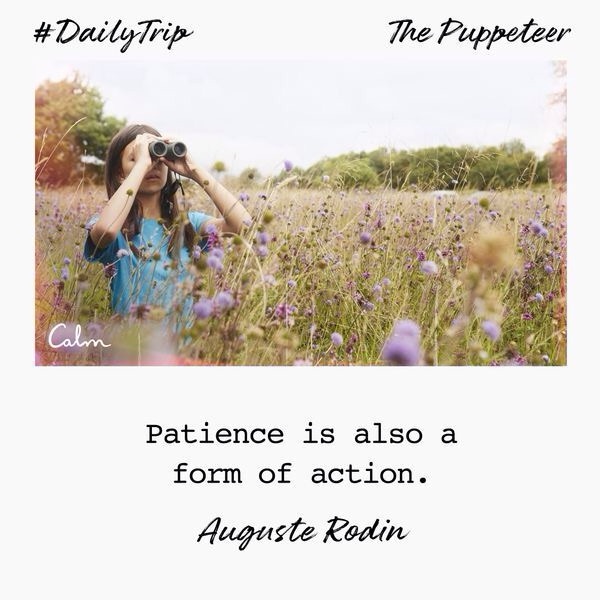
When should I be patient and when should I take action?

This can be a tough question for anyone at any level in life. I know it has been for me, at every stage of my life up to this point. I remember thinking that epiphanies brought about by consuming and then applying knowledge would be a permanent solution to this puzzle.

I suppose I’m old enough to possess the wisdom through experience to know that there is no such epiphany. I’ve had epiphanies. Did they create permanent change? No. Nothing does. Habitualized action creates permanent change. Anything else is snake oil.

“The two most powerful warriors are patience and time.” – Leo Tolstoy

Patience and action are practical examples and applications of yin and yang. Buddhist philosophy has been a big help for me in taking the pressure off of the choice between patience and proactivity.

Because it is natural to worry about being too patient just as it is normal to worry about taking too much action. Bringing mindfulness into my life helped to relieve some of the pressure that modern life puts on us to always be doing something exciting and interesting while simultaneously always relaxing in an exotic location vacation. And of course, making sure to document anything and everything one does in HD 4K photo and video, posted and reposted in portrait and landscape mode.

After suffering textbook burnout multiple times in my life, I overcalibrated towards patience. Buddhism, Taoism, and other spiritual philosophies that I studied lent themselves to patience and non-doing, which I felt I desperately needed at the time. Stoicism helped steer me back towards proactivity.

“Action without vision is blind; vision without action is just a dream.” – Nelson Mandela

I have found that Stoicism pairs well with Buddhism and Taoism. I would counsel people to consume all three in equal proportion. Stoicism helped teach me to take action and to do so boldly and consistently AND THEN to let go from there.

Detach from the outcome. Let go of how the action is received and perceived. 

That last part is a major missing piece from the good advice I received my entire life and hear/see being given to people these days by well-meaning folks. My experience has taught me that the majority of people are heavily tied up in the outcome of their actions. Not just entangled, but almost completely identified with their actions. 

That is also totally normal and natural. Aren’t we taught to believe that we are the result of our actions? Even if we aren’t taught that, isn’t there a consensus that a person’s identity is what they do? This is where spiritual philosophies and spiritual teachings fill in the hole I and many people feel inside of us when we’ve lived a life identified externally.

The teachings of Alan Watts, Ram Dass, Eckhart Tolle, and others provide empathy and compassion for myself and others in place of the default of judgment. The judgment of the patience, the judgment of the action, and the judgment of the results. Replacing all that judgment requires teaching and training because we live in a society that encourages and rewards judgment. 

Traditionally we have been our own worst critic. The modern era of the comment section has put negative judgment on steroids and placed it into a weapon of mass destruction with unlimited ammo.

“Empathy is about finding echoes of another person in yourself.” Mohsin Hamid

The scales of balancing patience and action are properly weighted with studying philosophy and spirituality.

Studying and applying the knowledge of these disciplines also helps to put an immeasurable, immaterial, internal balance on the scale in our very measurable, material, externally focused world. 

Before them, I was lost. I may not yet be found but I know I am at least on a path rather than walking alone and confused in the dark. 


“Man suffers only because he takes seriously what the gods made for fun. We seldom realize, for example, that our most private thoughts and emotions are not actually our own.” – Alan Watts

It is a lovely experience whenever I meet someone who hasn’t been conditioned to take everything and everyone so seriously. Do you know the type of person I’m talking about? Do you currently know people like that? Or do you have to access memories to think of that type of person?

It seems like more and more often I meet people who don’t have a sense of humor and who take everything and everyone as seriously as serious can. I know I fall into that trap as well, often in social situations. So I have empathy for the serious ones. I have been a very serious person for a good portion of my life and it was almost the death of me.

More than journaling or meditation, studying spirituality (starting at the peak of my agnostic/atheist phase) has helped me to lighten up and become more in touch and tune with the playful side of existence. First coming across, then diving right into the teachings of Wayne Dyer, Alan Watts, Eckhart Tolle, and Ram Dass introduced me to different perspectives that I desperately needed at the time and still need now in decisive moments and times of stress. 

I sometimes wonder if simply getting older would have made me take things less seriously. But then all I have to do is turn on the news during an election cycle in America and see how the masses drive themselves crazy taking themselves so seriously. Tens of millions of people have fallen into a “seriousness trap”.

We can fall into a “seriousness trap” by pledging allegiance to a political party, viewing it as a tribe destined to rule. This imbues the thoughts, opinions, and actions of not only the politicians but also their loyal followers (and even their enemies) with an inflated sense of immediate importance.

I used to be politically focused. I wanted to be a journalist so following politics was not optional for that desired career. Then, I dove deep into American economic history. The dispiriting realities of capitalism over the past century weren’t exactly inspiring. This, however, became a catalyst for my spiritual awakening. Two key takeaways from that part of my journey: the power of letting go and the joy of embracing life’s playful side.

“Mix a little foolishness with your serious plans. It is lovely to be silly at the right moment” – Horace

These aren’t just personal philosophies; they’re tools anyone can use. Regardless of background or beliefs, we can all benefit from loosening our grip and rediscovering the inherent fun of existence. Engaging in guided meditations and studying some of the spirituality teachers I’ve listed above are great places to begin your paradigm shift(s).