
Posts Tagged ‘life’

We’re not done until we’re dead.

Done with what?

Our life’s work.

What is our life’s work?

What we spend our time doing.

Time, the one thing we can’t get back regardless of how rich or poor we are.

It is normal to spend the majority of one’s life just trying to survive as long as possible.

Human, animal, plant…survival and replication is the name of the game, the purpose of life.

But things have changed for some people in some parts of the world depending on external factors completely outside of their control that determine whether or not they can devote their waking hours to doing something that has come to be known as…thriving.

Not just surviving, but thriving.

Not just living moment to moment, minute to minute, hour to hour, day to day, week to week, month to month, year to year. But something the privileged say is greater than just going on until we can’t go on anymore.

Something greater than doing what I am capable of doing to live to see another day? Wonderful! I’m in, sign me up, mark me down, I love it, I want it. This means my all my necessities will be provided for me so I can focus completely on thriving right? Right?

No, I am still completely responsible for my own survival. But now, I have to choose to find, cultivate, and expend from within me an entire new being’s worth of focus, energy, effort, determination, and consistency to dedicate my life to something greater? Even though I still have to devote the majority of my waking hours to doing what I am capable of doing to make sure I don’t die homeless, starving, and dehydrated?

Luckily we can choose what to focus on. We can choose how to perceive things. We can choose how to feel. We can choose how to act and what to do.

Not by default though. After all, we would be urinating and defecating where we sit or stand without being potty trained. So we have to learn the theories, concepts, skills, tools, practices, habits, rituals and routines to develop and improve ourselves gradually, over time, patiently into a better more actualized version of ourselves.

How many steps is that? How many choices is that? How many days is that? How many years is that? What is the cost of that? Why is it up to me to do all that? Shouldn’t they be teaching us those things in school? Shouldn’t that be paid training on how to live rather than pay to play?

Luckily we can choose what to focus on. We can choose how to perceive things. We can choose how to feel. We can choose how to act and what to do.

I suppose trying to be a better person is a better use of leisure time than watching tv. But what about people who don’t have leisure time?

That’s out of my control or ability to influence. The best thing I can do is focus on improving myself without negatively impacting others. No harm, no foul. Becoming a better version of myself may even end up having a positive effect on the people around me. That is certainly a good thing. To positively impact the people, places, and things around us.

It would be nice to know why we have to discover this on our own and do it on our own when in America we are forced to spend the first quarter of our lives being educated. Educated in what? For what? Now I have to spend the rest of my life learning and applying knowledge that will actually benefit me pragmatically?

I thought I was done learning. I thought one day I would be done working.

We’re not done until we’re dead.

Done with what?

Our life’s work.

What is our life’s work?

What we spend our time doing.

I found it to be a tangible sign of progression on my path that I stopped be as internally triggered by external reality not matching up with what I wanted, expected or hoped for.

Have a achieved zen? HA! We all need goals to chase.

Maybe it’s just part of growing older and accumulating more life experience that teaches us, whether we like it or not, that external reality is going to do what external reality is going to do and the best we can do is attempt to influence it then completely let go/detach from there.

I have gotten better at that.

There is a balance there too.

One can give up altogether. Stop trying.

Giving up control is good. Giving up altogether is bad.

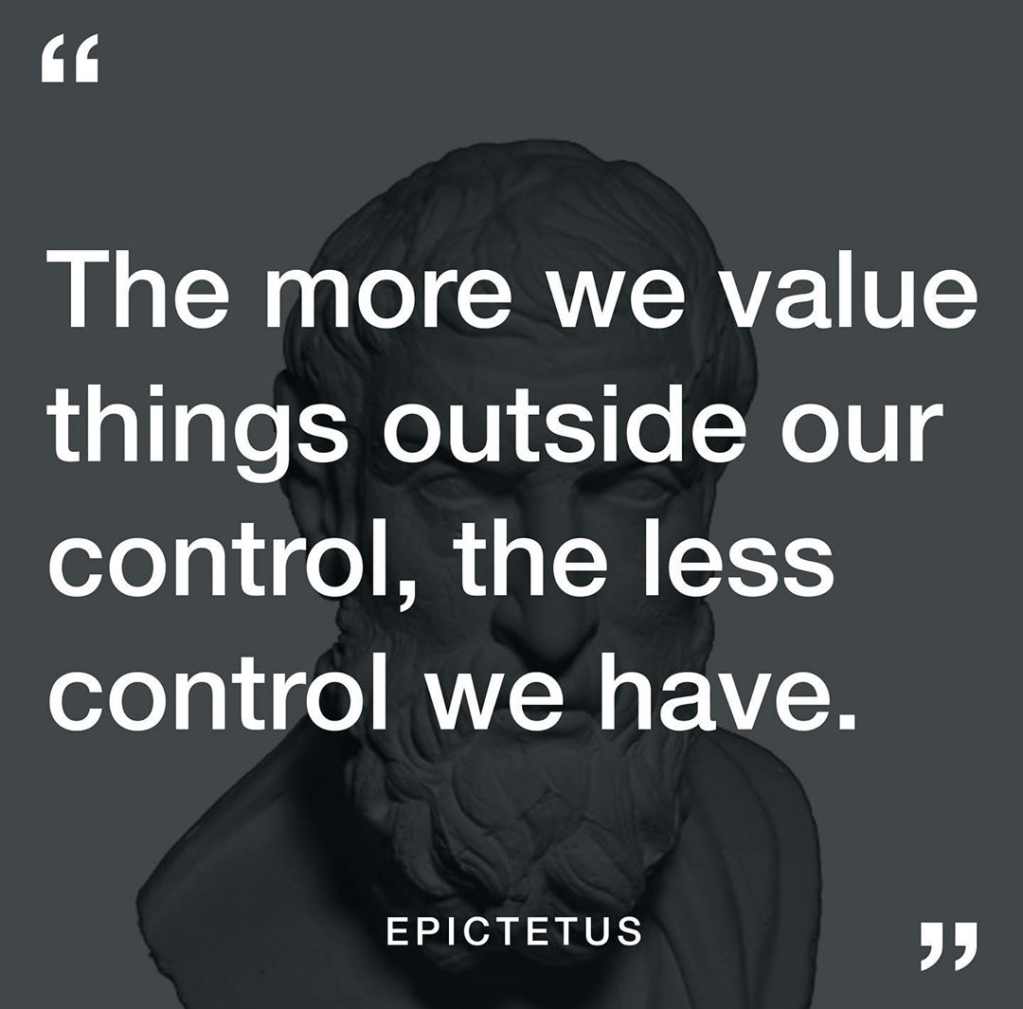
Identifying what is in our control and what is not is a pillar of stoicism. It is one of the things that initially drew me to the ancient philosophy that has helped so many people for so many thousands of years.

I remember in the depths of my depression turning to personal development/self help books. In my case, audiobooks. My education in America taught me to hate learning. I hated reading. I would learn to unlearn to paradigm of hating learning, slowly, over time. Renting audiobooks from my local library was a big step in that direction.

One of the first authors that drew my attention was the late great Stephen Covey and his iconic book The Seven Habits of Highly Effective People. A book I recommend to everyone that is capable of reading or listening to audiobooks.

More than his book were his speeches and interviews. Regardless of the material he preached, he had an amazing voice and a magnetic presence.

In his book and his talks he talked about two circles. The Circle of Control and the Circle of Concern. As one might guess, the circle of control is very small and the circle of concern is very big. Yet the attention we pay to each is often inversely proportional. I know it was for me when I first learned about the terms. I know that learning about those terms or any terms is in no way a cure all.

So it still takes constant effort over a decade and a half after first learning about what I have direct control over and what I have no control over. I’ve studied stoicism through reading, listening to podcast, and watching videos for almost a decade now. No one thing magically makes my shortcomings or predispositions disappear.

But I am as grateful or more grateful for the progress I’ve made in this area of my life than anything that has ever happened to me or anything I have ever done. Because putting my focus, energy, and effort towards things outside of my control has been a source of tremendous suffering for me. Life experience has shown me it is a great source of suffering for many if not most of the people I have ever met.

Meditation, stoicism, journaling, theanine, ashwaghanda have all helped me calm my mind, slow my thought streams down at least enough to realize I am in the witness and not a passenger.

Things happen.

I can choose to put my focus, energy, and effort into accomplishing a goal regardless of size or scope and then when I have done all that I am capable of doing to the best of my ability at that time…I can choose to let go and then I can choose to accept what is.

It is as it is…

Laughter is good for the soul.

Genuine, deep, belly laughter is the way to inner peace.

Not nervous laughter or polite laughter or doing the physical, literal equivalent of typing lol at the end of every line of a text message or DM.

Laughter that makes your whole body move…thats the good stuff.

ā€œa merry heart really does a spirit, soul and body good like medicineā€ Proverbs 17:22

It’s easy to forget how good laughter is for us. So easy, it’s natural.

During bouts of depression or even just a string of bad days, when something struck my funny bone it was like the parting of the Red Sea.

Living life makes us forget, laughter helps us to remember.

Real laughter has aftershocks like an earthquake.

Our breathing changes, our muscles tense then relax, we feel aligned and at peace. A temporary state of ecstasy we wish we could bottle and take on demand.

Real laughter bonds and creates memories with people and events.

It feels great, it’s spontaneous, unpredictable, unreproducible as much as we may want and may try. We try to replicate the experience early and often. But it’s different each time, a little less than the real thing.

We all wish we could capture it, bottle it, put it in a pill, pump it to our veins.

Laughter is pure. It’s a reflex. It’s involuntary.

It feels great…just lovely.

I just had a belly laugh that inspired me to write. I saw a clip online from something I used to watch as a kid. I laughed so hard if someone was walking on the sidewalk outside I’d be surprised if they couldn’t hear me.

I laughed so hard I started swearing for no reason.

I laughed so hard that a half hour later my body still felt different.

What a wonderful part of life. What a piece of simple, practical magic.

Let laughter be thy medicine, medicine thy laughter.

It can be hard to focus on what we can control or influence when we have a harder time distinguishing between the two. Generations raised on movies, television, and social media have been socially conditioned to have egos the size of the Grand Canyon.

It often takes some negative external event to pop or at least penetrate the illusion that we are the center of the universe, we are the main character surrounded by NPCs, and/or we can’t always get what we want, when we want it, how we want it.

ā€œThe world breaks everyone and afterward many are strong in the broken places. But those who will not break it kills.ā€ Ernest Hemingway – A Farewell to Arms

I know for me it is a regular battle of focusing on things I have no control over whatsoever, realizing it, and changing my focus to something more productive or beneficial. But nothing in life of substance is a one and done. No magic pills to take or magic wands to wave.

It’s human nature to focus on things outside of our immediate control in order to survive. What is going on in our environment around us is outside of our control. But how we maneuver within it to live to fight another day, is in our control. So we evolved with an outward focus rather than an inward focus.

So we constantly have to fight ourselves to prioritize what is pragmatic.

So much suffering comes from time and attention that turns into emotion spent on things completely outside of our control.

Equally or perhaps more frustrating for me has been the knowledge of this and still failing to execute properly. Identifying what is within my control, focusing on it, and still failing to take right action.

Awareness is the way out, but it still takes action to get there.

Recognizing and placing proportional value on what we directly have control over is necessary for peace of mind and quality of life.

Taking appropriate action consistently, habitually, that is a whole other ball of wax. But one can spend a lifetime chasing their own tail without the awareness of the difference between what we control and what we don’t.

One must take the time to genuinely think and write about this. I feel like with this issue deep thought and mediation are not enough. Our thoughts on this must be transcribed somehow to make a good faith attempt at attain wisdom here.

Luckily, choosing to make time, think deeply, meditate, write/journal, and reflection are all things we can control.

One thing at a time.

One choice at a time.

I think there is value there.

Is there a difference between societal norms and cultural norms?

Have either of those changed in the past generation (20 years)?

How about the past half century?

Living at home with one’s parents into adulthood used to be akin to the scarlet letter. At least for men. A forehead tattoo with a capital L for the child, and there parents.

Go to school, get a job, get married, have kids, retire, die…

Millennials and Gen Z went to school, more than any other generation in history. Millennials and Gen Z got jobs. Yet more of us are living at home with our parents than ever before.

Nearly half of adults under 30? That’s a lot of lazy freeloaders. Or is it something else?

Are the most educated generations of men and women in history failing the system or is the system failing them? Are they failing society or is society failing them? Are they failing culture or is culture failing them?

Wages hadn’t kept up with productivity for half a century before the pandemic and the historic aftershocks of inflation. How many mind fucks can developing brains take before they’re permanently fried?

Both my parents are dead, so I’m happy to hear so many people 18-29 have living parents that they can live with. But I have a feeling they would rather leave the nest if they didn’t have to choose between rent and eating.

An upside to living at home is that it gives more time for organizing.

The empirical data on this issue seems to keep moving in one direction. Capitalist bootlickers will gaslight and deny saying that unemployment and the stock market are doing better than ever. As if either of those things has anything to do with suffering and quality of life for actual human beings.

Every year, every election cycle, every generation the rank and file seem to be asked to take less, do more, have less, save more, enjoy less, suffer more, think less, feel less, be less so that those with the most can have that much more.

Is this sustainable? Is this ethical? Is this tolerable? Is this how it’s always been? Is this how it will always be?