Posts Tagged ‘society’


What happens when the most powerful institutions in society become experts at shaping attention itself?

For most of human history, power was relatively easy to recognize.

Kings controlled armies. Governments controlled laws. Corporations controlled resources. Media organizations controlled information. The centers of influence were visible.

Today, influence is becoming harder to see.

It arrives through recommendation engines, notifications, search results, personalized feeds, and algorithms that quietly decide what appears in front of us each day.

Glenn Greenwald famously argues that the greatest power of the state is not controlling what people think, but controlling the actual information they are allowed to see.

That distinction matters.

Most people imagine propaganda as something obvious—a government ministry, a state broadcaster, or a censor with a red pen. But modern influence rarely works that way. Instead, it emerges through systems designed to maximize engagement, collect behavioral data, and compete relentlessly for human attention.

The result is something new in human history: a world where billions of people interact daily with platforms that continuously study, predict, and increasingly shape human behavior.

Not necessarily because anyone designed a grand conspiracy. But because influence itself has become profitable. And profitable systems tend to expand.


The Most Valuable Commodity on Earth

Oil powered the industrial age. Data powers the digital age.

Every click, scroll, pause, search, purchase, and interaction leaves a trail behind. Individually, these actions seem insignificant. Collectively, they create a remarkably detailed portrait of who we are, what captures our attention, what triggers our emotions, and what keeps us engaged.

Consider what happens during a typical day. A smartphone records location data. A search engine records questions. An online retailer records purchases and browsing habits. Social media platforms record likes, shares, comments, watch time, and scrolling behavior.

Individually, these data points appear trivial. Together, they form a behavioral profile of extraordinary depth.

For the largest technology companies, this information has become one of the most valuable resources on Earth. The longer we stay engaged, the more advertisements can be shown. The more advertisements that can be shown, the more revenue can be generated.

At first glance, this appears to be a simple business model. But once engagement becomes the primary objective, the incentives begin to change. The goal is no longer merely to understand behavior. The goal becomes predicting it and eventually shaping it.


When the Experiment Was Real

For years, critics warned that social media platforms possessed extraordinary power to influence human behavior.

Then, in 2014, Facebook demonstrated it.

Researchers working with the company altered the news feeds of hundreds of thousands of users without their knowledge. Some users were shown slightly more positive content. Others were shown slightly more negative content. The objective was to determine whether changes in information exposure would influence emotional expression.

The results suggested they would.

Users exposed to more negative content tended to post more negatively themselves. Users exposed to more positive content tended to post more positively.

The study became controversial after it became public, largely because participants had not given informed consent. But the larger implication received less attention.

The significance was not that Facebook conducted the experiment. The significance was that Facebook possessed the capability to conduct it.

A platform used by hundreds of millions of people had demonstrated that adjusting information flows could produce measurable changes in behavior.

The experiment was small. The implications were enormous.


Behavioral Futures

In her work on surveillance capitalism, Shoshana Zuboff details how tech monopolies no longer merely predict human behavior but actively seek to modify it for corporate profit.

The Facebook experiment offered a glimpse into a much larger economic model.

For decades, businesses have studied consumer behavior to predict purchasing decisions. Digital platforms expanded that process dramatically. Every interaction became measurable. Every preference became data. Every behavior became another signal that could be collected, analyzed, and monetized.

Prediction gradually evolved into optimization. Optimization gradually evolved into influence.

Not because engineers necessarily wished to manipulate people, but because engagement was rewarded. The system followed the incentives placed before it. And over time, optimization itself became a form of behavioral engineering.


The Day the Curtain Moved

If Facebook’s emotional contagion experiment revealed the capability, Cambridge Analytica revealed the potential.

The scandal exploded into public view in 2018 after reports revealed that data from millions of Facebook users had been harvested and used to build psychological profiles. The controversy centered on elections. But elections were only part of the story.

The larger revelation was that modern digital platforms had created the infrastructure for highly personalized persuasion.

Different people could receive different messages. Different fears could be activated. Different motivations could be targeted.

Not at the level of demographics. At the level of individuals.

Cambridge Analytica did not invent these capabilities. It exposed them.

For many people, it was the first glimpse into a world where persuasion itself had become increasingly automated, data-driven, and personalized. The curtain moved just enough for the public to see the machinery behind it.


Manufacturing Reality

Tech ethicist Tristan Harris frequently warns that modern technology is no longer just competing for our attention; it is competing for absolute control over it.

That competition for attention shapes nearly every aspect of the modern digital experience.

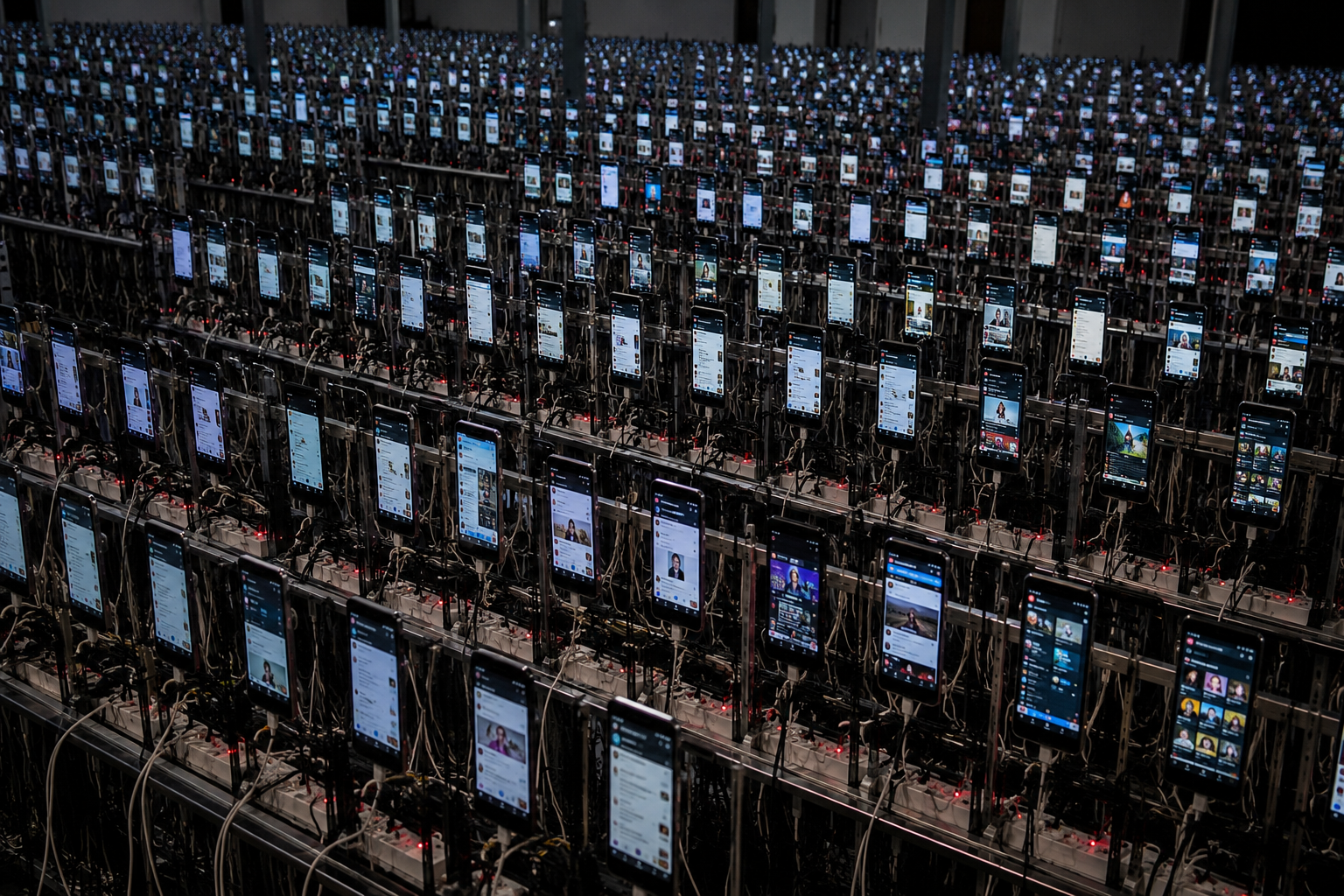
Consider TikTok’s recommendation engine. The platform became famous not because users carefully selected what they wanted to watch, but because the algorithm became exceptionally good at predicting what would hold attention. A few seconds of watch time, a pause, a replay, or a swipe can rapidly reshape the content that follows.

Within minutes, two people opening the same app for the first time may find themselves in entirely different information environments.

A similar dynamic has fueled years of debate around YouTube’s recommendation system. Researchers and former employees have questioned whether engagement-driven recommendations can gradually push users toward increasingly sensational content. The platform’s goal is straightforward: keep people watching.

Yet emotionally charged content often performs exceptionally well.

Conflict performs well. Outrage performs well.

The recommendation system may not intend to create polarization, but it can amplify polarization when polarization proves engaging. The result is not a single shared reality. It is millions of individualized realities.

Two people can open the same app at the same moment and encounter different headlines, different narratives, different fears, and different priorities. Both may believe they are seeing an accurate reflection of reality.

In truth, they are seeing a filtered version of reality assembled through algorithms designed to maximize engagement.


The Invisible Architecture

The Twitter Files reignited debates about censorship, content moderation, and government influence. Reasonable people continue to disagree about many of the conclusions.

But one observation emerged clearly: the modern information ecosystem is far more interconnected than most people realize.

Government agencies communicate with platforms. Researchers communicate with platforms. Journalists communicate with platforms. NGOs communicate with platforms. Political actors communicate with platforms.

Influence no longer flows through simple hierarchies. It flows through networks.

The public often imagines information control as a top-down process directed by a single institution. The reality appears considerably more complex.

Multiple actors, pursuing different objectives, interact within a sprawling ecosystem that helps determine which information gains visibility and which disappears from view.

No single organization controls the entire system. Yet the system itself remains extraordinarily powerful.

Because influence does not require centralized control. It only requires aligned incentives.


The Influence Ecosystem

Viewed individually, Facebook’s emotional contagion experiment, Cambridge Analytica, and the Twitter Files appear to be separate stories. Together, they reveal a broader pattern.

Facebook demonstrated that exposure to information can influence behavior.

Cambridge Analytica demonstrated that behavioral data can be used for highly personalized persuasion.

The Twitter Files demonstrated how networks of institutions increasingly shape information environments.

Consider how most people now experience major events. Elections, wars, public health emergencies, and social movements increasingly arrive through algorithmically ranked feeds rather than direct observation. Most people encounter reality through recommendations, trending topics, suggested videos, and curated posts.

The information may be accurate, inaccurate, or somewhere in between. But the experience is increasingly mediated. Three separate stories. One emerging reality.

Attention has become a strategic resource. And the institutions that understand it best possess extraordinary influence over public perception.


The New Architecture of Power

“The smart way to keep people passive and obedient is to strictly limit the spectrum of acceptable opinion, but allow very lively debate within that spectrum…” – Noam Chomsky

For much of history, accomplishing that required editors, gatekeepers, and institutions.

Today, portions of the process can be automated. Not through conspiracy. Not through ideology. But through optimization.

Algorithms shape visibility. Visibility shapes attention. Attention shapes belief. Belief shapes behavior. Behavior shapes history.

Previous generations worried about who owned the factories. Today, we may need to ask who owns the systems that shape perception itself. Because power no longer depends solely on controlling land, resources, or industry. Increasingly, power belongs to those who can guide attention.

And in an age of influence machines, attention may be the most valuable form of power ever created.


The system breaks us, then sells us pills.

They tell us it’s a personal failing. That anxiety is a chemical imbalance. That depression is a genetic curse. That burnout is solved with resilience. But look around: the conditions that feed this crisis are man-made.

“Doctors … argue that chronic stress, stemming from social problems such as financial distress, racism, and poor working conditions, is a key driver of mental health issues.”The Guardian


We work longer hours for less pay. We doomscroll through endless cycles of bad news and empty distraction. We spend more time isolated in front of glowing screens than in human connection. The pressure is relentless—engineered to keep us consuming, competing, and collapsing.

“About one in four American adults suffers from a diagnosable mental disorder in a given year, and one in ten will suffer from a depressive illness, such as major depression or bipolar disorder.”Johns Hopkins–derived data


And just when we break, they offer us a fix. Not by changing the system—but by medicalizing our despair. Big Pharma has turned misery into a trillion-dollar market. Antidepressant prescriptions keep climbing. ADHD meds are at record highs. Anti-anxiety pills sell like candy. And yet, rates of suicide, loneliness, and mental illness are higher than ever.

“In 2020, 20.3% of adults had received any mental-health treatment in the past 12 months, including 16.5% who had taken prescription medication for their mental health.”CDC

“Today, a full fourth of U.S. women are on antidepressants.”KevinMD / Harvard Health


This isn’t healing—it’s management. Profitable management. The more the machine grinds us down, the more pills they can sell us to function well enough to keep serving the machine. It’s a cycle of extraction: from our labor, our attention, and now our very psychology.

“The monthly antidepressant dispensing rate for females ages 12–17 surged 129.6% from March 2020 onward compared with beforehand.”University of Michigan study in Pediatrics


None of this denies that meds can help. But let’s be clear: the crisis isn’t random. It’s not just “in our heads.” It’s the direct product of an economy built on overwork, digital isolation, and engineered anxiety. A society where meaning is stripped down to productivity, and hope is marketed back to us in capsules.

“Despite a significant rise in mental-health awareness and treatment … mental-health conditions are worsening. Suicide rates have increased by 30% since 2000, and nearly one-third of adults report symptoms of depression or anxiety.”Time

“Between 1999 and 2022, antidepressant-related overdose deaths climbed; in 2022, there were 5,863 overdoses—comparable to heroin overdose deaths that same year.”The Guardian


The mental health crisis wasn’t an accident. It was manufactured. And the ones cashing in are the same ones who built the conditions that broke us.

Wisdom is Resistance. Truth Over Tribalism.


How manufactured distraction masks elite power grabs


“The most potent weapon in the hands of the oppressor is the mind of the oppressed.” — Steve Biko


We’re not fighting each other.

We’re being told we are.

While billionaires rig markets, write laws, and extract more than ever before, we’re fed a diet of distraction: who wore what, who said what, who to cancel, who to worship.
Culture wars and celebrity scandals dominate the headlines. Political rage becomes entertainment. Reality is replaced with performance.

Meanwhile, real decisions get made in rooms we’re not in.


Distraction is strategy.

Bread and circuses is policy.

The phrase comes from ancient Rome. Give the people food and entertainment, and they’ll ignore the empire crumbling around them.
Today’s version isn’t lions and gladiators. It’s 24/7 news cycles, viral beef, televised outrage, algorithmic dopamine, and the myth that “both sides” are the problem.

But both sides serve the same class.
The one you’re not in.


“The purpose of the modern media is to make the public passive and distracted, not informed and engaged.” – Glenn Greenwald


Who benefits from distraction?

Follow the money.

Culture wars don’t threaten capital.
They serve it.
If we’re busy hating each other, we’re not organizing. If we’re bickering about bathrooms, we’re not taxing billionaires. If we’re glued to gossip, we’re not watching the war profiteers, the surveillance state, or the bought politicians signing our futures away.

Distraction is not a side effect. It’s the point.


Manufactured chaos is cover.

Power prefers shadows.

The more noise, the less clarity.
The more conflict, the less unity.
The more fear, the more control.

Every celebrity trial, every TikTok feud, every political theater act keeps us from looking up. Keeps us consuming, not questioning. Arguing, not organizing.


“The press is not a watchdog. It’s a tool used by the powerful to manage public opinion.” – Matt Taibbi


We don’t need more sides.

We need more sight.

Start with the question: Who does this serve?
When the story goes viral, when the talking heads scream, when the rage is addictive—ask it again:
Who benefits from our attention being here?
Because the real theft isn’t always money.
Sometimes, it’s focus.


“You are being made to focus on the sideshow, while the tent burns down.” – Edward Snowden


anarchyjc.com // Truth over tribalism.
@anarchyroll_ on TikTok | @anarchyroll on Threads, X, IG, and Bluesky

I love weight training. It is one of three things I recommend to every human being. It is one of the things I love that is actually good for me.

Weight training has positively impacted my life as much or more than any other external concept I’ve encountered while I’ve been alive. I’ve been regularly weight training for two thirds of my life now.

I don’t plan on stopping. All physical exercise is a marathon, not a sprint. Weight training is not something one does for a season, it is something one does for life.

Every year that goes by more and more scientific studies come out showing greater and greater benefits of weight training. Broader benefits and deeper benefits. Physical benefits, mental benefits and social/emotional benefits. Benefits for children and benefits for the elderly. Benefits for living longer and benefits for living a higher quality of life.

There has been and will continue to be resistance to weight training because of it being intertwined with bodybuilding. Male bodybuilders are to weight training as female instagram influencers are to yoga pants. They go hand in hand but only represent the egomaniacal extremes of the user base.

Most people want to exercise and benefit from weight training for practical health benefits. Not because they are seeking external validation from strangers via their smartphone to compensate for an internal lack.

For every fitness influencer covered in athleisure shape ware from head to toe while they photoshop their selfies, there are 10,000 people who would benefit from going to their local gym, a few times per week, to see and feel tangible physical benefits of exercise, surprisingly quickly.

Warm up, lift some weights that challenge their effort and comfort level, do some cardio, stretch, cool down, go home, shower, and eat. Anything beyond that moves into intermediate and beyond which one can find infinite information on in the growing podcast and youtube fitness video sphere.

Weight training helped me in the deepest, darkest times in my life. From depression, to burn out, to grieving the deaths of both of my parents. It helped me to feel good, feel challenged, feel accomplished, feel pride, feel growth. I wish that for every person I meet which is why I recommend it to everyone regardless of demographic or type.

Weight training also makes for great analogies and metaphors. Meditation, another thing I universally recommend, has been called doing bicep curls for the brain. Seeking general challenges and discomfort has been called weight training for life.

More weight training for all and more weight training metaphors please.

Notice how I am yet to bring up aesthetics. Except to poke at the social media narcissists who use perceived visual fitness achievement as a fix for their addiction to attention. Aesthetics is a by product of weight training and exercise in general.

Exercising for aesthetics can be a path the dark side of the fitness world. See fit fluencers and steroid abusers. People who are chemically and surgically enhanced, making a living, by living and lie. Lying to anyone and everyone, including themselves, that their aesthetics can be achieved with discipline, consistency, and whatever products they are selling.

I’ve had multiple IFBB pros tell me when it comes to who is on gear/has had cosmetic surgery vs naturals; muscle mass volume to body fat percentage never lies, ever.

So use common sense, although I’m not so sure how common that is anymore.

But common sense would dictate all humans engage in some form of physical exercise unless they spend their days engaging in physical labor for the job/career.

Use it or lose it. That applies to your body and your mind. Physical and mental ailments and deterioration are often brought about by physical and mental inactivity. The happiest and most spry elderly are the most active. The saddest and slowest youths are the most sedentary. Use it or lost it.

More weight training for all and more weight training metaphors please.

We’re not done until we’re dead.

Done with what?

Our life’s work.

What is our life’s work?

What we spend our time doing.

Time, the one thing we can’t get back regardless of how rich or poor we are.

It is normal to spend the majority of one’s life just trying to survive as long as possible.

Human, animal, plant…survival and replication is the name of the game, the purpose of life.

But things have changed for some people in some parts of the world depending on external factors completely outside of their control that determine whether or not they can devote their waking hours to doing something that has come to be known as…thriving.

Not just surviving, but thriving.

Not just living moment to moment, minute to minute, hour to hour, day to day, week to week, month to month, year to year. But something the privileged say is greater than just going on until we can’t go on anymore.

Something greater than doing what I am capable of doing to live to see another day? Wonderful! I’m in, sign me up, mark me down, I love it, I want it. This means my all my necessities will be provided for me so I can focus completely on thriving right? Right?

No, I am still completely responsible for my own survival. But now, I have to choose to find, cultivate, and expend from within me an entire new being’s worth of focus, energy, effort, determination, and consistency to dedicate my life to something greater? Even though I still have to devote the majority of my waking hours to doing what I am capable of doing to make sure I don’t die homeless, starving, and dehydrated?

Luckily we can choose what to focus on. We can choose how to perceive things. We can choose how to feel. We can choose how to act and what to do.

Not by default though. After all, we would be urinating and defecating where we sit or stand without being potty trained. So we have to learn the theories, concepts, skills, tools, practices, habits, rituals and routines to develop and improve ourselves gradually, over time, patiently into a better more actualized version of ourselves.

How many steps is that? How many choices is that? How many days is that? How many years is that? What is the cost of that? Why is it up to me to do all that? Shouldn’t they be teaching us those things in school? Shouldn’t that be paid training on how to live rather than pay to play?

Luckily we can choose what to focus on. We can choose how to perceive things. We can choose how to feel. We can choose how to act and what to do.

I suppose trying to be a better person is a better use of leisure time than watching tv. But what about people who don’t have leisure time?

That’s out of my control or ability to influence. The best thing I can do is focus on improving myself without negatively impacting others. No harm, no foul. Becoming a better version of myself may even end up having a positive effect on the people around me. That is certainly a good thing. To positively impact the people, places, and things around us.

It would be nice to know why we have to discover this on our own and do it on our own when in America we are forced to spend the first quarter of our lives being educated. Educated in what? For what? Now I have to spend the rest of my life learning and applying knowledge that will actually benefit me pragmatically?

I thought I was done learning. I thought one day I would be done working.

We’re not done until we’re dead.

Done with what?

Our life’s work.

What is our life’s work?

What we spend our time doing.