Posts Tagged ‘personal development’

Control. It’s human nature to want to control things. It makes us feel safe. It makes us feel powerful. It makes us feel better. Certainly better than feeling in danger, weak, or confused.

We seem to want more and more control as time goes on. Our institutions want more control over its citizenry. Every year there seems to be more and more attempts at censorship on social media. Always for the greater good right?

The road to hell is paved with good intentions.

We have so little control over what happens to us and around us, to really think about it is scary. That’s why it’s so much easier for the masses to not think about it. Not only do we not think about it, we deny it. We deny it and try to force control on the external world and ourselves. Always for the greater good right?

The road to hell is paved with good intentions.

Trying to turn the world into an ever expanding safe space is as misguided as it is wasteful.

It is hard, if not impossible to accept how little of our lives we actually control without some kind of philosophy or spirituality practice, or in my case, both. Stoic philosophy and the spiritual teachings of Alan Watts have been tremendously helpful for me in letting go.

Focusing on what I can control, letting go of what I can’t.

Easier said than done of course, just like everything else in life.

My mind seems to drift into mental movies about possible future events and possible future outcomes that stir up my emotions with the velocity of a jet engine. I was never taught to think like that, or feel like that. Not directly, I suppose. So where does that way of thinking and feeling come from?

I’ve lived enough life, met enough people, to know that not only am I not alone in that way of thinking and feeling but that way of thinking and feeling is the norm.

I’ve also lived long enough to know that what is considered normal is insane.

Insanity wrapped in social acceptability.

Studying stoic philosophy, listening to Alan Watt’s speeches (preferably with some video playing to compliment his words) helps calm my mind with perspective, and ease my emotions with wisdom. Breaking vicious circles inherited through nature and nurture, and in a way, restoring child like ease and wonder towards life and the world…until the next challenge presents itself. And those don’t take too long to show up. If we’re alive, we’re facing challenges.

Anxiety comes about because we want to control the uncontrollable. We would prefer to not have challenges but that is not how life operates so we get anxious about it. And why wouldn’t we? Did we ask to be born? Did we ask for a series of never ending challenges sporadically spaced out from the time we are born until the time we die? Absolutely not. Who would?

At least we are fortunate enough to be alive at a time when the knowledge and wisdom of the greatest thinkers in the history of the world is so accessible with such little effort. So we have to tools to better address our so called problems.

It is natural to forget. It is natural to be anxious. Philosophy and spirituality practices help us to remember.

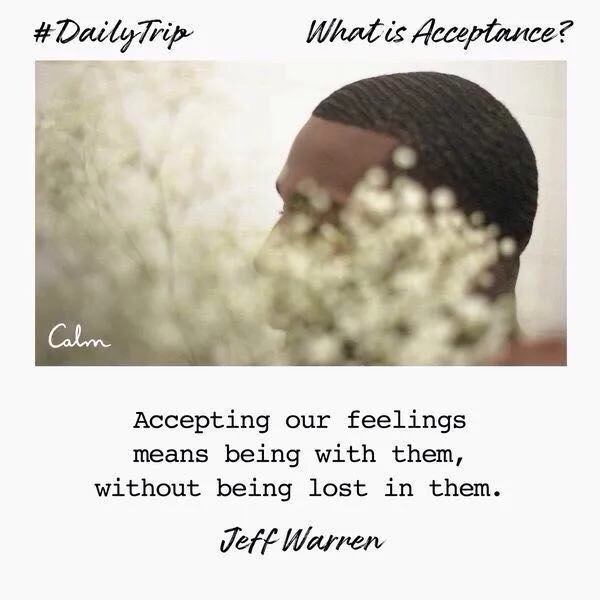
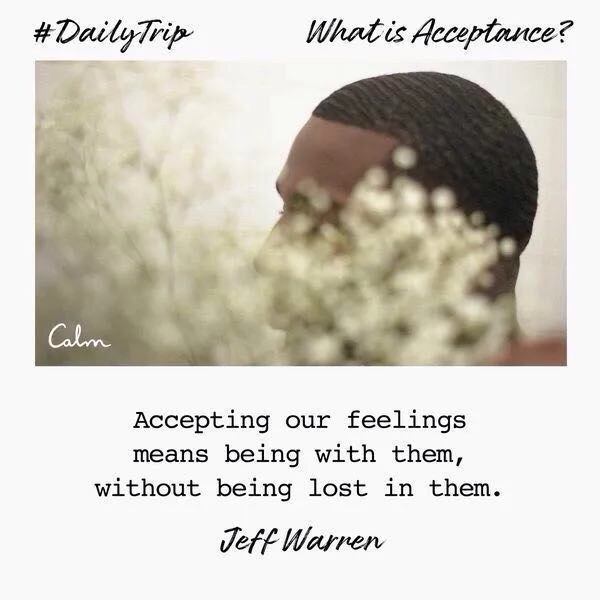
It’s already hard to not identify with our emotions, without our culture ruthlessly exploiting our emotions perpetually professionally.

We’re never taught that we are not our thoughts, we are not our emotions. It’s usually the opposite or taught nothing at all. Figure it out as you go. On the job training. Job in this case being…being.

I’ve been meditating for over ten years, I’ve been studying spirituality for longer, journaling longer than that. I’ve been regularly studying stoicism seven years, started studying other philosophies on a regular basis four years ago…and negative emotions can still take me for a ride like a teenager in puberty.

Life may be simple, but easy? I don’t know about that one. The older I get, the more experiences I have, the more people I meet, it seems like living is hard.

If one were to say life is easy, they would at least agree that our emotions don’t add to the simplicity or ease of life. I feel confident in the determination that it is our emotions that are the primary sources of many of the difficulties and complexities of our collective and individual existence.

Are the things that happen to us hard and complex, or is it our emotional reactions that make them so?

Are the events of our life hard and complex, or is it our thoughts that make them so?

Detaching those two questions from spirituality teachers and gurus is worthwhile for all secular types. To be honest, most religious people I know would be wise to ask those questions regularly. I need to ask myself those questions more often, and I already had a couple of instances this week where I was asking myself those questions repeatedly.

Breathing, following the breath with our attention, walking, stretching, laughing can all help detach ourselves from the grip of our thinking mind and emotional reactions.

No one things is gonna make us go from A to Zen as if a magic wand was waved in front of our face.

But awareness is the way out.

It’s not just easy to get lost in our thoughts and emotions, it’s normal…it’s natural.

And if it was normal for us to get lost in productive thought streams and positive emotional reactions, then we’d be living in a utopia…and have you seen the news lately?

It’s natural to want to be externally successful at what we do.

In the era of social media, that desire is exploited and gaslit at historic levels

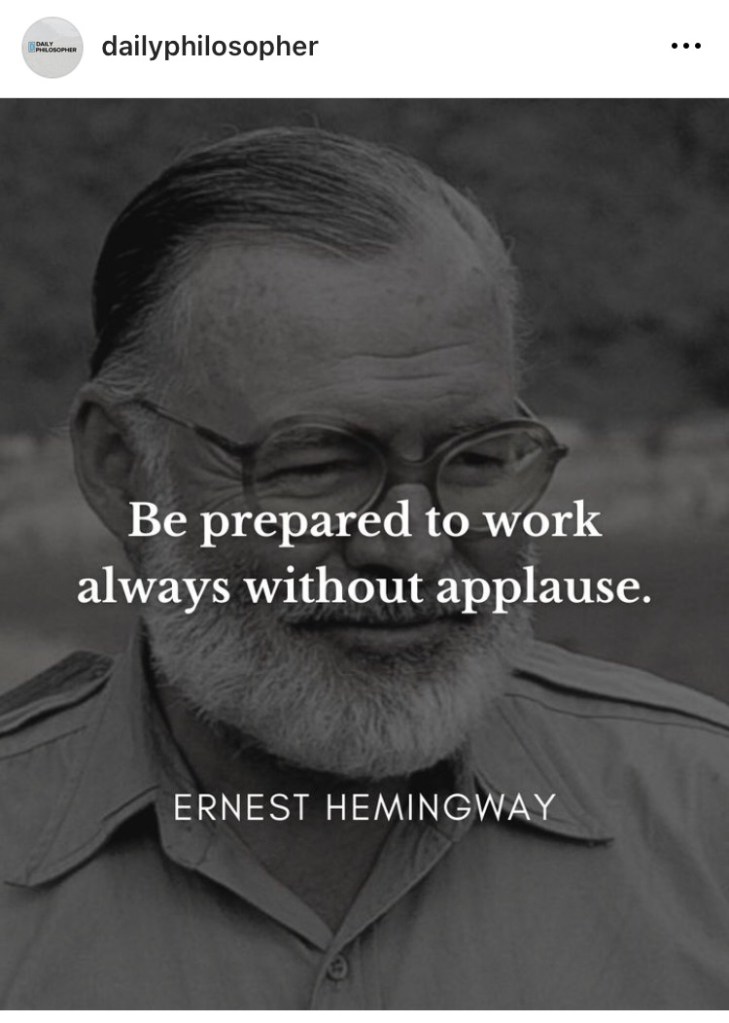
I find the Hemingway quote, “be prepared to work always without applause” to be as close to the perfect piece of life advice as there is. It’s not negative. It’s not cynical. It’s honest. It’s fair. It’s objective. It’s true.

I’ve also always liked the term passion project.

Doing creative/artistic work is hard and there is no objective standard of quality.

Personal taste is not up for debate.

So how do we know if we’re good? How do we know if we’re successful? How do we know if we’re on the right path? Capitalist controlled cultures would point to money, fame, influence, clout, etc. Does that mean those are the only good creatives?

Perfectionism is the trap we put ourselves in to shield from external judgement. Not only from external criticism but from external success, and lack thereof.

If we’re creating from our ego, we need the success. It’s not about the work, it’s about the result. It’s not about the journey, it’s about the destination. It’s not about the depth, it’s about the shallow features. It’s not about what’s real, it’s about the facade. It’s not about originality, it’s about clap trap zeitgeist.

Get those numbers up, so they can be used as a pillars of humble brags and how to listicles. How can I monetize this? Monetize what? ANYTHING! EVERYTHING!

The work is the win. Creating is the purpose. It’s so much better when we come from that place. Because then we’re not chasing. We’re not selling. We’re creating. We’re contributing. We’re being authentic. We’re being real. We are being.

Like sweat in our eyes, water in our ears, oil on our skin.

How much of what we think and perceive about ourselves internally and the external world are beneficial vs detrimental?

This was something I asked myself a lot last year. At the time I was using the terms productive vs counter productive. I found myself asking how much of my thoughts, perceptions, feelings, and actions were/are productive vs counter productive?

It’s a question we all need to ask ourselves. The data on depression, anxiety, stress, negativity, mental health, etc all keeps going in the wrong direction. I personally believe much of that has to do with late stage capitalism and being forced to participate regardless of our physical, mental, or emotional health.

That is an external reason. Internally however, we do need to take responsibility for our the way we think, perceive, feel, and act. At least at a 51/49 split.

I’m still doing the work of changing myself for the better based on my own standards, my own goals, and what works for me. It came as a surprise, whether it should have or not, that I was not doing what works for me in multiple areas of my life.

We all have our issues. We all have experienced trauma. The world breaks everybody. But I found myself day after day, noticing detrimental habits of thought, perception, and action. And when I would think; “why am I like this” or “why do I do this?” The answer has yet to be one of external blame. The answer has also yet to be a singular thing.

It’s layers of emotional reactivity to events, situations, and challenges that I developed unconscious responses to. A stimulus happened and I reacted unconsciously and built layers of detrimental thoughts, perceptions, feelings, and actions as my response(s).

I dug a hole for myself. I fell underwater. I got lost in darkness.

Meditation, journaling, philosophy have all helped me little by little to dig out, swim to the shore, and walk towards the light.

Little by little, day by day, one choice at a time.

Then a slip up happens. A mistake repeated. Then comes the challenge of not beating myself further down into the hole underwater in the darkness. The habit of making a bad situation worse with negative emotional reactivity.

The habit of having a detrimental perception of myself. That for me has been maybe the most consistent challenge. That was the eye opener. How much of my self talk was negative. How I was my own worst enemy and critic.

And why? For doing what? I wasn’t hurting anyone else. I wasn’t causing harm or misfortune to bystanders or people in my life. But I would berate myself like I was being paid handsomely to do it. Why?

The habit of negative emotional reactivity. Unconscious negative reactions to minor situations. Making a mountain out of a molehill. Detrimental perceptions.

Cultivating the space between stimulus and response with meditation, journaling, philosophy, and spirituality practices has been the yin to the aforementioned yang. The white to the black. The silence to the sound. The beneficial to the detrimental.

Live long enough and you’ll eventually ask yourself internally or out loud; “Why am I like this?”

The rational answer sans emotional baggage and personal history is…habits.

We are a product of our habits. Habits being repeated actions. Our most repeated actions. We are what we repeatedly do, without exception.

Habits by their nature, are unconscious. The purpose of forming habits is to be able to do them with minimal or no thought. That’s how they stick for better AND for worse.

New Years Resolutions are the most popular, socially accepted, tradition of bringing conscious awareness to our habits. For the first couple of weeks every year people become aware of and focus on their eating habits, drinking habits, social habits, exercise habits, leisure time habits, relationship habits, etc.

It’s also a meme that people drop off of their resolutions within days or maybe weeks the beginning of the new year. Planet Fitness’ profitability is dependent on people signing up, dropping off, but not canceling their membership.

However the act of the new years resolution is a proper formula for change. At least for the beginning portion of change. One can’t change without being aware change is needed. Again, habits are by their nature unconscious. We have to bring awareness to our habits to change them for better AND for worse.

Our lives aren’t just dominated by our habits, our lives are our habits. Whatever our individual life constitutes as normal is made normal by the habitual actions we take every hour of everyday or every week of every month of every year of our lives.

Awareness is the way out. I know I’ve had to spend a lot of mental energy on building new habits in pretty much every area of my life. Naturally there was/is emotional baggage attached to them. We’re all human beings after all. We’re not productivity or efficiency machines no matter how much capitalism wants us to be.

It’s a marathon not a sprint.

Some of the new years resolutions I stuck to last year, literally didn’t become habitualized until December. Because habits don’t form in a couple of days or a couple of weeks no matter how impatient we may be.

We may have to work to make a living but our life’s work is the work of making our life. As long as we’re alive, we can dedicate the time, energy, focus, and consistency to improving our lives based on our own criteria for what brings us consistent joy and fulfillment. And we can’t do that unconsciously with one off actions.