Posts Tagged ‘psychology’

Compassion can be hard to give and confusing to receive.

Experiencing suffering, to me, is the spiritual equivalent of eating our green vegetables. The trauma that can be associated with the suffering is what makes us feel unworthy of empathy or compassion.

I am grateful for the suffering I have experienced in my life. I know that it has added value through giving me grit, toughness, endurance, patience, perspective and the wisdom that comes from living a life with the previously listed traits.

The traumatic experiences I’ve gone through, I’m not so sure I’m ready to be grateful for those yet. I’ll need more meditation, journaling sessions, help and life experiences before that gratitude comes around, if it does.

But the suffering, that really has helped me. I really am grateful for the suffering I have experienced. Getting to the other side of it and looking back on the trials by fire, molded me beneficially. Certainly for survival, for thriving, well maybe not so much. A hardened edge with layers of empathy and compassion is preferable to walking around as an open wound.

Because of suffering; I’m much more grateful for the self compassion I give myself in dark times, and exponentially more grateful to others, who extend empathy and compassion to me in trying times. People that give empathy and compassion are the real ones and in my experience are few and far between. Those are the ones to keep close and prioritize relationship nurturing.

The suffering I have experienced has made me empathetic to the suffering of others. When I see suffering written on people’s faces while they try to go about their lives and maintain normalcy and sanity, as I have, I gain instant respect for their strength and courage. It takes monumental strength and courage just to keep the train on the tracks sometimes.

Giving ourselves, and others compassion is a zero cost gesture with infinite reward. To feel a token tinge of love and appreciation in the world eases the burden of existence.

Compassion is love adjacent, and we all need more love. Compassion, empathy, love are real and we all need more real. Because real is hard, fake is easy. Indifference, harshness, and hate are easy. The strength it takes to be vulnerable and understanding to the pain and confusion experienced by ourself and others is as remarkable as it is immeasurable.

And we need more remarkable and immeasurable in this world almost as much as we need more love and understanding almost as much as we need more empathy and compassion.

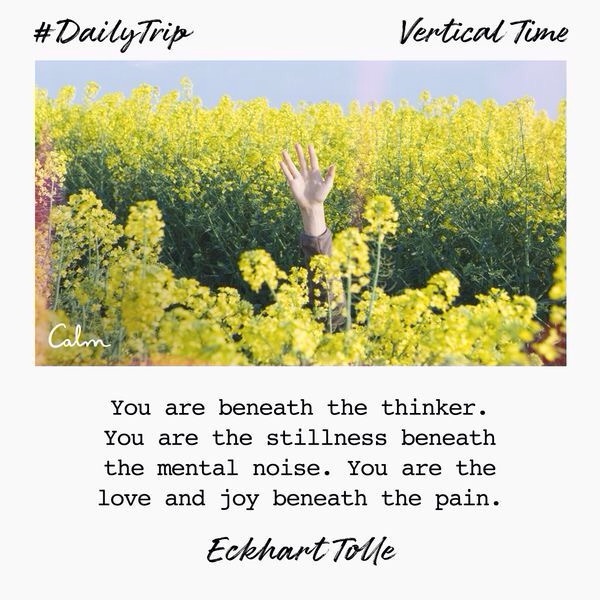
We’re so conditioned to believe that we are what we think.

That who we are is our mind, our thoughts, our emotions.

Even if we aren’t taught that by our; culture, our schools, our families, our communities; and we are; it is natural to assume that. The voice in our head. The streams of thoughts and perceptions and feelings must be who we are. If not that, then what?

What does it mean to be a human being?

If we are our thoughts, our mind, then how does our hair know to grow? How does our heart know to beat? How do our lungs know to breathe? We’re not consciously doing any of that or any of the million other things that our body does on auto pilot. Try to stop breathing and see what happens.

If we are our mind then what does that mean about our dreams?

Bad thoughts and negative emotions are a normal occurrence, but if we have a certain amount of both does that mean we’re a bad person?

It was a wonderful and liberating experience when I learned that we are not our thoughts, that we are the being or the state of consciousness that recognizes our thoughts and emotions. I came across this concept from Eckhart Tolle. He isn’t the first or the last spirituality philosopher, he’s simply the one who’s message resonated and stuck with me for almost two decades now.

Wonderful and liberating, but not a miracle cure for all my ills. No such thing unfortunately. But to even get a sliver of space between by thoughts/emotions and my reaction to them was like coming up for air after almost drowning at sea.

Learning about something doesn’t equal mastery. One can know something beneficial but still do the opposite, detrimental action out of habit. I think that’s the norm actually. It certainly has been for me on my spiritual path and personal development journey.

However, it is a big help on the bad days to know that the negative thoughts are happening to me and not from me or because of me. Couple that with the classic advice of; this too shall pass, and you’ve got a one two punch to get through the tough times just a smidge easier than before.

A meditation practice helps me process and incorporate self improvement knowledge better than just passive information consumption. A journaling practice helps me embed the personal development knowledge even further. Yet I still have much work to do, many miles to go. At times, I’m still a dog chasing it’s tail.

But we all have to walk our own path. Eckhart’s teaching help take some of the self imposed pressure off, as well as the pressure our cultures forces upon us. The pressure of more more more. Do more, say more, take more, buy more.

Our culture gives us a lot to think about. Information overload is the fitting term for it. Information overload is the expressway to burnout. I’ve had textbook burnout a few times in my life. Each time it was Eckhart’s teachings that helped me find my way back to myself.

What is myself? Who am I? What was I finding my way back to? My thoughts? My emotions? My perceptions? My past? My life situation? No, none of those things.

Then who am I? How did I find myself?

By cultivating my inner awareness and spaciousness. Those are the portals to connecting with our essence, our being. We’re human beings. We’re being human.

By getting still, silent, paying attention to one’s breath or inner energy field in specific areas of the body; we can connect with our consciousness, our essence, our being.

I am so happy and grateful that I was able to realize what I am and connect with it. I still aspire to connect with my true self more frequently as thoughts, perceptions, and emotions still swallow me up from time to time. But practice makes progress. And if there’s one things I’m not getting tired of practicing, it’s remembering that I am not my thoughts and emotions, I am the awareness that witnesses them.

Namaste

Is anything universal or is it all relative?

The more life experience I accrue the more I find things to be relative. No two people experience the world the same way after all.

The closest thing I’ve found to a universal positive is gratitude. Gratitude meditations, gratitude affirmations, gratitude expression, all seem to have a net positive for myself and many others for many centuries.

I think why gratitude is universal is because it is pragmatic. Being grateful for one thing doesn’t mean we have to be grateful for everything. And all living beings have at least one thing to be grateful for.

Expressing gratitude either internally or externally or both can be a useful aide to stop the bleeding when the external challenges of life metaphorically cut us on on an artery. Does expressing gratitude make our challenges or problems go away? Of course not. Does expressing gratitude make anything worse? Of course not.

Even an insincere expression of gratitude is better than no gratitude. Bringing one’s attention into the present moment to offer fake gratitude for something will even for a moment take one’s mind off a negative situation. Shifting attention and perception is often a first step to handling a challenging situation.

I know for me I need to express gratitude constantly. I have reminders on my phone and sticky notes in my bedroom about gratitude. My favorite guided meditation sessions are often about gratitude. I’ve had detrimental habits of thought, perception, and emotion. Gratitude is a beneficial habit that I can pepper in when the going gets tough and I need to get going.

Does gratitude drastically make everything better? Well, is ice cream only good with toppings? No, but it can make a good thing even better and can make something that sucks a lot suck a little less.

In the midst of hard times and dark days, finding something simple, and super basic to be grateful for can be a needed break and bright spot. I know gratitude has at least helped me at least little bit while suffering. Then when I’ve gotten to the other side of suffering the gratitude is that much greater.

For one to think there is nothing to be grateful for is a classic cry for help. Which is another reason why gratitude makes everything better. One may be blind to their situation until they hear themselves say out loud they have nothing to be grateful for. Gratitude serves as a wonderful metaphorical mirror for all of us.

For one to have an abundance of things to be grateful for is a great way to start the day. Better than starting the day with the alternative perception. Easier to remember all the things one has to be grateful for after morning coffee in my experience.

Keeping gratitude in mind throughout the day, when dealing with the external world is why I have reminders and very much need them. Also why I still use guided meditations as the anchor of my practice despite being a regular meditation practitioner for over a decade. Gratitude serves as both an ideal anchor and springboard.

A multi purpose, multi faceted metaphysical tool available at all times for all people. Gratitude makes everything better.

One thought at a time

One choice at a time

One action at a time

One thing at a time

I am grateful.

The perception of peace coupled with passivity seems as natural as peanut better going with jelly and peas with carrots. I find that the balance I am looking for internally and externally is a combination of peace and proactivity.

To be in a peaceful state, in my experience, lends itself to being laid back, chill, and just letting things happen. But that’s a trap. It’s better than the combination of inner and outer turmoil. That combination is a one way ticket to a medical facility.

Aspiring for pragmatic balance between inner peace and external proactivity is a personal development example of why our life’s work is never done until we’re dead. For years and years I would over correct from one end of the extreme to the other. Too busy to too lazy, to hectic to too peaceful, too aggressive to too passive.

Is it ever just right or is that for fairy tales and Hollywood movies?

We all need goals to chase after all.

To find balance between inner peace and external proactivity is a goal pursuit worthy of a life’s work. To be peaceful enough to not sweat the small stuff yet assertive enough to not be taken advantage of while being able to take advantage of win-win opportunities.

In a clean, quiet, stressless, anxiety free, vacuum sealed environment a balance of inner peace and external proactivity sounds simple enough. A few minutes in the chaos prone real world will put a goal like that on the long term goal list real fast.

But it is when the world is challenging us that we need the peace without passivity the most. That is why it is so rare and can be even hard to comprehend and put into words. Because it just isn’t natural.

A trip to any populated public place will show anyone this. Any crowded store, street, park, concert, sporting event, bar, nightclub, or coffee shop drive thru will show how humans naturally act is not synonymous with a balance of peace without passivity. It’s usually a lot of one and little to none of the other.

Don’t want to go out to a public place? That’s fine, just look at your own behavior when you’re hungry and/or haven’t had your morning coffee. Two states of human behavior so common they’ve been a point of cultural parody for almost a century. Snickers has been running an ad campaign on the concept of hangry for what seems like two decades now.

Internally peaceful, externally proactive. What a thought. What a concept. What a goal. What an ideal. Possible? Of course. Practical? Well that depends.

Nature and nurture as per usual loom heavy over how we think, perceive, feel, and act internally and externally. What can we do for ourselves here and now to move towards this ideal?

I’ve found that my path towards this goal, my very long, winding, obstacle ridden path on my way towards this goal involves a combination of yoga/meditation practice(s), weight training, studying philosophy, journaling and taking supplements.

Nothing innovative or unique about that list. Certainly nothing to copyright there. No magic wand or alchemy like combination. But my life before all of those practices and protocols was nothing resembling peaceful or proactive. I find all of my idols regardless of age, gender, or field of expertise have a similar list of hobbies.

I know that I think of that list when I feel the internal anxiety of the external challenges presented by life pressing against me in moments of choice. I know that without the years I’ve put into meditation, journaling, exercise, and my supplement regimen that my ability to cope with the challenges of life would be drastically inferior to my ability now.

So I do recommend them. Not in specific form but in generic form to be tailored to the lifestyle and life experience of each individual who would incorporate yoga/meditation, weight lifting, journaling, philosophy, and nutritional supplements into their life.

Aides, helpers, boosts, a nudge, a push, support…that what meditation/yoga, weight lifting, philosophy, journaling, and supplements provide. Nothing more, nothing less. No magic wand. No cure all. No shortcut. No doing the work for me.

I just know I can use all the help I can get. And I hope those things can help you too.

Fear of failure is normal. Who wants to fail? Fear of failure is adjacent to fear of the unknown. Both lend themselves to the voices in our heads and our mental movies running amok with projections of worst possible scenarios.

“To err is human, to forgive divine”

I genuinely couldn’t guess the number of mistakes I’ve made in my life.

I genuinely wouldn’t want to keep a running tally for more than an hour.

Humans are imperfect. All of us. No exceptions. Even the exceptional ones are flawed.

Forgiving ourselves, and forgiving others for making mistakes and repeating mistakes is divine because that is extraordinarily exceptional. Why?

In the time before curated social media feeds and visual filters, we would project our self hatred for our failures onto the failures of other people. Now, in a world where people who are able to fake perfection professionally on social media are increasingly rewarded and lionized, there is an extra layer of shame added to failure.

Failure is normal. Failure is the standard. If we succeeded at everything we tried all the time the world we live in would be truly unrecognizable. We need to try, fail, learn and try again on never ending cycles. We don’t stop trying and failing until we die.

To err is human.

We are all going to die. We are all going to fail. Everything is going to change.

It’s hard to constantly try and fail. We are human after all. So of course thoughts and emotions come into the mix. Our thoughts and emotions and perceptions make us human.

Failing a lot and repeated the same mistakes?! Oh boy, I know that combo. I’d rather have the combo that involves a burger and fries.

To err is human.

Empathy, compassion, understanding are constantly needed for ourselves and others. How much negativity comes from the perceptions and emotions surrounding failure?

Failing in front of other people?! Eek, been there. Failing in front of other people was already a cruel enough fate before the possibility of all bystanders having a high definition camera in the palm of their hand pointed in your direction.

Forgiveness, acceptance, patience, perspective are needed as much as the internal desire to check our feeds and doom scroll. Love and gratitude go well here too, but they go well everywhere every time for everyone.

To err is human.

It would be nice if things went according to plan. That’s why when they do we celebrate and feel so good. Because it’s so special when it actually happens. Success is so extraordinary that it is universally cause for celebration whenever it happens at every level of life. That’s why the concept of the treat was invented.

But life is hard by default and failure is the default result of action and effort. Ease and success don’t go hand in hand. Not in real life or in the media. All the best movies, shows, video games, and songs involve struggle or hardship at least at first.

To err is human.

It’s why we try hard but are then soft and easy on how we treat ourselves and other people. The hard and complex are for the actions and the things. Work hard, then take it easy. Don’t neglect either and don’t confuse one for the other. Easier said that done, but what isn’t?

To err is human.