What Happens When Everyone Becomes a Fascist?
There is a word we have become remarkably comfortable using. Fascist.
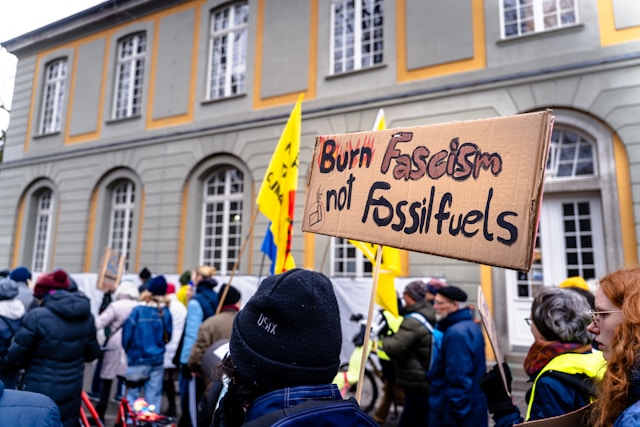
We use it for politicians, parties, governments, corporations, institutions, strangers online, and people who disagree with us.
Sometimes the accusation is justified. Sometimes it isn’t. That distinction matters.
Fascism is not simply another word for bad politics. It is a historically specific political phenomenon with a documented history, recognizable characteristics, internal variations, and decades of scholarship attempting to distinguish it from authoritarianism, nationalism, populism and other forms of political repression.
The word itself has always been contested. Fascist movements fought over its meaning. Political movements have used it as a weapon. Scholars still disagree about its precise boundaries.
But contested does not mean meaningless.
The more interesting problem is what happens when a historically specific political concept becomes a generalized political insult.
Because if everyone is a fascist, eventually nobody is.
And if nobody is, we may become less capable of recognizing one when we actually encounter one.
Fascism was not Always a Comment-Section Insult
Fascism emerged in the early twentieth century, most famously through Benito Mussolini’s movement in Italy. Nazi Germany developed its own distinctive form, combining authoritarian nationalism with racial ideology, antisemitism, expansionism, and genocidal violence.
The two regimes were not identical, and fascism has never been one perfectly uniform ideology. But that does not mean the word can mean whatever we want it to mean.
Scholars have identified recurring characteristics including ultranationalism, political violence, rejection of liberal democracy, leader-centered politics, the creation of internal enemies, mass mobilization, and visions of national rebirth.
Different scholars weight these characteristics differently. That debate is useful. It reminds us that fascism requires analysis rather than a simple checklist. It also gives us some necessary distinctions.
- Authoritarianism is not automatically fascism.
- Nationalism is not automatically fascism.
- Conservatism is not automatically fascism.
- Populism is not automatically fascism.
- Political repression is not automatically fascism.
A politician behaving badly is not automatically fascist. A government making a cruel or unjust decision is not automatically fascist.
And calling someone fascist does not make them fascist. Evidence does. That should be the starting point.
When a Warning Becomes a Weapon
Political language does more than describe reality. It shapes how we interpret it. Calling someone a fascist can therefore be an analytical claim and a rhetorical act at the same time.
It can mean: This person represents a dangerous political tendency. That can be a legitimate warning. But it can also become shorthand for: This person is beyond the boundaries of acceptable politics.
Once that happens, the word stops helping us distinguish political phenomena and starts helping us sort people into moral camps. This isn’t new.
Historian Stanley Payne has examined the complicated “career” of the concept of fascism and the semantic changes surrounding the term since the 1930s. Fascist movements themselves understood the political value of controlling language. Mussolini’s regime worked to attach “fascism” to the state, nation, empire, and political loyalty.
The fight over the word did not begin after fascism. The fight over the word was part of fascist politics itself. Today the word operates inside a different machine.
Social media and cable news reward speed, outrage, tribal identity and certainty. A careful explanation of political characteristics does not travel as quickly as a one-word condemnation.
“Fascist” is efficient. It tells your audience who the villain is. It tells your tribe that you recognize the villain. And it can end the conversation before the investigation begins.
That is where a useful political concept starts becoming political ammunition.
When Everything Becomes Fascism
Imagine a smoke alarm that goes off every time you make toast.
At first, you investigate. Eventually, you become annoyed. Then you stop listening. That is the danger of semantic inflation.
If “fascist” can mean authoritarian government, corporate power, censorship, a political opponent, an unpopular policy, capitalism, socialism or simply someone we find intolerable, the word can retain enormous emotional force while losing its ability to distinguish one political phenomenon from another.
The result is not merely bad vocabulary. It is bad perception. If everything is fascism, we lose the ability to identify what specifically makes something fascist.
And then something worse can happen. People begin treating the accusation itself as noise. The warning system still works. Nobody listens to it.
That is how a word designed to identify danger can become part of the environment that makes danger harder to see.
Fascism and Capitalism
This is where the history becomes uncomfortable.
There is a popular argument that fascism is simply capitalism in its most extreme form. Another argument is that fascism and capitalism are fundamentally incompatible. History supports neither simplification. Fascist governments did not simply abolish private enterprise.
In Nazi Germany, private businesses continued to operate. At the same time, the regime exercised enormous control over economic activity, redirected production toward military objectives, destroyed independent labor organizations, and incorporated economic institutions into a political system built around dictatorship, racial persecution, and war.
Businesses participated in processes including the expropriation of Jewish property and the exploitation of forced labor.
The relationship between private economic interests and the fascist state was not simply ideological agreement.
- Profit mattered.
- Institutional survival mattered.
- Access to contracts and resources mattered.
- Power mattered.
A company does not necessarily need to believe in an ideology to discover that cooperation with the government controlling its operating environment is useful.
Fascism did not require private ownership to disappear. It could subordinate economic activity to political objectives while allowing private businesses to operate and profit.
Nor does that mean capitalism naturally produces fascism. It doesn’t.
The historical lesson is more precise: Private economic power and authoritarian political power can coexist, cooperate, bargain, and become mutually useful without becoming identical.
That relationship is not confined to the history books.
A Recent Example
Look at India.
Recent scholarship has explicitly examined the relationship between Hindutva, fascism, neoliberal development, and global corporate capital. One 2025 Oxford chapter describes contemporary Hindutva as a Hindu supremacist fascist project increasingly intertwined with neoliberal global capital accumulation. Another study of Modi’s Gujarat model describes a political economy combining top-down development, favoritism toward big business, violently practiced Hindu nationalism, and repression of dissent.
Other scholarship is more cautious about the precise fascism label but reaches a related conclusion about the political economy. Research on Modi’s India describes an authoritarian project combining Hindu nationalism with neoliberal policy themes, while a 2023 study of authoritarian neoliberalism in India examines the alliance between right-wing authoritarian forces and neoliberal capital and its effects on labor, inequality and dispossession.
The point is not that India is simply another Nazi Germany. It isn’t. The point is that we now have a contemporary capitalist democracy in which scholars are documenting a relationship between majoritarian nationalism, authoritarian political practices, repression of dissent, market-oriented economic policy and concentrated economic power.
That is worth knowing. It also gives us a better vocabulary. The relationship between authoritarian politics and capitalism does not have to look like a dictatorship abolishing the market.
Sometimes it looks like the market continuing to operate while political power becomes increasingly centralized, dissent becomes increasingly costly, and economic policy increasingly serves particular concentrations of capital.
Turkey provides another example of this broader phenomenon. Scholars studying the Erdoğan era have described the country’s trajectory as “authoritarian neoliberalism,” in which executive centralization, autocratic legalism, cronyism, privatization, commodification, and the criminalization of opposition became intertwined.
That does not make every authoritarian neoliberal government fascist. It does demonstrate something important: Capitalism does not automatically immunize a society against authoritarianism.
And authoritarianism does not require capitalism to disappear. Those two facts are enough to make the relationship worth watching.
What are we looking at in America?
This is where historical comparison becomes dangerous if we stop thinking.
America in 2026 is not Nazi Germany. It is not Mussolini’s Italy.
The United States remains a constitutional democracy, and Freedom House continues to classify it as “Free,” even while its 2026 score declined and the organization identified concerns involving political polarization, institutional dysfunction, executive power, political violence, media concentration, and pressure on democratic institutions.
Democratic erosion is not the same thing as fascism.
But “we are still a democracy” does not mean there is nothing worth examining. Several contemporary conditions are measurable.
Trust in the federal government is near historic lows. Pew Research Center found that only 17 percent of Americans in 2025 said they trusted the federal government to do what is right most or all of the time.
Americans increasingly view political opponents through intensely negative emotional lenses.
Political violence is another measurable concern. A 2025 nationally representative study found that 35.6 percent of respondents considered violence justified for at least one of twenty political objectives. The researchers also found that the year-to-year increase was modest and that willingness to personally commit political violence was substantially lower.
Another 15 percent strongly or very strongly agreed that having a strong leader was more important than having democracy.
None of this demonstrates a fascist America. It demonstrates something more useful: authoritarian attitudes, political polarization, institutional distrust, and tolerance for political violence exist at measurable levels within American society.
That is a condition worth examining. It is not a diagnosis.
Follow the Money
The political system also exists inside an economy characterized by substantial concentrations of wealth and economic power.
The Federal Reserve’s distributional data show enormous disparities in ownership of financial assets between the wealthiest Americans and the bottom half of the population. Organized labor is substantially weaker than it was several generations ago.
In 1983, 20.1 percent of U.S. wage and salary workers were union members. In 2025, the figure was 10 percent. The private-sector rate was only 5.9 percent.
Again, none of this proves fascism.
- Economic inequality is not fascism.
- Corporate concentration is not fascism.
- Declining union membership is not fascism.
But they tell us something about the distribution of power. And that matters because democracy does not exist only inside voting booths.
People encounter power at work. They encounter it when negotiating wages, deciding whether they can leave a job, dealing with dominant employers, confronting concentrated markets, or trying to make their political voices heard.
Economic power can become political power when it becomes sufficiently concentrated. That does not make concentrated wealth fascist. It does mean that any serious examination of modern political power should ask how economic institutions interact with the state.
History gives us reason to ask the question. It does not give us permission to skip the evidence.
The Danger of Looking for a Costume
One of the easiest ways to misunderstand fascism is to imagine that it arrives fully formed.
- The dictator appears.
- The uniforms appear.
- The flags appear.
- The secret police arrive.
- Everyone knows what is happening.
History is rarely that clear while it is happening. Political systems are built through institutions. Institutions operate through incentives. And incentives change behavior.
A corporation does not have to become ideologically fascist to find cooperation with authoritarian power useful. A voter does not have to hate democracy to become comfortable with a strong leader. A political party does not have to abolish elections to weaken democratic norms. A government does not have to become a dictatorship overnight to accumulate more power than surrounding institutions can effectively restrain.
This is why historical comparison is useful when handled carefully. History does not give us a script. It gives us patterns worth investigating. And this is where the language problem comes back.
The Word Can Become Camouflage
If every authoritarian politician is simply “fascist,” then authoritarianism becomes a footnote. If every instance of corporate power is “fascism,” then the mechanisms of economic power disappear beneath the label. If every political disagreement is “fascism,” then political repression becomes indistinguishable from ordinary disagreement.
And if every use of state power is “fascist,” we stop asking the most important question: What kind of power is actually being exercised, against whom, and for what purpose?
That question is harder. It requires research. It requires history. It requires following money. It requires looking at institutions instead of personalities. It requires being willing to discover that the people we dislike may not fit the label we wanted to give them. And sometimes it requires discovering that the label fits more closely than we wanted to admit.
That is the uncomfortable part. Because precision is not a shield for our preferred side. It cuts both ways.
So What Should We Call it?
Don’t begin with the label. Begin with the behavior.
- What is happening?
- Who has power?
- How is that power being used?
- What happens to opposition?
- What happens to independent institutions?
- What happens to organized labor?
- What happens to minorities and designated internal enemies?
- Is political violence being normalized?
- Is a leader being elevated above institutions?
- Is national identity being defined around exclusion and a promise of national rebirth?
- Are democratic constraints being weakened?
- Are economic policies being insulated from democratic pressure while concentrated private interests benefit?
- Are these developments isolated?
- Or are they reinforcing one another?
Then ask the historical question: Does the pattern actually resemble fascism?
If it does, say so. If it doesn’t, don’t.
The point is not to make the word safer. The point is to make the analysis harder to bullshit.
Recovering the Word
There is a strange irony in all of this. We live in an age obsessed with political labels while becoming increasingly impatient with the work required to understand them.
Everything needs a side. Everything needs a villain. Everything needs a caption. Everything needs to be reduced to a clip that can be consumed before the next outrage arrives.
“Fascist” fits that environment perfectly. One word. Maximum emotional payload. Minimum explanation.
That is precisely why we should resist it. Not because fascism is too strong a word. Because it is too important a word to waste.
Fascism is real. It happened. It killed people. It destroyed institutions. It mobilized ordinary citizens against designated enemies. It subordinated independent organizations. It used violence as politics. It made loyalty to the nation and the leader more important than liberal democratic constraints. And it did not always arrive wearing a costume that announced what it was.
So when the word becomes a generic insult, something more than vocabulary is lost. We lose a piece of our political eyesight. And there is another reason to care.
The modern outrage economy has learned that fear sells. Anger sells. Tribal identity sells.
A frightened population is easier to divide. A divided population is easier to market to. A population that spends all day fighting over which side is fascist has less time to ask who owns the platform, who profits from the conflict, who benefits from the distraction, and what economic and political structures are operating underneath the spectacle.
That does not mean some secret cabal is sitting in a room manufacturing every argument. It means incentives matter. The machine does not need a mastermind. It needs engagement. And we keep feeding it.
That is where the capitalism question becomes impossible to separate completely from the language question. A political culture organized around outrage exists inside an economic system that can monetize attention, conflict, and division.
Political power can become concentrated. Economic power can become concentrated. Media power can become concentrated. And when those concentrations reinforce one another, democracy can weaken without anyone needing to formally announce that democracy has ended.
That is the part worth watching. Not the costume. Not the comment section. Not the person screaming “fascist” loudest.
The structure underneath.
If Everyone is a Fascist, Nobody is
That is not an argument for silence. It is an argument for precision.
- Call authoritarianism authoritarianism.
- Call political repression political repression.
- Call nationalism nationalism.
- Call economic exploitation economic exploitation.
- Call concentrated power concentrated power.
- Call political violence political violence.
- And if the evidence shows fascism, call it fascism.
But be prepared to show your work.
- What historical characteristics are present?
- What evidence supports the comparison?
- What characteristics are absent?
- What alternative explanation fits?
- What incentives are operating?
- Who benefits?
- Who loses power?
- What institutions are being weakened?
- What happens to people who resist?
- And what evidence would change your mind?
Those questions do not tell you what to think. They give you something better. A way to think without being handed the conclusion.
Because the greatest danger of turning fascist into a meaningless word is not that somebody gets called a name they don’t deserve. It is that we train ourselves to hear the word and stop listening. And then, when something genuinely dangerous begins operating in plain sight, we may mistake the warning for just another piece of noise.
Fascism does not become less dangerous because we misuse its name. We simply become less capable of seeing it.
So protect the word. Not for fascists. For everyone else. Because political language is a tool.
Use it carelessly, and it becomes a weapon against your own understanding. Use it precisely and it becomes what it was supposed to be all along: a way of seeing power clearly.