


When integrity becomes a civic responsibility
There is a quiet moment that happens before most acts of conformity.
Someone says something you disagree with. You know you disagree. You might even know why. Then you look around the room.
You consider who is listening. You think about what happens if you say it. Maybe someone will argue. Maybe someone will think less of you. Maybe you will sound difficult. Maybe your boss will remember. Maybe your friends will stop inviting you. Maybe the conversation will become exhausting.
So you say nothing. Nobody censored you. Nobody threatened you. You simply decided that speaking was not worth the cost. That distinction matters.
Conformity does not always arrive as an order. Sometimes it arrives as a calculation.
And sometimes the most powerful pressure a group can exert is convincing you to perform the calculation yourself.
We Are Built to Belong
Human beings are social creatures. We learn language, customs, values, and expectations from the people around us. Belonging is not a weakness. It is one of the conditions that makes human life possible.
That is part of what makes conformity so complicated.
We should be careful about turning every agreement into evidence of social control. Sometimes other people are right. Sometimes consensus reflects accumulated knowledge. Sometimes changing your mind because someone else made a better argument is exactly what intellectual maturity looks like.
The problem begins when belonging becomes more important than judgment.
Solomon Asch demonstrated one version of this problem in his famous conformity experiments. Participants were asked to compare the lengths of lines. The correct answers were obvious. Yet when a group of other participants unanimously gave the wrong answer, people sometimes went along with the group anyway. In Asch’s original experiments, participants conformed to the incorrect majority on 36.8 percent of the critical judgments, while roughly a quarter remained completely independent.
The lesson is not that people are stupid. It is that social reality can interfere with individual judgment. And that interference does not require anyone to be malicious.
People want to belong. They want to avoid embarrassment. They want to believe that they are not the only person who sees things differently.
That is why dissent can feel strangely physical. You can know what you believe and still feel the pressure of being the only person willing to say it.
Sometimes we mistake that discomfort for evidence that we are wrong. Sometimes it is simply the cost of standing apart.
Nobody Has to Tell You to Be Quiet
The more interesting form of conformity happens after the external pressure has become internal.
Research on the “spiral of silence” has found that people are less willing to express views when they believe those views are unpopular among the people around them. In a 2014 Pew Research Center study examining discussion of the Snowden-NSA revelations, 86 percent of Americans said they were willing to discuss the issue in person, but only 42 percent of Facebook users and 41 percent of Twitter users said they were willing to discuss it on those platforms. People who believed their social-media networks disagreed with them were less willing to speak both online and, in some settings, offline.
That study does not prove that social media has made society uniformly more conformist. It examined one issue at one point in time, and the researchers themselves noted important limitations. But it demonstrates something important.
The expectation of disagreement can be enough to change behavior.
You don’t need a censor. You need an audience. Once we know what kinds of opinions are likely to be rewarded, mocked, challenged, or remembered, we can begin editing ourselves before anyone else does the editing for us.
This happens at dinner tables. It happens in classrooms. It happens at work. It happens in families. It happens online. And it can happen inside political movements, religious communities, activist organizations, professional associations, and every other group humans create.
The mechanism is remarkably ordinary: I don’t want trouble.
That sentence has prevented an enormous amount of unnecessary conflict. It has also prevented an enormous amount of necessary conflict.
The Price of Speaking Up
The workplace offers one of the clearest examples.
Organizational researchers distinguish between employee voice and employee silence. Voice means voluntarily communicating concerns, suggestions, information about problems, or opinions to someone higher in an organization. Silence means withholding that information—even when it could be useful. Research on the subject examines the factors that influence whether people speak or remain silent, as well as the consequences for both employees and organizations.
This is more than office politics. Imagine an employee sees a problem. They know something is inefficient, dishonest, unsafe, or simply stupid. They also know who has authority. They know how that person reacts to criticism. They know who gets promoted. They know who gets labeled “difficult.” The employee does the math. And sometimes silence wins.
It is easy to condemn that person from the outside. It is harder when the consequences are real.
A paycheck is not an abstract principle. Neither is health insurance. Neither is professional reputation. Neither is the fear of becoming responsible for supporting a family while unemployed.
This is why a mature conversation about dissent has to begin with compassion.
People have legitimate reasons to protect themselves. Not every disagreement deserves confrontation. Not every workplace problem requires a crusade. Not every unpopular opinion needs to be broadcast to the world.
But understanding why people remain silent does not mean pretending that silence has no consequences. When everyone who sees the problem decides that someone else should mention it, the problem becomes part of the institution.
Silence stops being an individual decision. It becomes organizational culture.
Dissent Is Not the Same as Being Right
There is another danger here. If conformity is bad, then dissent must be good. That conclusion is tempting. It is also wrong.
History is full of people who stood apart from the majority and were completely mistaken. Being unpopular does not make an idea true. Being censored does not make an idea true. Being mocked does not make an idea true. And being willing to stand alone is not evidence of courage if the person standing alone has simply confused stubbornness with principle.
This is where responsible dissent separates itself from contrarianism.
The contrarian needs to disagree. The person acting with integrity needs to remain willing to disagree when the evidence and conscience require it. Those are not the same thing.
Real intellectual independence requires a much harder discipline than rejecting the consensus.
- It requires being willing to reject your own side.
- It requires listening to arguments that make you uncomfortable.
- It requires changing your mind when the evidence changes.
- It requires admitting when you were wrong.
- And sometimes it requires saying, “I don’t know.”
The independent thinker is not the person who disagrees with everyone. It is the person who does not outsource judgment to anyone.
- Not the majority.
- Not the minority.
- Not the algorithm.
- Not the political tribe.
- Not the people they admire.
- Not even themselves.
Integrity Has a Cost
This is where dissent becomes more than an intellectual exercise.
Integrity means that there is some relationship between what you believe and how you behave. That sounds simple. It isn’t.
Every person eventually encounters a moment when convenience and principle point in different directions.You can tell the truth or protect yourself. You can speak or remain quiet. You can participate or refuse. You can laugh along or say that something isn’t funny. You can repeat what everyone else is saying or admit that you don’t believe it.
Sometimes the cost is trivial. Sometimes it isn’t. That is why integrity matters. If doing the right thing never cost anything, integrity would require very little courage.
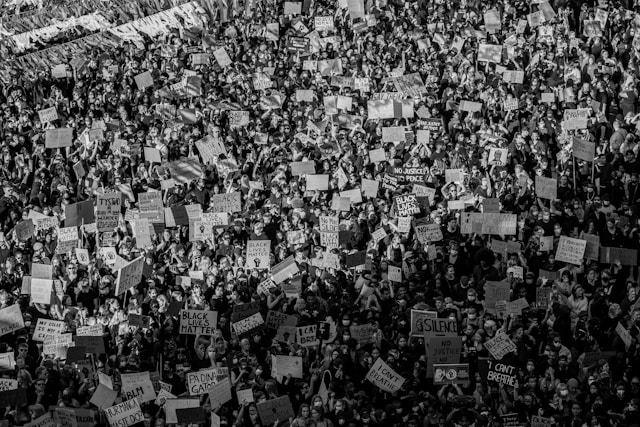
Civil disobedience is a more extreme version of this principle. In its most widely accepted philosophical definition, it involves a public, nonviolent, conscientious breach of law intended to bring about a change in law or government policy. The willingness to accept consequences is part of the tradition because the protester shows the act is principled rather than merely convenient.
Most acts of integrity are not civil disobedience.
You do not have to break a law to refuse to participate in something you believe is wrong. You do not have to get arrested to tell the truth. You do not have to stand on a street corner holding a sign.
Sometimes dissent is simply saying, “No. I can’t do that.” Sometimes it is asking the question nobody wants asked. Sometimes it is defending someone who has become unpopular. Sometimes it is telling your own political tribe that it has gone too far. Sometimes it is admitting that the other side has a point.
The scale varies. The principle does not. You are choosing not to surrender your judgment merely because surrender would be easier.
Dissent Is a Civic Duty
There is a temptation to think of citizenship as something we do when we vote. It is more demanding than that.
A functioning civic culture depends on people being willing to question authority, challenge institutions, criticize their own communities, expose problems, defend unpopular people, and correct one another.
That does not mean permanent outrage. It does not mean treating every disagreement as oppression. It does not mean assuming that every institution is corrupt or every majority is blind.
It means accepting that a society cannot correct what nobody is willing to name.
Democracy needs disagreement. Not because disagreement is inherently virtuous. Because no institution, political movement, community, or majority is infallible.
Someone has to notice the problem. Someone has to ask the uncomfortable question. Someone has to say that the emperor has no clothes. And sometimes someone has to make a scene.
We should be careful about romanticizing that person. Protesters can be wrong. Whistleblowers can be wrong. Activists can be wrong. Journalists can be wrong. Governments can be wrong. Majorities can be wrong.
The point is not to create a society in which everyone is permanently fighting. The point is to create one in which people remain capable of fighting when something important is at stake.
There is a difference. Civility is valuable. Peace is valuable. Compromise is valuable.
But peace purchased by silence is not always peace. Sometimes it is simply an unresolved problem waiting for someone else to inherit it.
The Courage to Dissent
We do not need more people who think they are rebels. We need more people who are willing to be responsible for their judgment.
That means resisting the easy version of dissent as much as the easy version of conformity.
Don’t disagree because everyone else agrees. Don’t agree because everyone else agrees. Don’t oppose authority because opposition makes you feel independent. Don’t defend authority because obedience makes you feel safe.
Look. Listen. Check. Think. Then decide.
And when the moment comes when your conscience, your evidence, and the social pressure around you point in different directions, understand what is actually being asked of you.
You may be asked to risk being disliked. You may be asked to risk being misunderstood. You may be asked to risk your position. You may even discover that you were wrong. That is part of the bargain.
Courage does not guarantee correctness. It only makes honesty possible when honesty becomes expensive.
A healthy society does not require everyone to agree. It requires people willing to remain honest when agreement becomes easier.
You don’t have to be the loudest person in the room. You don’t have to be fearless. You don’t even have to be certain that you are right.
But you do have to remain willing to speak when silence would require you to betray what you know to be true.
That isn’t rebellion for its own sake. It is citizenship.


