Posts Tagged ‘climate’


How disaster capitalism thrives in the age of climate chaos


Disaster as a Business Model

Hurricanes rip coastlines apart, wildfires reduce neighborhoods to ash, floods drown farmlands. Each new disaster is framed as a natural tragedy—yet behind the smoke, someone always finds a way to profit.

Swiss RE reports climate disasters are already costing the U.S. 0.4% of GDP annually, with every dollar of adaptation saving eleven in avoided damages【time.com】. But adaptation isn’t what elites are betting on. Instead, they see chaos as an opportunity.

As American Studies scholar Kevin Rozario puts it:

“The human component is a massive accelerant to the fires.”【smith.edu】

The accelerant isn’t just carbon—it’s capitalism itself.


The Pattern of Profit

When a climate disaster strikes, everyday people lose homes, livelihoods, and loved ones. Meanwhile, corporations cash in.

In the insurance sector, even a catastrophe doesn’t halt profits. The Financial Times reports that despite massive underwriting losses, insurers are hiking premiums and retreating from high-risk zones, and “investors are rewarding them for becoming increasingly selective in the coverage they offer.”【ft.com】

In 2024, global disaster losses hit $320 billion. Only $140 billion was insured, leaving $180 billion uninsured, shifted onto individuals and taxpayers【thinklandscape.globallandscapesforum.org】.

Kay Young, a 63-year-old survivor of the Los Angeles wildfires, summed up the fight ordinary people face:

“They’re not going to give you the value of your house … if they do, you really have to fight for it.”【reuters.com】


The Shock Doctrine Playbook

This cycle is not an accident—it’s a strategy.

Naomi Klein’s Shock Doctrine laid it bare: disasters create a “shock window” in which elites exploit public disorientation to push radical privatization. The American Bar Association defines disaster capitalism as:

“Exploitation of natural or man-made disasters in service of capitalist interests.”【americanbar.org】

We’ve seen it after wars, coups, and financial crashes. Now, the same playbook drives climate response.


Wildfires & the Land Grab Economy

Few examples show this more clearly than California’s wildfires. In Malibu, where entire neighborhoods burned, wealthy investors swooped in. The Times reports lots reduced to rubble were resold for up to $7.5 million, raising “troubling questions about gentrification in the wake of climate-related disasters.”【thetimes.co.uk】

Governor Newsom eventually issued an order barring unsolicited offers from speculators preying on survivors—some of whom were approached while their houses were still burning【gov.ca.gov】. But the vultures had already circled.

Stephen Pyne, the historian of fire, describes this era as the Pyrocene:

Humanity’s combustion—fossil fuel and ecological disruption—has created a fire-dominated epoch.

In other words, we lit the match. Now, profiteers are selling the ashes.


Who Pays the Price

Communities most vulnerable to climate chaos are the ones paying the heaviest price. In developing nations, most disaster losses are uninsured. In the U.S., low-income and marginalized neighborhoods bear the brunt of heat waves, toxic smoke, and flooding.

Scholars writing in Global Environmental Change warn:

“Climate-induced disasters deepen inequality and social vulnerability, disproportionately harming marginalized communities.”【sciencedirect.com】

Meanwhile, wealth insulates the few: billionaires hire private firefighters, build fortified compounds, or buy real estate on higher ground. The rest of us scrape together GoFundMe donations.


Who Cashes In

The winners of this game are clear:

  • Insurance companies post record profits even as payouts shrink【greenmoney.com】.
  • Wall Street invents catastrophe bonds, letting investors bet on disasters.
  • Developers flip ruined communities into luxury zones.
  • Corporations snap up FEMA contracts.

The Allianz Group—hardly a radical source—warned bluntly that at 3°C of warming, damage will be impossible to adapt to or insure against, threatening the foundations of capitalism itself【theguardian.com】. Even the system’s architects know it’s unsustainable.


Resistance Against the Shock Doctrine

When fire levels a community, it should be a moment of collective rebuilding. Instead, it’s too often a handoff: loss for the many, leverage for the few.

As Vanity Fair reported from wildfire-stricken California:

“Profiteers and misinformation have exacerbated the distress of the affected … community members … are concerned about future rebuilding efforts potentially displacing them.”【vanityfair.com】

This is the heart of the Climate Shock Doctrine: the transformation of catastrophe into capital.

The fight for climate justice is not just ecological—it’s economic. We can’t stop disasters from striking, but we can decide who owns the recovery. That means:

  • Public ownership of critical resources.
  • Investments in resilience for poor communities first.
  • Grassroots solidarity networks that sidestep corporate vultures.
  • Cutting off financial pipelines to fossil fuels—the “oxygen on which the fire of global warming burns”【newyorker.com】.

Because if disaster capitalism keeps winning, we’re not just burning forests—we’re torching the future.


Wisdom is Resistance. Truth Over Tribalism.

frackishimalogo1

global-warming

by @anarchyroll

You gotta have faith, faith, faith.

Faith is essential, when going through hard times. During hard times one must have faith that things will get better. One needs to have faith in his or herself to do the work needed to dig out of the hole they are in. Faith in other people is essential to living in civilized societies. Our currency is backed by the full faith and credit of the US government. More than 3/4 of the world’s population belongs to a religious faith.

The leader of the world’s largest religion believes in global warming and believes science is the way forward on the issue.

I wonder how many of his followers across the globe feel the same or in this case, believe as he does. I’m pretty sure they have to, or are at least supposed to. But aren’t we supposed to believe 97% of scientists, NASA, and the Pentagon when they all agree global warming is happening and is a threat to our security and very existence?

Is it faith that a higher power will protect us that stops people from accepting the reality of global warming? Is it greed from money earned from contributing to the acceleration of global warming over the past thirty years? Is it ignorance in thinking that because the weather in one’s hometown is fine that global warming is a hoax? Is it denial? Accepting global warming as the reality of our present and future forces both a painful look in the mirror and even more painful wide scale changes moving forward.

The Military Industrial Complex knows global warming is real. When did they become a bastion of liberal ideology? The effects of global warming are presently causing security risks and have potential for greater security threats in the future. Maybe fighting two wars for oil got them to change their tune on wind, hydro, and solar energy. Or maybe its the nature of military operations being centered around collecting, analyzing, and accepting results of measurable data that got them to come around to the reality of global warming.

On the other end of the spectrum is the current President of the United States who has said that global warming is a “hoax” perpetrated by the Chinese. Many of his supporters/voters are also climate change deniers. Trump is backing up his words on this issue by attempting to cut the Environmental Protection Agency budget. He also recently green-lit the Keystone XL Pipeline which has negative environmental concerns associated with it.

Climate change deniers may sound and come across as ignorant, but at least they don’t have the power to further damage the planet in an negative way. Trump, in his first 100 days in office has taken two measures to tangibly create negative consequences for the planet. I suppose I could have faith that Trump will do the right thing, change course, and become an environmentally friendly President. I could have faith and believe that all the climate skeptics will accept the scientific facts and reality.

They can have faith, I’ll trust…but verify.

frackishimalogo1ajclogo2599657-now-i-get-it-the-flint-water-crisis

by @anarchyroll

Tackling environmental causes is as important as it is thankless.

There is nothing more important to the survival of the human race, than insuring that we have clean air, drinkable water, harvestable land as well as habitable temperatures and sea levels. Other issues are as important on micro/local levels. Some issues are artificially inflated to seem as important. The only other topic that carries the gravitas of capability of wiping out the human race is warfare…..and asteroids from outer space. But as long as Bruce Willis and Ben Affleck are alive, we’re safe.

Warfare and environmental issues parallel each other. Both can have truly global impacts. Both issues have resulted in global changes over the past century. Both issues are so complex it’s hard to wrap one’s head around them. Both issues are so important they are boring. Both issues change and evolve in a way inconvenient for twenty four hour news cycles. Both issues see new sub issues come up immediately after victories making celebrations both limited and moot.

WWI to WWII to Vietnam to Gulf War One to Gulf War Too to Al Qaeda to ISIS. Global warming to drought to famine to flooding to super storms. But it’s not just the big macro stuff. It is also the smaller micro topics. Terrorist attacks and poisoned drinking water reservoirs. Hostage crises to methane leaks.

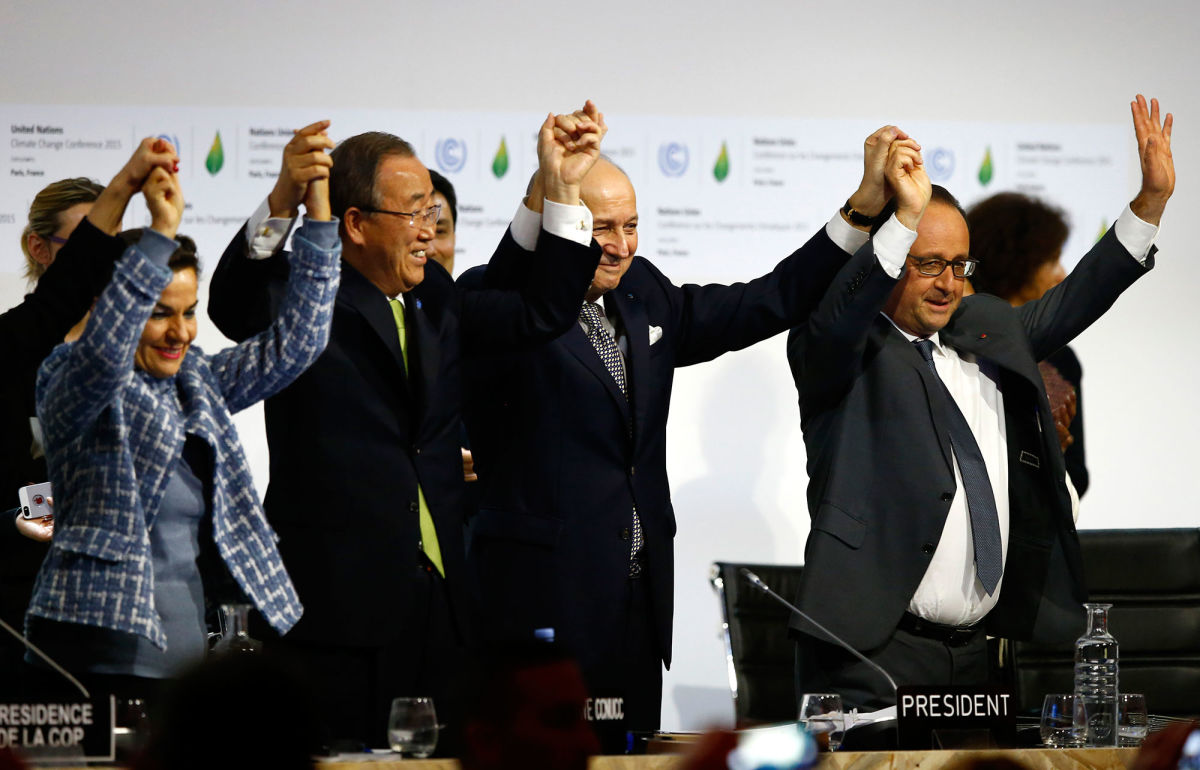
People who care about the environment and know about climate change should still be rejoicing over the historic Paris Climate Deal that was signed in mid December. 200 countries signing an agreement with legal force to reach zero carbon emissions in the second half of this century is certainly worth a celebration. 2015 closed with the biggest victory to date in regard to the biggest macro environmental issue.

Kolbert-The-Paris-Climate-Deal-Really-is-Historic-1200

In the United States, 2016 has begun with a two micro environmental issues making the Paris Agreement feel a world away. The California Methane Leak and the Flint Water Crisis have grabbed attention and headlines usually reserved for sports and celebrity gossip. If the body count goes up, maybe either issue can be talked about as much as the weather.

EMERGENCY!!!

A State of Emergency has been declared in California over the three month and counting leak of underground methane reservoirs into the air. 2,000 people have been evacuated from their homes with many more seeking relocation assistance in Southern California. A bonafied environmental disaster has struck the Porter Ranch area.

EMERGENCY!!!

A presidential emergency declaration has been given to Flint, Michigan by Barack Obama. $80 million in resources will be given to city that has had its water supply poisoned via bureaucratic cost cutting. 100,000 people including schools full of children have been exposed to toxic drinking water for years.

Wide reaching and far stretching damage at a biblical scale. That is why environmental issues are the most worthy of the attention and resources of the masses and those in power. 200 countries came together in Paris knowing this. That economic bickering and small scale terror attacks mean nothing in the face of environmental crises capable of wiping out the entire human race.

Flint and Porter Ranch merely scratch the surface of the severity of negative environmental issue impacts. Poisoned air, poisoned water, and a poisoned atmosphere that will effect global warming. Each issue individually can lead to death instantly and severe pain, discomfort, and displacement. The negative consequences of the issues will be on a monumental scale at an unceasing length.

Environmental issues are real issues. Nothing soft news about them, they are very hard news second to none. Scientists giving speeches or scientific reports/studies being released don’t get the play or attention that war stories get. If it bleeds it leads in the broadcast news world. It is not wrong to care and focus on the casualties of war. But please remember that just because the destruction is immediate and sensational, doesn’t mean it is the most austere.

A gun can kill many. A bomb many more. But a poisoned water supply? Unbreathable air due to toxic gas? If an army or terrorist group poisoned the water supply or the air supply of two American cities, what would the reaction be? Does incompetence of a corporation or governing body make the consequences less grave?

The impact of environmental issues are immune to perception and/or plausibility. You can choose to not believe or not care about the methane leak in Southern California. I can choose to tell my social circle the effects on global warming of the methane leak won’t be huge and felt for decades to come. But the gigantic amount of methane leaking into the air, like the lead in the Flint water supply is immune from peoples’ perceptions and beliefs.

The same is true for battles and war. The people of Paris probably believed they were safe from ISIS. America perceived the constant conflict in the Middle East wouldn’t have any effect on the homeland before 2001. Perception and belief just don’t mean anything when it comes to the facts and events that are happening. It is how we react to them and what we do going forward to minimize damage and maximize the effect of the lesson(s) learned from the events.

The methane leak is happening, the water crisis is happening, global warming is happening. These are hard facts immune from political beliefs and personal perception. What are we going to do to minimize their damage? How are we going to maximize the effects of the lessons learned from these events going forward? The answers to these questions don’t just effect a community, a country, or a continent.

They literally effect the entire human race and the entire planet we inhabit. That is why environmental issues are the most worthy of the attention and resources of the masses and those in power. The answers to these questions will be difficult, inconvenient, expensive, and require massive sacrifice. Which is why ;

Tackling environmental causes is as important as it is thankless.

frackishimalogo1

by @anarchyroll
9/21/2014

The #PeoplesClimate marches/rallies that occurred across the globe are a great representation of the good news/bad news holding pattern that pro environment supporters have been stuck in for decades. The good news is the #PeoplesClimate was so big, involving so many people, in so many of the world’s biggest cities that it literally could not be ignored by the press or anyone on the internet on 9/21/2014. The bad news is that tangible, global, legislative action is unlikely to occur for at least another full year.

This good news/bad news paradigm has most recently been demonstrated in regards to the two most talked about environment issues of the last quarter century; the ozone layer and the deforestation of the Amazon.

The good news is that scientists have discovered that the ozone layer is starting to heal. How awesome! Certainly no negative spin to put on this story. Since the 1970s attention has been brought to this issue in hopes of reversing the now notorious hole in the ozone layer that has been a direct contributor to global warming and rising skin cancer rates.

Ready for the bad news?

The Amazon rainforest is getting slashed and burned at a 30% increase. Deforestation is right there with industrial pollution as the greatest causes of global warming and climate change. We need rainforests to sustain the planet, but captains of industry seem to think we need grazing land for cattle and industrial logging more.

Good news, bad news unfortunately isn’t going to cut it, why? Because we are playing from behind. Pro environmentalists can’t keep scoring field goals while polluters and deforestrers are scoring touchdowns. It’s great that more people are aware of the negative effects of climate change, the fact that it’s man-made, and we must do something to reverse it. The problem is that this has happened because the negative effects of climate change are being felt more and more every single day. We have let so much wrong get done that the Earth is irreversibly changing all around us quicker, in real-time. It’s great to have good news to report but wildfires, droughts, and other natural disaster devastation is only going up. Is it too late? The good news is that in this fight, there is literally no reason to quit, because there is nothing else as worthy of fighting for as the future of the planet we inhabit.