Posts Tagged ‘economics’

eanda logo

by @anarchyroll
7/3/2014

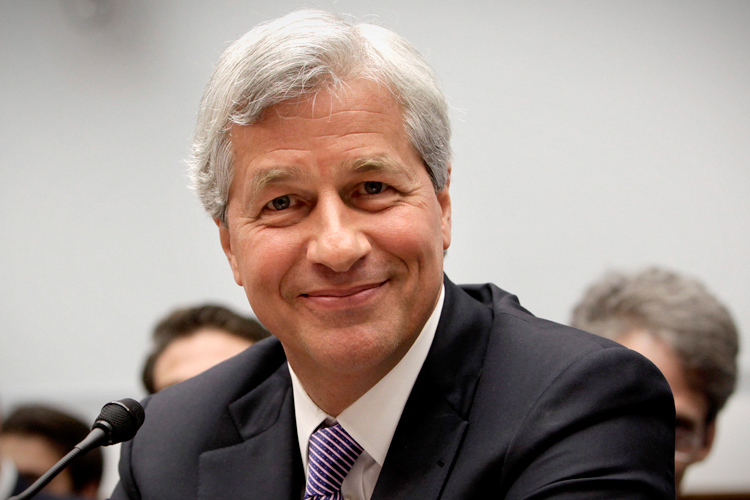
Nothing quite says 1% like CEO of the biggest bank in America. That is the title held by Jamie Dimon (pictured above).

Jamie Dimon is the CEO of JPMorgan Chase and one of the most brilliant economic minds in the world.

JPMorgan Chase was a beneficiary of the TARP bailout following the 2008 economic collapse. Dimon and Chase were also at the center of the London Whale economic scandal in 2012.

Dimon and Chase took billions of dollars from the government when they didn’t need it, then turned around and used it to fund the same type of reckless gambling that was responsible for the economic collapse. If that doesn’t symbolize American greed and the 1% I don’t know what does.

Jamie Dimon may be a symbol, but he is also a human being. A human being who has been diagnosed with throat cancer.

Dimon wrote in a memo that his prognosis is excellent. The cancer was caught early, the treatment plan is all set up, he won’t even have to miss work. Of course, because he has the best healthcare money can buy and then some.

I wonder if the doctors will be injecting cash directly into the tumors.

I do hope this experience will change Mr. Dimon. I hope it will affect him. I hope his paradigm will shift dramatically. Cancer is still cancer, even for a wealthy white man. I’m sure he will do serious thinking, reflecting, and planning during his treatment sessions. Hopefully he will use his massive influence on the world to do something other than use money to make money. Hopefully.

eanda logoajclogo2

by @anarchyroll
6/8/2014

There is something about the word, and the monetary figure trillion that catches one’s attention. Trillion, as in; the total amount of student loan debt in America is $1 trillion.

A standing rule I have is that anytime the word debt and trillion are together in the same sentence, it is worth keeping an eye and an ear on.

Elizabeth Warren has been attempting to push a student loan debt reform bill through Congress. A bill that would in essence, allow debtors to refinance their student loan debt, something that is not currently allowed to happen.

President Obama has now formally put his support behind the bill.

Student loan debt has real potential to be the next bubble that busts the entire economy akin to the housing and dot-com collapses of the previous two decades.

The other important piece of the legislation is that it lowers the interest rates on the loans themselves. The first benefit of the bill helps those already in debt. The second benefit helps those yet to take out loans. Sounds like a common sense piece of win win legislation. Naturally in Washington it is facing an uphill battle with stark opposition.

Regardless of political affiliation or economic situation, $1 trillion of debt must be formally addressed with public policy of some kind to at least take a small preventive measure against a future recession or depression caused by outstanding debt on a mass scale as currently exists with student loan liabilities.

eanda logoby @anarchyroll
5/27/2014

What happens when the country that we borrow from needs to borrow from someone?

China is starting to see companies collapse and borrowing go up. Why should you care?

Because the United States of America is dependent on China whether we want to be or not, whether people know it or not. China now has to spend $4 to make a $1.

If China goes through a depression or a recession or even something resembling a recession, we are going to feel the negative effects here at home. Not just because they buy so much of our government debt, but because China is responsible for 1/3 of global economic input according to the article linked to above.

There’s no need to panic or ring a doomsday alarm. But China is in a debt crisis.When that language/terminology is used there must be cause for concern in the name of financial responsibility and fiduciary duty. Why is that the case? Why should you care about this?

China owns $1 Trillion with a T of US Government Debt.

That may not seem like a lot when you see the total amount of government debt. But a trillion dollars is a trillion dollars no matter how economists may try to justify it to themselves. Anytime a trillion dollars is involved, it’s safe to say that an eye and an ear should be paid to it at all times. Especially when a margin call from China could put us on a bullet train to a 2008 sequel. The sequel is never better than the original, but let’s keep this one in the territory of Casablanca and Old School and let the original stand alone with the test of time.

eanda logoajclogo2by @anarchyroll
5/22/2014

How many people went to jail for causing the 2008 economic collapse of not just the United States, but the entire global economy?

I thought the answer was zero, it turns out I was wrong. The answer is one, one person from Wall Street went to jail post 2008.

It’s not just an income inequality gap that exists and is expanding in America, there is also a judicial inequality gap. Since I’m white I’ve only noticed this recently. If I was a minority I would have likely not just written about the disparity, but would have been arrested and put in jail already.

Graph courtesy of Project.org

In America, white-collar criminal really is a double entendre. One for the type of crime, a second for the race of the criminal.

Though maybe it is time to update the image and the term. Something more appropriate would be green collar crime. Though the fact that almost all of the white-collar corporate CEO’s were/are white; it is the quantity of dead presidents in their offshore bank account that is the blade to their prison term skate.

What does it say about us as a society that we allow this kind of disparity to justice to become the norm? Is the damage caused by the architects of the ’08 collapse greater than, equal to, or less than the robbery of a single person? How about the rape of a single person? The murder of a single person? Selling drugs to a single person?

I’m not pretending to have an answer here. I am certainly not standing on a pedestal.

Was the damage caused by World Com and Enron akin to a serial robber? A serial killer? A serial rapist? A drug kingpin? How do we measure the collateral damage? Is the death by stabbing of a man in his early twenties different from a retiree who finds out they have lost all of their money in a Ponzi scheme and is destitute without the physical ability to earn for the rest of their life?

What about the people who kill themselves due to an economic depression? What if they have spouses and children? Is their loss, pain, and suffering different from a woman who gets robbed and raped at gun point walking home from the train station?

When entire neighborhoods and towns are put into foreclosure. Hundreds, thousands, millions without work, shelter, food, water, or hope for the future…are the people responsible for causing so much human tragedy somehow less evil, deserving less scorn, and less judicial prosecution than a teenager who runs over a kid while texting and driving? What about drinking and driving?

When blood is spilled, lives taken, innocence stolen in violent crimes we as a society hunt down the criminals, lock them up, throw away the key, and turn the other cheek while they are habitually raped in prison. Victims of violent crimes and their families are forever changed, unable to ever fill the hole created by an evil person that took something that can never be given back.

But is that psychological damage not shared by victims of massive financial crimes against society like in 2008? When we aren’t talking about a single person losing a job or life’s savings but a large percentage of the global population. Are the strains placed on society not akin to that placed on the immediate friends and families of violent crimes?

If not, can we at least as a society agree that we should lock up hedge fund managers, investment bankers, and Ponzi schemers that cause global recessions and depressions as strictly and regularly as we lock up drug dealers and users?


eanda logoajclogo2

by @anarchyroll
5/4/2014

Do you know who Thomas Piketty is? If not, get to know him because anyone who has any real influence on the world at large is reading his book, meeting with him, or seeing him speak live. He is being praised by the 99% as a harbinger for what the future of economics should look like and demonized by the 1% as another crazy socialist in a suit.

Thomas Picketty is a French economist and author. His recent book Capital in the Twenty-First Century is breaking tradition from past economic books and actually selling really well. He is a believer an evolved, progressive taxation to battle income inequality that has become a global pandemic over the past thirty years. The Guardian recently followed Picketty on a speaking tour of London. The video below contains the meat and potatoes of what you need to know about Picketty’s viewpoints, theories, and demeanor in his own words, in less than five minutes. Click on the picture to be directed to the video. Enjoy!