

Posts Tagged ‘mindfulness’


When should I be patient and when should I take action?

This can be a tough question for anyone at any level in life. I know it has been for me, at every stage of my life up to this point. I remember thinking that epiphanies brought about by consuming and then applying knowledge would be a permanent solution to this puzzle.

I suppose I’m old enough to possess the wisdom through experience to know that there is no such epiphany. I’ve had epiphanies. Did they create permanent change? No. Nothing does. Habitualized action creates permanent change. Anything else is snake oil.

“The two most powerful warriors are patience and time.” – Leo Tolstoy

Patience and action are practical examples and applications of yin and yang. Buddhist philosophy has been a big help for me in taking the pressure off of the choice between patience and proactivity.

Because it is natural to worry about being too patient just as it is normal to worry about taking too much action. Bringing mindfulness into my life helped to relieve some of the pressure that modern life puts on us to always be doing something exciting and interesting while simultaneously always relaxing in an exotic location vacation. And of course, making sure to document anything and everything one does in HD 4K photo and video, posted and reposted in portrait and landscape mode.
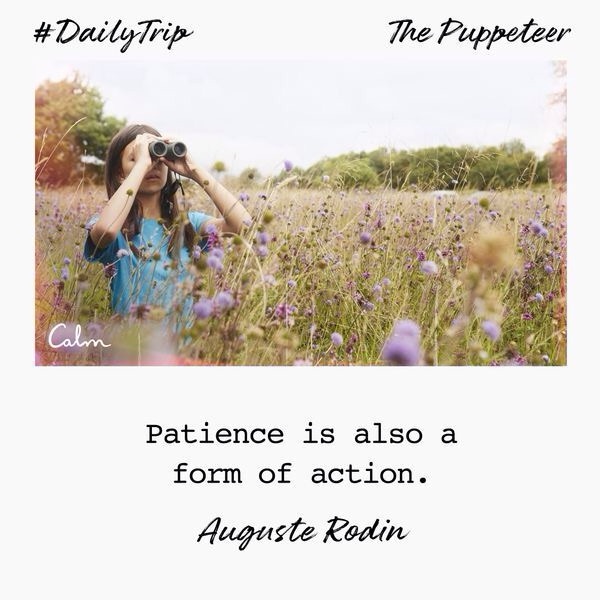
After suffering textbook burnout multiple times in my life, I overcalibrated towards patience. Buddhism, Taoism, and other spiritual philosophies that I studied lent themselves to patience and non-doing, which I felt I desperately needed at the time. Stoicism helped steer me back towards proactivity.

“Action without vision is blind; vision without action is just a dream.” – Nelson Mandela

I have found that Stoicism pairs well with Buddhism and Taoism. I would counsel people to consume all three in equal proportion. Stoicism helped teach me to take action and to do so boldly and consistently AND THEN to let go from there.

Detach from the outcome. Let go of how the action is received and perceived. 

That last part is a major missing piece from the good advice I received my entire life and hear/see being given to people these days by well-meaning folks. My experience has taught me that the majority of people are heavily tied up in the outcome of their actions. Not just entangled, but almost completely identified with their actions. 

That is also totally normal and natural. Aren’t we taught to believe that we are the result of our actions? Even if we aren’t taught that, isn’t there a consensus that a person’s identity is what they do? This is where spiritual philosophies and spiritual teachings fill in the hole I and many people feel inside of us when we’ve lived a life identified externally.

The teachings of Alan Watts, Ram Dass, Eckhart Tolle, and others provide empathy and compassion for myself and others in place of the default of judgment. The judgment of the patience, the judgment of the action, and the judgment of the results. Replacing all that judgment requires teaching and training because we live in a society that encourages and rewards judgment. 

Traditionally we have been our own worst critic. The modern era of the comment section has put negative judgment on steroids and placed it into a weapon of mass destruction with unlimited ammo.

“Empathy is about finding echoes of another person in yourself.” Mohsin Hamid

The scales of balancing patience and action are properly weighted with studying philosophy and spirituality.

Studying and applying the knowledge of these disciplines also helps to put an immeasurable, immaterial, internal balance on the scale in our very measurable, material, externally focused world. 

Before them, I was lost. I may not yet be found but I know I am at least on a path rather than walking alone and confused in the dark. 


“Man suffers only because he takes seriously what the gods made for fun. We seldom realize, for example, that our most private thoughts and emotions are not actually our own.” – Alan Watts

It is a lovely experience whenever I meet someone who hasn’t been conditioned to take everything and everyone so seriously. Do you know the type of person I’m talking about? Do you currently know people like that? Or do you have to access memories to think of that type of person?

It seems like more and more often I meet people who don’t have a sense of humor and who take everything and everyone as seriously as serious can. I know I fall into that trap as well, often in social situations. So I have empathy for the serious ones. I have been a very serious person for a good portion of my life and it was almost the death of me.

More than journaling or meditation, studying spirituality (starting at the peak of my agnostic/atheist phase) has helped me to lighten up and become more in touch and tune with the playful side of existence. First coming across, then diving right into the teachings of Wayne Dyer, Alan Watts, Eckhart Tolle, and Ram Dass introduced me to different perspectives that I desperately needed at the time and still need now in decisive moments and times of stress. 

I sometimes wonder if simply getting older would have made me take things less seriously. But then all I have to do is turn on the news during an election cycle in America and see how the masses drive themselves crazy taking themselves so seriously. Tens of millions of people have fallen into a “seriousness trap”.

We can fall into a “seriousness trap” by pledging allegiance to a political party, viewing it as a tribe destined to rule. This imbues the thoughts, opinions, and actions of not only the politicians but also their loyal followers (and even their enemies) with an inflated sense of immediate importance.

I used to be politically focused. I wanted to be a journalist so following politics was not optional for that desired career. Then, I dove deep into American economic history. The dispiriting realities of capitalism over the past century weren’t exactly inspiring. This, however, became a catalyst for my spiritual awakening. Two key takeaways from that part of my journey: the power of letting go and the joy of embracing life’s playful side.

“Mix a little foolishness with your serious plans. It is lovely to be silly at the right moment” – Horace

These aren’t just personal philosophies; they’re tools anyone can use. Regardless of background or beliefs, we can all benefit from loosening our grip and rediscovering the inherent fun of existence. Engaging in guided meditations and studying some of the spirituality teachers I’ve listed above are great places to begin your paradigm shift(s).


We think without realizing we’re thinking and we judge without realizing we’re judging.

It’s hardwired into us, as a survival mechanism. Like the majority of survival mechanisms that are hardwired into us thanks to evolution, our constant judging of the people, places, things, and situations around us serves as a detriment more than a benefit in the modern world.

For years, I’ve immersed myself in philosophy and spirituality, and my meditation practice goes back even further. Yet, day to day, I find myself falling back into egocentric judgment. It’s like an unconscious default – I judge myself and others harshly. I’m sure I’m not alone in this experience. It’s frustrating to dedicate so much time and effort to cultivating awareness and non-judgment, only to find myself slipping back into negativity.

Building awareness and staying non-judgmental is a never-ending process.

It’s kind of like meditation – you have to keep catching yourself when your mind wanders and bring it back to the present moment. Self-improvement and personal development are lifelong journeys, much like maintaining a healthy lifestyle. Despite years of studying great thinkers, my ego persists. I wonder if it will ever fully disappear, or if consistent awareness is the key to minimizing its influence.


Eckhart Tolle is quick to remind everyone that the world is not here to make our life easy, it is here to awaken us through challenges.

Awareness is the way out but it doesn’t do the work for us. No one else does. Nothing else will. 

I would love to think that I have been challenged and humbled by the universe thoroughly enough to be as detached from my ego as any living person. But I’m swimming against the tide in the quest to be detached from the ego. Another thing I need to be aware of consistently. 

Perhaps this is my spiritual practice. Tolle talks about what challenges us most is our spiritual practice. I suppose in that case I have a baker’s dozen worth of spiritual practices. 

Ryan Holiday has built a literary empire by reminding people that Ego is the Enemy.

I do know that negatively judging myself and others doesn’t help me at all. I’ve learned that through a good chunk of life experience. I was very much the cynical, sarcastic type for the majority of my youth and early adulthood. Sure the one-liners were occasionally a hit in bars, at parties, and on dates but eventually the barrel to shoot vitriol always ended up getting aimed at myself and those I cared about the most.

Over-calibrating to being a toxically positive patsy wasn’t the answer either.

One of the pragmatic benefits of studying and applying philosophy studies and spirituality practice is helping one find a middle ground. Being aware enough to detach from pride/ego even temporarily in the service of goal. 

Becoming aware enough to realize when I’m negatively judging is a recurring gift of meditation for me.

Studying the wisdom of some of the greatest thinkers in human history to guide my actions when I’m consciously aware is a recurring gift of philosophy study. Together they make existence a little simpler, a little easier, a little smoother, a little clearer. The more life experience I accrue the more I know that all of those little benefits are worth their weight in gold.

Overcoming ego is a lifelong journey

The small victories of self-awareness are the milestones that keep us motivated. Keep practicing mindfulness and cultivating awareness in your daily life. You’ll be amazed by the positive changes you experience, and how much easier it becomes to navigate the challenges that inevitably arise.


The good news is; that nothing lasts. The bad news is; that nothing lasts. 

Freeing if one perceives things going neutral or worse in their life situation.

Frightening for those doing well or better and want to go on winning living forever.

Stoic philosophy came into my life at the right time. After my mother passed away, along with therapy and psychedelics, stoicism helped me process my grief by providing a bird’s eye view or long-term perspective on life itself. Guided meditations, which had already been a part of my life before her passing, became an even more significant part of my mental-emotional survival. 

Death, the knowledge of death, and acceptance of death play a significant role in why I still study stoicism daily. We are all going to die – it’s the only guarantee in life and something all living things have in common.

No two people experience life the same way. But we are all going to die someday. 

Everything that rises must fall; everything that comes up will pass away. And so the beat goes on.

Change is the only constant.

Permanence is an illusion.

“Nothing is permanent in this wicked world, not even our troubles” – Charlie Chaplin

I find that to be very freeing. 

But like the concept, the thought itself is fleeting. I haven’t remembered that thought when anxiety, melancholy, or laziness hijacked my mind in the past. Albeit, only temporarily.

In the blink of an eye from one moment to another – one choice to another – one day to another – one week to another – one year to another – everything goes from being identical to being completely different.

Yet there is something about human nature that makes us unconsciously cling to the concept of permanence. Regularity and reliability are lionized, why? Because they are the exception. 

Order is not the rule, chaos is. Nature is chaos. Life is chaotic. Yet we as humans think if we surround ourselves with concrete and cement we can shirk the truth and natural order of existence. 

Eventually, everyone finds out that everything is temporary. 

The good news is; that nothing lasts. The bad news is; that nothing lasts. 

A simple, irrefutable fact that like many things, is easy to forget. Stoic philosophy and guided meditation practices help me to remember. I recommend them both wholeheartedly. Because we can all benefit from remembering the transient nature of life more frequently than the current western world status quo. 


“There is beauty and humility in imperfection.” – Guillermo del Toro

We are our own worst critic. We identify with our thoughts by default. We think we are our minds by default. So the idealized image of ourselves that we have in our heads is the standard we hold ourselves to. Regardless of how unrealistic that image is.

Then life layers wouldas, couldas, and shouldas on top of that idealized self-image. Social media inundates us with non-stop upward social comparisons. The rest of the media seems determined to scare and isolate us. Now all of a sudden negative self-talk that was once a pesky house fly, has evolved into a full-on rodent infestation. 

Our lives are constantly a work in progress. Social media not only encourages but actively boosts and rewards people and brands who present their image as a finished polished product. In the moment, how could we not compare ourselves and feel less than?

“Comparison is the thief of joy,” – Theodore Roosevelt

Self-criticism, like everything else in life, doesn’t happen in a vacuum. It often spirals, like all bad habits seem to do.  Before we know it, we haven’t just had our joy taken from us, but our confidence, esteem, and belief in ourselves. 

Curating our social media feeds is a more tangible option than deleting them altogether. Much like how eating a little better and doing a little exercise is a more realistic way of getting in shape. Small steps, one at a time, will add up more consistently than radical change at once for the majority of us.

The current era of social media has made philosophy, mindfulness, psychology, health, and wellness information more accessible, digestible, and entertaining than ever before. Searching topics and following accounts on informative and educational content has been a big help for me since the COVID lockdowns. 

Not a day goes by that I don’t watch at least a couple of Reels or YouTube shorts with clips from some of my favorite authors or thought leaders on self-improvement material. Whereas I once had to choose to watch a twenty-minute video or listen to a whole podcast, I can now get snack-sized, 30-second, personal development information on pretty much any platform. 

This can serve as a positive/productive double-edged sword. In that, it can make people feel less bad/wasteful about using social media in the first place, then provide beneficial information that is as easy to consume as it is to understand. So we’re beating ourselves up less for doom scrolling, and beating ourselves up less because we’re feeding our minds healthy information instead of metaphorical junk food.

Every little bit helps.

It really does. Every little beneficial thing we do for ourselves does help and does add up the more we do. No cure-all or magic pill of course. Consuming some informative content while we’re staring at a screen doesn’t do the work of self-actualizing for us. But it’s a step in the right direction, even if it is a baby step.  Baby steps still mean we’re moving forward. 


Some of the accounts I follow that create content that adds value to my life:

The Daily Stoic, The School of Life, Eckhart Tolle, Robert Green, Philosophies for Life, Therapy in a Nutshell, Dr. Tracey Marks, HealthyGamerGG, T&H, Einzelganger, Hellohappie Inspiration, Huberman Lab, and After Skool

Check any/all of those out, let me know what you think of them, and if you have some recommendations of accounts you think I should look into, please let me know in the comments.