Posts Tagged ‘politics’

The $900 Billion That No One Voted For

A $900 Billion Decision With Little Public Scrutiny

The U.S. House of Representatives this week approved the annual defense policy bill — the National Defense Authorization Act (NDAA) — authorizing roughly $900 billion in Pentagon spending for fiscal year 2026. The measure passed with broad bipartisan support, continuing a streak that has now lasted more than six decades.

According to reporting from CBS News and Reuters, the bill cleared the House by a 312–112 vote, once again exceeding the administration’s initial budget request and reinforcing a familiar outcome: the Pentagon’s budget grows, regardless of party control or global conditions.

Despite the scale of the authorization — one of the largest federal expenditures approved annually — the vote generated limited sustained public debate. Media coverage focused largely on procedural elements, such as troop pay increases and geopolitical provisions, rather than the broader question of why military spending has become one of the few areas of government effectively insulated from public resistance.


What the Public Actually Thinks

Public opinion data paints a far more complicated picture than congressional voting patterns suggest.

Long-term polling by Gallup shows that Americans are not clamoring for ever-higher military budgets. In 2024, only about 29 % of respondents said the United States was spending too little on national defense, while the majority believed spending was either “about right” or “too high.”

When asked more directly about budget increases beyond Pentagon requests, opposition becomes even clearer. A Data for Progress survey found that 63 % of Americans opposed increasing military spending above the requested level, including majorities of both Democrats and Republicans.

The disconnect is difficult to ignore: voters across party lines express skepticism about increased military spending, yet Congress delivers it year after year with bipartisan consensus.


A Budget That Always Goes Up

The Pentagon budget has become one of the most consistent growth mechanisms in American governance.

Wars begin, and the budget rises. Wars end, and the budget rises. Economic downturns, inflation, and public health crises — none have reversed the trend. Even in years without newly declared conflicts, defense authorizations continue to expand.

According to the Peter G. Peterson Foundation, defense spending remains the single largest category of discretionary federal spending, often rivaling or exceeding all other discretionary priorities combined.

This growth occurs with remarkably little interrogation of outcomes. While most federal programs are subjected to cost-benefit scrutiny, defense spending is treated as inherently justified — a baseline necessity rather than a policy choice.



The Military-Industrial Complex: Structure, Not Conspiracy

President Dwight D. Eisenhower’s warning about the “military-industrial complex” was not a prediction of corruption so much as a diagnosis of incentives.

Today, more than half of Pentagon discretionary spending flows directly to private defense contractors, including Lockheed Martin, RTX (Raytheon), Boeing, General Dynamics, and Northrop Grumman.

These firms spend tens of millions of dollars annually on lobbying, shaping procurement priorities and legislative outcomes in Washington.

This is not a shadowy conspiracy — it is an openly functioning system. Defense spending sustains regional economies, fuels revolving-door careers between government and industry, and anchors think tanks and policy institutions whose incentives align with budget growth.

When peace is bad for business, conflict does not need to be declared to remain profitable.


If Not Defense, Then What?

This is where the numbers stop being abstract.

$900 billion is not just a defense budget — it is a statement of national priorities.

That sum could meaningfully expand healthcare access, address student debt, fund public housing initiatives, modernize infrastructure, or strengthen climate resilience programs. These are not fringe ideas; they are perennial public demands.

Yet unlike military spending, domestic investments are always conditional. They must be negotiated, trimmed, justified, and re-justified. Defense spending, by contrast, is treated as automatic — the one area of government where growth is assumed rather than debated.

What threat, exactly, requires permanent expansion?

The United States increasingly practices defense by spending rather than defense by strategy. Budgets grow while outcomes remain unclear, conflicts multiply, and interventions persist with little accountability for long-term consequences.


America Is the Pentagon Now

At some point, the distinction between institution and identity blurs.

The Pentagon is no longer just a department — it is an economic engine, a political stabilizer, and a defining feature of American global posture. Its budget reflects not only perceived threats abroad, but a domestic system built around permanent militarization.

When Congress passes another massive Pentagon authorization that the public never meaningfully demanded, it sends a clear message: defense is not merely a priority — it is the default.

America does not simply have a military budget.
America is organized around one.

The question democracy must eventually confront is not whether defense matters. It is whether a democracy can remain responsive when its largest annual decision is effectively pre-decided.

That answer won’t come from another bipartisan vote. It will come from whether the public insists on asking why the budget always grows — and who it is really for.
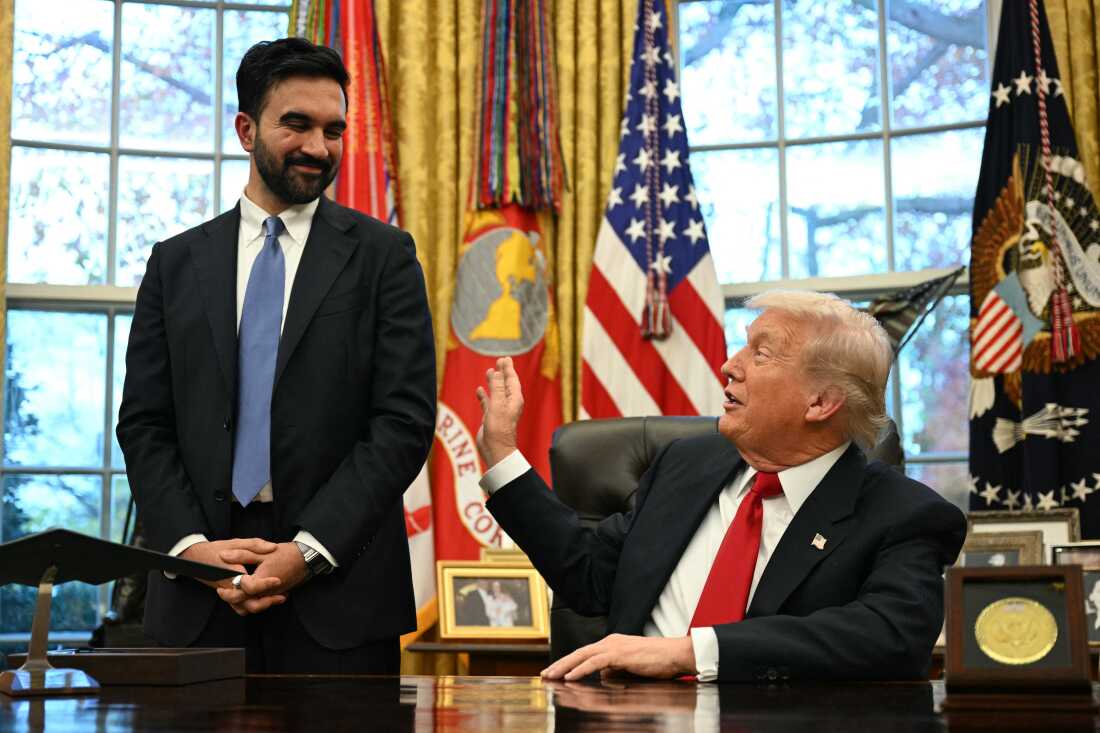


From Trump’s era of spectacle to a socialist rebalancing — what the city’s next chapter might look like.


Why the Race Shook the Nation

This mayoral race wasn’t just about New York. It became a national battleground — because billions of dollars and elite players converged on it; because the ideological stakes felt existential. A socialist candidate threatened not just the local housing market or rent rolls, but the very architecture of a city that defines global finance, real estate, and ambition. The backers saw more than policy — they saw precedent.

That’s why so much was poured into Super-PACs, media attacks, and fear-mongering. Because if New York could pivot, what would that mean: for other cities? For national capital flows? The spectacle of New York wasn’t just local drama. It had become a battleground in a broader war over what cities — and society — are for.


New York did not crown Trump by accident. The towers, the tabloids, the myth of power — all reflected the city’s appetite for dominance, extraction, being bigger than the system itself. Trump’s triumph was less about him than the ecosystem he mirrored.

Then came Zohran Mamdani. Young. Muslim. The son of immigrants. Raised in Queens. A former foreclosure counselor turned labor organizer turned state assemblymember. Now the city’s mayor-elect. His campaign pitched housing as infrastructure, transit as a right, wages as dignity. No private jets. No tabloids. A different axis. Wikipedia+1

On November 4, 2025, New York turned. It elected Mamdani over Andrew Cuomo (independent) and Curtis Sliwa (Republican). The Associated Press called it at 9:34 p.m. ET. The city spoke: it opted not for spectacle, but for substance. Wikipedia+1


Who Is Mamdani?

Born in Kampala, Uganda, to Indian parents, transplanted to Queens at age seven. U.S. citizen since 2018. Foreclosure counselor. Labor organizer. Then elected to the State Assembly for Queens/Brooklyn (AD-36). A political upbringing rooted in justice, community, dignity—not empire, tabloid glitz, or extraction. Wikipedia


What He Ran On (And Why It Matters)

  • Rent freeze on rent-stabilized units + building genuinely affordable housing. Wikipedia+1
  • $30/hour citywide minimum wage. Wikipedia
  • Fare-free buses and expanded public transit access. Wikipedia+1
  • Universal childcare and public-run grocery provisions, funded by higher taxes on wealthy & corporations. Wikipedia+1

These are structural prescriptions. If the prior era whispered “growth at all costs,” this one asks: “What does it cost you just to live? And how do we fix it?”


The White House Meeting: A Moment of Symbolic Weight

On Nov. 21, 2025 — just weeks after Mamdani’s win — he met Trump at the White House in the Oval Office. It was their first face-to-face after months of trading insults: Trump had framed Mamdani as a “communist” and threatened to pull federal funding; Mamdani had publicly called Trump a “fascist.” PBS+2The White House+2

But when cameras turned on, the posture changed — at least publicly. The meeting was “surprisingly cordial.” Trump praised Mamdani’s victory as a sign of strength; the two discussed affordability, economic security, and public safety. Trump later remarked they “agree on a lot more than I would have thought.” Vanity Fair+2PBS+2

Media outlets instantly framed the encounter as weird, symbolic — a moment where two political opposites met quietly in the same room. Some called it surreal. Others saw it as evidence the “establishment” might tolerate — or even try to co-opt — the threat represented by a socialist mayor in the world’s financial capital. Vanity Fair+2C-SPAN+2


The Swing, Not the Rupture

This isn’t a clean break. The mechanisms — capital, real estate, media — still loom. But for a moment, elected power shifted its axis. Instead of “How do we out-shine the competition?” we heard: “How do we out-serve a city?”

Because balance isn’t static. The spectacle that defined past decades will test this administration: budgets will strain, expectations balloon, the opposition circles. If Mamdani behaves like the organizer he once was, not a brand, maybe this pendulum will settle.


The Real Test — And the Larger Narrative

Free transit costs money. A $30 wage shifts markets. A rent freeze courts legal pressure. And behind it all: can governance stay grassroots in a global city when the old order is still breathing loud and heavy?

The White House meeting — the optics, the handshake, the “we agree more than you think” line — it added a layer to the story. Not a twist. A warning. A lens. Because when the world sees a socialist mayor walking into the same Oval Office as the buttoned-down president, the question becomes: Is the message containment — or accommodation?

This isn’t about whether socialism will “save” New York. It’s about whether New York can sustain a politics of belonging — when every institution around it expects performance, not belonging.

Because when New York changes, everything else listens.


We’ve just been through another moment: Charlie Kirk dead, an American provocateur murdered during a public event.

Immediately, the gears of outrage, social media spectacle, and moral posturing started turning. But underneath the noise, ask yourself: how much of what’s going on is politics as usual? And how much is a vivid distraction from what really holds power in this country?

“If I see a Black pilot, I’m going to be like, boy, I hope he’s qualified.” — The Charlie Kirk Show, January 23, 2024 The Guardian


The Spectacle & Response

If you scroll through social media or listen to pundits, a few things become crystal:

  • Charlie Kirk has been more than “just another right-wing podcaster”; for many on the Right, he is being elevated to martyr, symbol, hero. This is intentional. It fuels identity, animus, and grievance.
  • Meanwhile, the Left is also practicing its version of virtue displays: denunciations, calls for “free speech,” arguments over who is more morally responsible. Sometimes these are sincere; often they are performative.

Then there’s the machinery of suppression/support. Jimmy Kimmel gets pulled off the air indefinitely for his remarks about the killing. Platforms scramble. Lawmakers issue statements. Some people are fired, suspended, disowned for social media posts judged too flippant, too critical, too celebratory (or even just insufficiently mournful).

“You will never live in a society when you have an armed citizenry and you won’t have a single gun death. That is nonsense. It’s drivel. But I am — I think it’s worth it.” — Charlie Kirk


Lost in the Frenzy: What Actually Matters

While we lock into tribal alignment over “Is X more to blame?” or “Did Y censor free speech?”, real decisions continue to be made elsewhere—decisions that hurt or help ordinary lives.

  • Income inequality: Since 1980, the bottom 90% of U.S. earners have seen incomes rise ~36%, while the top 1% shot up ~162% and the top 0.1% exploded by ~301%.
  • Wage stagnation: Median weekly earnings for full-time workers in mid-2025 are ~$1,196. For women, it’s ~$1,078. Adjusted for inflation, most wages haven’t moved much in decades.
  • Medical debt: 40% of adults report bills they can’t pay. Roughly 20 million Americans owe medical debt, totaling at least $220 billion.
  • Bankruptcies: 2024 saw over 517,000 filings, up 14% from the year before. Medical bills remain a top driver.
  • Life expectancy: Americans in the wealthiest counties live about 7–10 years longer than those in the poorest. Poverty literally shortens life.

These are not abstractions. They are the ground we stand on, and they’re being ignored while we fight over who disrespected whose memory.

“Happening all the time in urban America, prowling Blacks go around for fun to go target white people, that’s a fact. It’s happening more and more.” — The Charlie Kirk Show, May 19, 2023 The Guardian


The Trap of Left vs Right

This is the pattern: tragedy or provocation → political polarization → spectacle → distraction. And the Left vs Right framing helps elites on both sides:

  • Right-wing media gets a martyr, a rallying cry, an excuse to push further culture war rhetoric.
  • Left-wing media and centrist commentators get to critique, outraged, safe inside their media bubbles, while pointing fingers.
  • Neither side is forced to substantially challenge the power structures: the economic inequality, corporate control of media, tech platform power, the role of political money.

“Keep America free … You should be allowed to say outrageous things … There’s ugly speech. There’s gross speech. There’s evil speech. And all of it’s protected by the First Amendment.” — earlier in 2025, in remarks pushing back against limits on free speech. The Santa Barbara Independent


Class War, Not Culture War

Here’s what we lose when class war is displaced:

  • People who could be allies don’t realize their shared stakes. Someone working a low-wage job and voting for the Right may still suffer under the same rent inflation, the same healthcare inaccessibility as someone voting for the Left. But because symbols and culture dominate, they are told to hate each other instead.
  • Policies that could improve life—universal health care, affordable housing, stronger unions, more equitable taxation, campaign finance reform—are sidelined as too “political” or unsexy amid culture war spectacle.
  • Elites (corporations, wealthy donors, political insiders, media conglomerates) are mostly unaffected by the noise. Their power increases because scandal, outrage, fear allow for more regulation of dissent (or selective enforcement), more control over narrative, and more justification for reinforcing the “security” apparatus.

“America was at its peak when we halted immigration for 40 years and we dropped our foreign-born percentage to its lowest level ever. We should be unafraid to do that.” — The Charlie Kirk Show, August 22, 2025 The Guardian


What We Should Be Looking Up At

If we want to shift the ground, here’s what it means to look up not sideways:

  • Hold powerful institutions accountable: Big tech, media conglomerates, regulatory agencies, secret lobbying networks.
  • Shift public focus to material conditions: how many people cannot afford medical care; how many are one paycheck from eviction; how wealth is concentrated.
  • Build movements oriented around economic justice, not just identity or ideology. Worker organizing, co-ops, mutual aid, housing justice.
  • Demolish or weaken the structures that enforce class inequality: tax loopholes, corporate welfare, deregulated finance, and campaign finance that amplifies elite voices.

“If we would have said that Joy Reid and Michelle Obama and Sheila Jackson Lee and Ketanji Brown Jackson were affirmative action picks, we would have been called racists. Now they’re coming out and they’re saying it for us … You do not have the brain processing power to otherwise be taken really seriously. You had to go steal a white person’s slot to go be taken somewhat seriously.” — The Charlie Kirk Show, July 13, 2023 The Guardian


Defend free speech. Don’t confuse theater with truth. Don’t let the spectacle steal the stage from power.


Culture war is a powerful machine. It divides communities, drains energy into rage, and channels anger toward the wrong targets—often toward each other. Meanwhile, the people who really control the levers of economic power, of media control, of policy-making, carry on largely unchallenged.

The class war may not feel dramatic; it may feel slower, like moving tectonic plates. But its consequences are far deeper and more pervasive than the latest outrage.

And if we don’t shift our attention, the cycle will keep repeating: event → sides drawn up → outraged tweets and show cancellations → temporary appeasement → next event. Without meaningful structural change, nothing really gets better for most people.


“It isn’t ‘They’re spying on me through my phone’ anymore. Eventually, it will be ‘My phone is spying on me.’” That warning from Philip K. Dick captures the slope Palantir is already halfway down—turning citizens into data points, and autonomy into algorithmic obedience (Goodreads).

As Edward Snowden put it, “Under observation, we act less free, which means we effectively are less free” (Goodreads). That’s the business Palantir is in: surveillance disguised as efficiency, control dressed up as analytics.

This isn’t theory. Palantir already fuels ICE raids, predictive policing, corporate risk dashboards, and battlefield logistics in Ukraine (IBANet). As Thor Benson reminds us, “Don’t oppose mass surveillance for your own sake. Oppose it for the activists, lawyers, journalists and all of the other people our liberty relies on” (Ammo.com).

Palantir isn’t just selling software. It’s selling obedience. And like all Silicon Valley myths, it started with a story about “innovation” that hid something darker.


Origins & Power Connections

Founded in 2003 by Peter Thiel, Alex Karp, Joe Lonsdale, and Stephen Cohen (Wikipedia), Palantir wasn’t born in a garage—it was born in Langley’s shadow. Early funding came from In-Q-Tel, the CIA’s venture arm (DCF Modeling). When your first investors are spymasters, your product isn’t disruption. It’s surveillance.

Its flagship platform, Gotham, was built hand-in-glove with U.S. intelligence agencies. Palantir engineers embedded inside government offices stitched together oceans of data: phone records, bank transactions, social media posts, warzone intel (EnvZone). Palantir didn’t just sell a tool; it sold itself into the bloodstream of the national security state.

By the time it was worth billions, Palantir was indispensable to the U.S. war machine. Its software was used in Afghanistan and Iraq (SETA Foundation), where surveillance wasn’t a civil liberties debate but a weapon of war. When those tools came home to American cities, they carried the same battlefield logic: control first, questions never.


Domestic Impact: Policing & Immigration

Palantir’s second act was on U.S. streets. Its predictive policing contracts in Los Angeles, New Orleans, and beyond promised crime prevention through data. In reality, biased arrest records fed the machine, and the machine spit bias back out dressed as math (SETA Foundation).

Shoshana Zuboff warned: “Surveillance is the path to profit that overrides ‘we the people,’ taking our decision rights without permission and even when we say ‘no’” (Goodreads). Prediction isn’t neutral—it’s a form of control.

Immigration enforcement sharpened that control. Palantir built ImmigrationOS for ICE, consolidating visa files, home addresses, social media posts, and more (American Immigration Council). Critics call it “deportation by algorithm.” In Palantir’s language, that’s “efficiency.” The human cost is invisible in the spreadsheet.

A traffic stop can spiral into deportation. A visa application can flag someone as “high risk” with no explanation. Entire neighborhoods live under digital suspicion. And when protests erupted against these tools, six activists were arrested outside Palantir’s New York office in 2025 (The Guardian).

Palantir insists it only “builds the tools.” But when those tools fracture families and criminalize communities, the line between code and consequence vanishes.


Global Expansion: From Battlefields to Boardrooms

War proved Palantir’s business case. In Afghanistan and Iraq, its engineers sat beside soldiers, mapping bomb patterns and insurgent networks with data fusion software (SETA Foundation). The Pentagon called it a breakthrough. Critics called it privatized intelligence.

Now, Ukraine is Palantir’s showcase. Its tools analyze satellite imagery, coordinate battlefield logistics, and even gather evidence of war crimes (IBANet). CEO Alex Karp boasts Ukraine is a “tech-forward war.” But once normalized on the front lines, surveillance rarely stays in the trenches.

And Palantir’s reach doesn’t stop at war. Its Foundry platform runs inside JPMorgan, Airbus, Merck, and Fiat Chrysler (Wikipedia). What began as battlefield software is now a corporate dashboard—tracking supply chains, financial risks, and consumer behavior. The architecture is the same: consolidate data, predict outcomes, reduce uncertainty. Only the labels change.


Surveillance Capitalism & The Future

Jeremy Bentham’s Panopticon imagined a prison where one guard could watch every inmate without them knowing when they were being watched. “Visible: the inmate will constantly have before his eyes the tall outline of the central tower… Unverifiable: the inmate must never know whether he is being looked at” (Farnam Street). It was a theory then. Palantir has built it for real—and scaled it to entire societies.

Zuboff called surveillance capitalism a regime that reshapes human behavior for profit (Yale Law Journal). Palantir goes further, reshaping governance itself. Its platforms don’t just analyze data; they dictate institutional behavior, target populations, and define acceptable outcomes. The architecture dictates the politics.

Glenn Greenwald cut to the core: “The mere existence of a mass surveillance apparatus, regardless of how it is used, is in itself sufficient to stifle dissent” (Goodreads). That stifling doesn’t make headlines. It happens in silence—when a protest isn’t planned, when a whistleblower doesn’t speak, when communities live in quiet fear of an algorithm they can’t see.

And that’s why Benson’s warning should stick: “Don’t oppose mass surveillance for your own sake. Oppose it for the activists, lawyers, journalists, and all of the other people our liberty relies on” (Ammo.com). Because the weight of Palantir’s code doesn’t fall evenly. It presses hardest on those who dare to resist.

Orwell said it plainly: “Big Brother is watching you.” The 21st-century twist is worse. Big Brother has been privatized, optimized, and sold at a markup (The Guardian).


Truth Over Tribalism

Follow anarchyroll:

Wisdom Is Resistance

Systemic Cruelty Dressed Up as Policy


Like slavery and apartheid, poverty is not natural. It is man-made and it can be overcome and eradicated by the actions of human beings. — Nelson Mandela (earth.org)


Criminalization of Survival

Across the United States, cities are treating the act of survival—sleeping, sitting, asking for help—as criminal behavior. These punitive “sit-lie” laws, camping bans, sweeps, and aggressive policing do not solve homelessness—they entrench it.

The National Homeless Law Center notes that criminalizing homelessness punishes life-sustaining activities and makes it “more difficult to escape” homelessness (homelesslaw.org). Human Rights Watch calls Los Angeles’s enforcement “cruel and ineffective,” targeting the visible poor rather than root causes (hrw.org).

And the National Alliance to End Homelessness found in a 2025 report that criminalization fails to enhance safety and instead deepens racial inequities (endhomelessness.org).


Welfare as Surveillance

What was once a safety net has become a web of surveillance and moral judgment. Welfare recipients often face drug testing, work mandates, and algorithmic gatekeeping. The state spends more money building systems to punish “fraud” than the fraud itself.

The broader trend is summed up in the concept of the criminalization of poverty—fines, anti-homeless laws, welfare policing—all disproportionately penalize people for behaviors tied to economic status (en.wikipedia.org).


Bipartisan Neglect

From Clinton’s “end of welfare as we know it,” to Republican austerity, to performative pandemic relief—both parties have abandoned structural solutions. Poverty remains a prop for campaigns, a scapegoat for policy failures.

The trajectory is clear: LBJ’s 1964 War on Poverty drastically reduced poverty, but the programs were retrenched in the decades that followed (en.wikipedia.org). As the New Yorker observed, “the retrenchment of the social-welfare state went hand in hand with the rise of the prison and policing state” (newyorker.com).


Policy as War

This isn’t side-effect cruelty—it’s intentional. Austerity is meticulously planned: sprawling military budgets and corporate bailouts while school lunches vanish, shelters shrink, and Medicaid is constantly threatened.

Anti-homeless laws that target sitting, sleeping, begging, and even sharing food are not about solving poverty—they’re about making the poor less visible (en.wikipedia.org).


Turning Cruelty into Care

Poverty isn’t inevitable—it’s policy. But if it’s made, it can be unmade.

Everyday Direct Care

  • Support mutual aid groups, solidarity kitchens, street medicine teams, and eviction defense networks.
  • Donate to or volunteer with organizations that protect civil rights for the unhoused, such as those advancing a Homeless Bill of Rights (en.wikipedia.org).
  • Choose ways to help that don’t rely on surveillance or punishment, but on trust and dignity.

Local Policy Pressure

  • Demand that local officials defund homeless sweeps and redirect funds to housing-first programs, mental health care, and tenant protections.
  • Organize for the passage of Homeless Bills of Rights in your state or city.
  • Pressure city councils and state legislatures to prioritize affordable housing budgets over police budgets.

State & National Strategy

  • Advocate for restoring and expanding War on Poverty–era programs like Head Start, expanded tax credits, and affordable housing investments.
  • Oppose laws that subject welfare recipients to invasive surveillance, drug testing, or punitive work requirements.
  • Build alliances that prioritize social infrastructure over military expansion or corporate subsidies.

This is the real choice: treat poverty as crime, or treat it as solvable. The first path guarantees endless war on the poor. The second path builds a society worth living in.


Truth Over Tribalism

Follow anarchyroll:

Wisdom Is Resistance