Posts Tagged ‘self improvement’


Photo by Inggrid Koe on Unsplash

The Unseen Habit

I judge.
People. Situations. Myself.

It’s quick — reflexive. A smirk. A label. A silent narrative in my head.
Sometimes I catch it. Sometimes it slides right by, disguised as clarity or intelligence or “just being real.”

Lately, I’ve been thinking about the way judgment sneaks in. The way it steals connection. The way it shuts me down just as I’m trying to open up.


“When you judge another, you do not define them, you define yourself.” — Wayne Dyer


Judgment Is the Brain’s Shortcut

Here’s the thing: we’re wired to judge.

The default mode network in our brains lights up when we’re not focused — when we’re daydreaming, remembering, worrying. It loops us into self-referential thought, comparisons, fears, and projections. This is the architecture of judgment.

But it’s not just biology — it’s existential.


Until you make the unconscious conscious, it will direct your life and you will call it fate. — Carl Jung


Jung said we project the parts of ourselves we can’t face. That’s the shadow. So when I label someone as arrogant or fake, maybe I’m glimpsing something unresolved in me. Judgment becomes a mirror. A distorted one.


“It’s not things that upset us, but our judgment about things.” — Epictetus


It’s not the lateness — it’s the story I tell about what it means.
It’s not the failure — it’s the belief I should never fail.

Why It Feels Good to Judge (Even When It Hurts)

Judgment makes me feel like I know something.

Like I’m in control. It’s safer to judge than to feel.

I missed a goal I set? I rush to label myself “undisciplined” before anyone else can.

This is ego defense.


“Compassion is the radicalism of our time.” — Dalai Lama


Humanism reminds us that people need acceptance to grow. But judgment replaces understanding with control. It keeps others at a distance and keeps me in a loop of performance and critique.

Photo by Pawel Czerwinski on Unsplash

What We Lose When We Judge

Judgment disconnects.
From others. From ourselves.

It feels powerful in the moment, but it fractures trust. It turns people into characters in a play we’re writing. And when I’m in judgment mode, I can’t listen. I can’t learn. I can’t love.


“Hell is other people.” — Jean-Paul Sartre


But maybe the real hell is the lens we use to see them.

The Antidote: Awareness, Not Avoidance

So, how do we move forward?

Not by pretending we never judge.
But by noticing it, getting curious, and slowing down.


“Between stimulus and response, there is a space. In that space is our power to choose our response.”— Viktor Frankl


The Stoics called it prohairesis — the inner freedom to choose how we interpret and respond to life. That space is everything.

A Daily Practice in Unlearning

I still judge. But now I try to see it.
I question it. I sit with it. I breathe before I speak.

Sometimes I succeed. Sometimes I don’t.

But that’s the practice — replacing reaction with reflection.
Replacing condemnation with compassion.
Replacing the need to be right with the desire to see clearly.


“We’re all just walking each other home.”— Ram Dass


That hits differently now.

Maybe we walk each other home more easily when we stop narrating the journey and start sharing it.

Photo by Tegan Mierle on Unsplash

I write about the messy parts of being human — judgment, ego, awareness, and all the places we trip on our way to clarity.


If this piece made you pause or reflect, you can:

  • Leave a comment — what helps you catch yourself when you’re judging?
  • Follow me for more essays that blend Stoicism, spirituality, and human insight.


When Ego Poses as Progress

“It is impossible for a man to learn what he thinks he already knows.” — Epictetus

There’s a trap hidden inside progress: ego. It convinces us that a small victory is the end of the road. We meditate for a few days, journal for a week, resist anger once, and assume we’ve outgrown our old selves. The ego, ever clever, disguises pride as peace and comfort as growth.

But real growth is humble. It doesn’t parade. It continues quietly when no one is watching. Stoicism reminds us to stay grounded in process, not outcomes.

When we think we’ve “arrived,” we often stop doing the very practices that helped us make progress in the first place. That’s when we slide — not because we’ve failed, but because we’ve stopped paying attention.

In Buddhism, the same warning shows up in the cycle of craving and aversion. We crave success. We avoid discomfort. And those reactions can drag us backward even while we think we’re moving forward.

The Loop of Craving, Clinging, and Collapse

“You only lose what you cling to.” — Buddha

In Buddhist thought, suffering is born from clinging. We cling to progress, to feeling good, to staying motivated. When that feeling slips — because it always will — we resist. We call it laziness, backsliding, failure. But in truth, it’s just another turn of the wheel.

Falling back into old habits doesn’t mean we’re broken. It means we’re alive. The path isn’t straight — it’s circular. The work is in noticing when we’ve wandered, and gently guiding ourselves back.

Where Buddhism teaches us to notice and redirect, Taoism invites us to release altogether. It echoes this return not with instruction, but surrender.

Photo by Clay Banks on Unsplash

Flow Over Force

“Nature does not hurry, yet everything is accomplished.” — Lao Tzu

Taoism teaches that struggle often slows us down. We force progress with guilt, pressure, and shame. But flow — the true kind — is effortless. Not lazy, not passive, but aligned. When we move with the current instead of thrashing against it, life moves with us.

Progress isn’t always action. Sometimes it’s rest. Sometimes it’s the decision not to give up. In the Tao, stillness is not a setback — it’s a season. We forget this when we measure ourselves only by how fast or far we move.

Still, even when we trust the current, we’re swimming with a brain wired for old patterns. And once we understand how the brain resists change, we face the deeper challenge: choosing change anyway.

Biology Isn’t Destiny

“Neurons that fire together, wire together.” — Hebb’s Rule

Every old habit has a neural trail. The brain, designed for efficiency, defaults to what it knows, especially under pressure. When stress hits, we go back to autopilot. That might look like procrastination, self-doubt, or retreating from challenges.

But there’s no moral failure here. Just biology. The good news? Biology can change. When we choose new patterns — again and again — we start rewiring our reflexes. Not instantly. Not perfectly. But gradually. That’s the work.

Neuroscience gives us grace. It reminds us that missteps are not proof we’re doomed. They’re proof that our brains are following their training. And if we can train them once, we can train them again.

And to keep showing up for that work — again and again — we need to believe we’re worth the effort. Even when we fall short.

Photo by Harli Marten on Unsplash

Becoming Human On Purpose

“The curious paradox is that when I accept myself just as I am, then I can change.” — Carl Rogers

Humanist personal development starts with compassion. It isn’t about hacking our habits or becoming productivity machines. It’s about remembering we are people. Messy, brilliant, imperfect people. And we grow best in environments where we feel safe — not shamed.

We think self-criticism keeps us sharp. But often, it just keeps us scared. True accountability starts with honesty, not hostility. We can fall off without falling apart.

Forgiveness isn’t letting ourselves off the hook. It’s giving ourselves a hand backup. It’s choosing to keep going instead of giving up. Progress is possible — not through perfection, but through patience.

Closing Thoughts: Keep Going

Hope isn’t naïve. It’s necessary. Especially when we’ve stumbled, when our patterns feel unbreakable, when the voice in our head says we’ll never change. It’s easy to confuse rest with surrender, or to believe that one setback means we’re back at zero.

But we’re never at zero. Every breath, every choice, every moment we show up again builds something. This isn’t about hustle. It’s not about proving anything to anyone. It’s about building a reality that sustains us — from the inside out.

Whether we work with our hands or our minds, whether we’re exhausted or just starting, the path forward remains the same: one small, honest, imperfect step at a time. Not with shame. Not with panic. But with presence. With self-compassion. And with the quiet discipline to keep going.


I want to write about this subject because, despite years of meditation, personal development, journaling, yoga, philosophy, and spirituality, when I get pressed, I still find myself acting out of ego.

I judge people. I think negatively. I feel bad. My mind races. I replay negative situations over and over. I get vulgar, angry, hostile, and negative.

Being older now, and having studied philosophy and spirituality for almost two decades, and consumed personal development content for twenty years, I know that this doesn’t make me inferior or unique — it makes me human. And I want to share this with others. It’s okay to be human. It’s okay to screw up. Negative events don’t define who we are.

Photo by Jeremy Yap on Unsplash

A negative outburst doesn’t define me. Doing the wrong thing doesn’t define me. Failing to practice what I preach doesn’t define me. It makes me a human being.

That’s why I study philosophy. It’s why I have a spirituality practice. It’s why I meditate. It’s why I study humanist personal development. It’s why I’m drawn to neuroscience.

We all struggle with these challenges, and I want to explore how ego-driven anger is something we all experience, especially in today’s world.

Photo by Dave Hoefler on Unsplash

The Hidden Role of Ego in Anger

The ego — the sense of self that fuels our need for validation, control, and superiority — often hides in plain sight. It shows up in negative judgments, reactive thoughts, and moments of anger. But it’s not always the loud, brash ego we imagine. Sometimes it’s the quiet voice that whispers, “I deserve better,” or “I’m right and they’re wrong,” feeding our emotions and judgments without us even realizing it.

“Your anger and annoyance are more detrimental to you than the things themselves which anger or annoy you,” — Marcus Aurelius

Philosophy: The Stoic and Taoist View of Ego

Stoicism teaches us to observe our emotions without judgment — to step back and recognize that we are not our anger. Taoism, on the other hand, encourages letting go of resistance and embracing the natural flow of life.

“Knowing others is intelligence; knowing yourself is true wisdom.”— Lao Tzu

Spirituality: Understanding Ego through Mindfulness

Spiritual practice, especially mindfulness, offers a direct experience of observing the ego. Buddhism teaches that anger arises from attachment to the self and from clinging to identity and righteousness.

“When we let go of the need to be ‘right,’ we allow the ego to dissolve on its own, like a drop of water evaporating in the sun.” — Thich Nhat Hanh

Photo by Mike Labrum on Unsplash

Intellect and Neuroscience: How the Brain Reinforces Ego

Science has begun to confirm what ancient philosophies intuited long ago. Our brain’s default mode network — active when we’re ruminating or imagining — fosters ego identity. The brain rewards validation and recognition, making it easy to get stuck in ego-based loops, even when we know better.

Humanism: Embracing Our Humanity

The humanist approach is rooted in self-compassion. We don’t grow by shaming ourselves — we grow by understanding and responding with care. To be human is to be imperfect.

“The curious paradox is that when I accept myself just as I am, then I can change.” — Carl Rogers

Ego Is a Messenger

Ego-based anger is part of the human condition — especially in a fast-paced, comparison-driven society. We don’t need to destroy our ego. We just need to recognize when it’s taking the wheel. That recognition alone is a kind of freedom.

Next time the anger hits, ask: “Is this my ego speaking?”
Pause. Breathe.
Try to let that moment of awareness be enough.

Photo by Fabrizio Chiagano on Unsplash


The act of beginning again is itself the practice — not a flaw in the process, but the process. We tend to think of starting over as something reserved for mistakes or failures, as if it’s a sign we’ve strayed off course. But what if beginning again is actually the most honest course we can take?

Every breath is a reset. Every day we wake up alive is a quiet invitation to try once more — this time with a little more clarity, a little more compassion, a little less ego. We are not meant to stay in motion uninterrupted. We are meant to pause, to question, to recommit. To begin again is not weakness. It’s wisdom.

This idea — that beginning again is not a detour but the path itself — is something the Stoics understood deeply. To them, each moment was a fresh opportunity to align with reason, virtue, and the present.


“You could leave life right now. Let that determine what you do and say and think.” — Marcus Aurelius


The urgency here isn’t morbid — it’s motivational. It’s a call to reset with intention, without needing a grand reason. Just the present moment is reason enough. Focusing on what I have control over, in the present moment, and then taking action with a sense of urgency is a balanced approach to life that Stoicism has brought to my attention many times.

Where Stoicism urges us to meet the moment with discipline, Taoism invites us to meet it with ease. If the Stoics offer a firm hand on the tiller, the Tao offers an open palm to the wind.


“Nature does not hurry, yet everything is accomplished.” — Lao Tzu


There’s wisdom in allowing our return — our beginning again — to unfold naturally, like water finding its path downhill. Taoism helps to take the weight off our backs and reduce the pressure we put on ourselves.

Photo by Tatiana Rodriguez on Unsplash

Taoism teaches us to flow, but Buddhism teaches us to see. To see the moment clearly, without clinging or resistance. In the Buddhist view, every beginning is just part of the great cycle of arising and passing away. The breath in. The breath out. There is no need to carry the weight of yesterday when the present is already enough.


“Each morning we are born again. What we do today is what matters most.” — Buddha


These ancient philosophies of nature and simplicity feel more vital than ever in a world shaped by constant productivity, curated identities, and hustle culture. Internally and externally, we’re pressured to do more, be more, and prove our worth through performance.

That pressure often leads to stagnation, analysis paralysis, and burnout. But revisiting these timeless teachings — ones that predate democracy and capitalism — offers calming reassurance. It reminds us that what we’re feeling isn’t failure. It’s human. And it makes beginning again feel not only acceptable, but natural.

Returning to the present — the Stoic, Taoist, and Buddhist invitation to simply be — also finds support in modern psychology and neuroscience. Where ancient wisdom speaks in metaphors and mantras, contemporary science offers data and neural pathways.

Dr. Andrew Huberman often reminds us that real change begins not with motivation, but with action. Tiny, repeated actions reshape the brain through neuroplasticity. So even when the mind says, “Why bother starting over?” the body can respond, “Because this is how we grow.”

Science may explain how we change, but philosophy still asks us why. Why return to a craft, a calling, a version of yourself you once abandoned?

The answer, I’ve found, is rarely logical. It’s personal. It’s emotional. Because I’m a person and people aren’t logical, we are emotional beings.

Sometimes it’s a whisper — other times a reckoning. But whatever shape it takes, it’s a form of recommitment. Not to some imagined perfection, but to the values and curiosities that make us feel most alive.


“You’re under no obligation to be the same person you were five minutes ago.” — Alan Watts


All of this — the philosophy, the science, the stillness — eventually brought me back to something simple but easy to forget: the quiet power of recommitment. Not a dramatic restart. Not a brand-new version of me. Just a returning.

A choice to keep showing up, to remember what matters most, and to walk toward it again, even if slowly. I’ve realized it’s not about being perfectly consistent. It’s about being consistently willing to try — to give whatever effort you have in you, in the moment.


There will always be reasons to delay the return — doubt, fear, the feeling that we’ve waited too long. But the truth is, we don’t need permission to begin again. Not from others, and not even from our past selves.

The beginner’s mind is the bravest mind. The moment we choose to return — to a habit, a purpose, a part of ourselves — we’re already on the path. Whether it’s through meditation, journaling, movement, or simply pausing to take a breath, there are so many ways to come home to yourself. Whichever path you take, just know this: beginning again doesn’t make you a beginner. It makes you human. It makes you brave.


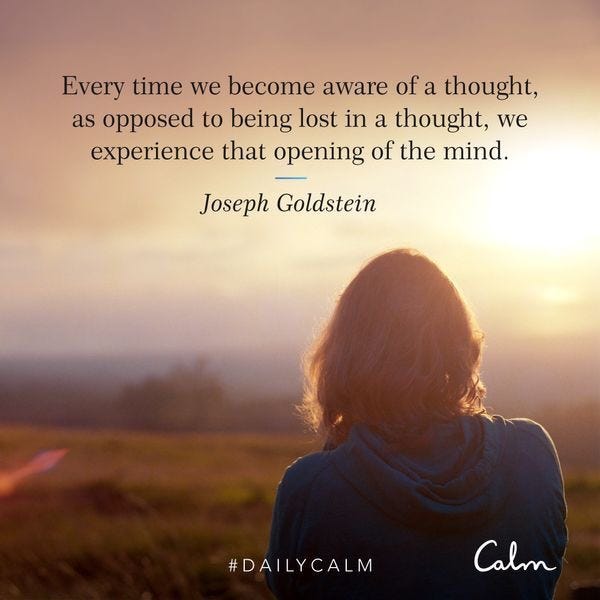
The challenge of maintaining awareness of our thoughts is a fundamental aspect of human experience. Our minds are hardwired to think and become lost in thought streams constantly.

However, awareness of our thoughts and the ability to open our minds is crucial for personal growth and mental well-being. By revisiting this concept, we can continually remind ourselves of its importance and strive to live more consciously.


Many, if not most, people are completely identified with their thoughts and emotions. Despite meditating and studying philosophy and spirituality for ten years, I still slip into identification with my thoughts and emotions. I have often found myself dragged into petty thoughts and judgmental emotions.

Even though I take multiple actions habitually to counteract negativity such as:

  • reading philosophy
  • meditating
  • journaling
  • taking mood support supplements
  • doing yoga
  • walking outside
  • getting around eight hours of sleep
  • hydrating
  • drinking herbal tea
  • lifting weights
  • eating healthy meals
  • watching self-improvement videos on YouTube
  • listening to binaural beats
  • limiting screen time

I still constantly identify with my thoughts, emotions, and life situations.

Becoming aware of our thoughts, breaking free from identifying with them, and opening up the mind are important subjects to me. Worth coming back to again and again. Because it is an inner fight we all must wage again and again if we are to live a life of inner peace.

Typically, awareness of our thoughts is not the norm — automatic thoughts usually dominate. In cognitive psychology, automatic thoughts are rapid, often unconscious assumptions or conclusions that arise in response to a situation or stimuli. They appear without conscious effort and are usually brief, immediate interpretations of an event, often with a negative bias.

“Thoughts are like clouds in the sky. Sometimes it’s clear, sometimes it’s cloudy. But don’t get attached to the clouds.” — Thich Nhat Hanh

Automatic thoughts often lead to runaway thoughts, which are longer and more intense versions of automatic thoughts. A consistent double dose of automatic and runaway thoughts can likely result in cognitive distortions, confirmation biases, and intense emotional triggers.

Observing social media and the modern world, it seems more people are easily triggered when their confirmation bias, built on cognitive distortions, is challenged or broken. A clear example is the state of America after a presidential election.


Photo by Dan Crile on Unsplash

“It is not what happens to you that troubles you, but your judgment about what happens.” — Epictetus


Identifying with our thoughts means being consumed by them. Our true selves get swallowed up and erased due to constant states of stress, anxiety, disappointment, depression, and anger. We can’t escape fight-or-flight survival mode if we are constantly pulled into the rushing stream of automatic and runaway thoughts.

We must continuously choose to be aware and detach from our thought streams because our thoughts never stop. Our minds are thinking machines, but they do not define who we are. We are not our minds. We are not our thoughts. We are not our emotions. We must constantly cultivate awareness and remind ourselves of this truth.

Photo by Bahadır on Unsplash

Practical ways to practice awareness include mindfulness, which involves being fully focused on the present moment. Deep breathing exercises and guided meditations have also significantly helped me in my ongoing effort to increase awareness in my life. Journaling is beneficial as well, provided you consistently write and periodically review past entries to observe your patterns and progress.

Cultivating awareness of our thoughts while remaining detached from them can create an opening in the mind. The more we expand that opening with healthy practices like mindfulness, yoga, journaling, meditation, and studying philosophy and spirituality, the better we become at utilizing that inner space.

This helps us avoid reacting automatically to stimuli like an animal and instead respond thoughtfully and consciously. By embracing these practices, we can strive to live with greater mindfulness and peace, continually growing and evolving in our journey of self-awareness.