Posts Tagged ‘science’


How disaster capitalism thrives in the age of climate chaos


Disaster as a Business Model

Hurricanes rip coastlines apart, wildfires reduce neighborhoods to ash, floods drown farmlands. Each new disaster is framed as a natural tragedy—yet behind the smoke, someone always finds a way to profit.

Swiss RE reports climate disasters are already costing the U.S. 0.4% of GDP annually, with every dollar of adaptation saving eleven in avoided damages【time.com】. But adaptation isn’t what elites are betting on. Instead, they see chaos as an opportunity.

As American Studies scholar Kevin Rozario puts it:

“The human component is a massive accelerant to the fires.”【smith.edu】

The accelerant isn’t just carbon—it’s capitalism itself.


The Pattern of Profit

When a climate disaster strikes, everyday people lose homes, livelihoods, and loved ones. Meanwhile, corporations cash in.

In the insurance sector, even a catastrophe doesn’t halt profits. The Financial Times reports that despite massive underwriting losses, insurers are hiking premiums and retreating from high-risk zones, and “investors are rewarding them for becoming increasingly selective in the coverage they offer.”【ft.com】

In 2024, global disaster losses hit $320 billion. Only $140 billion was insured, leaving $180 billion uninsured, shifted onto individuals and taxpayers【thinklandscape.globallandscapesforum.org】.

Kay Young, a 63-year-old survivor of the Los Angeles wildfires, summed up the fight ordinary people face:

“They’re not going to give you the value of your house … if they do, you really have to fight for it.”【reuters.com】


The Shock Doctrine Playbook

This cycle is not an accident—it’s a strategy.

Naomi Klein’s Shock Doctrine laid it bare: disasters create a “shock window” in which elites exploit public disorientation to push radical privatization. The American Bar Association defines disaster capitalism as:

“Exploitation of natural or man-made disasters in service of capitalist interests.”【americanbar.org】

We’ve seen it after wars, coups, and financial crashes. Now, the same playbook drives climate response.


Wildfires & the Land Grab Economy

Few examples show this more clearly than California’s wildfires. In Malibu, where entire neighborhoods burned, wealthy investors swooped in. The Times reports lots reduced to rubble were resold for up to $7.5 million, raising “troubling questions about gentrification in the wake of climate-related disasters.”【thetimes.co.uk】

Governor Newsom eventually issued an order barring unsolicited offers from speculators preying on survivors—some of whom were approached while their houses were still burning【gov.ca.gov】. But the vultures had already circled.

Stephen Pyne, the historian of fire, describes this era as the Pyrocene:

Humanity’s combustion—fossil fuel and ecological disruption—has created a fire-dominated epoch.

In other words, we lit the match. Now, profiteers are selling the ashes.


Who Pays the Price

Communities most vulnerable to climate chaos are the ones paying the heaviest price. In developing nations, most disaster losses are uninsured. In the U.S., low-income and marginalized neighborhoods bear the brunt of heat waves, toxic smoke, and flooding.

Scholars writing in Global Environmental Change warn:

“Climate-induced disasters deepen inequality and social vulnerability, disproportionately harming marginalized communities.”【sciencedirect.com】

Meanwhile, wealth insulates the few: billionaires hire private firefighters, build fortified compounds, or buy real estate on higher ground. The rest of us scrape together GoFundMe donations.


Who Cashes In

The winners of this game are clear:

  • Insurance companies post record profits even as payouts shrink【greenmoney.com】.
  • Wall Street invents catastrophe bonds, letting investors bet on disasters.
  • Developers flip ruined communities into luxury zones.
  • Corporations snap up FEMA contracts.

The Allianz Group—hardly a radical source—warned bluntly that at 3°C of warming, damage will be impossible to adapt to or insure against, threatening the foundations of capitalism itself【theguardian.com】. Even the system’s architects know it’s unsustainable.


Resistance Against the Shock Doctrine

When fire levels a community, it should be a moment of collective rebuilding. Instead, it’s too often a handoff: loss for the many, leverage for the few.

As Vanity Fair reported from wildfire-stricken California:

“Profiteers and misinformation have exacerbated the distress of the affected … community members … are concerned about future rebuilding efforts potentially displacing them.”【vanityfair.com】

This is the heart of the Climate Shock Doctrine: the transformation of catastrophe into capital.

The fight for climate justice is not just ecological—it’s economic. We can’t stop disasters from striking, but we can decide who owns the recovery. That means:

  • Public ownership of critical resources.
  • Investments in resilience for poor communities first.
  • Grassroots solidarity networks that sidestep corporate vultures.
  • Cutting off financial pipelines to fossil fuels—the “oxygen on which the fire of global warming burns”【newyorker.com】.

Because if disaster capitalism keeps winning, we’re not just burning forests—we’re torching the future.

Wisdom is Resistance. Truth Over Tribalism.

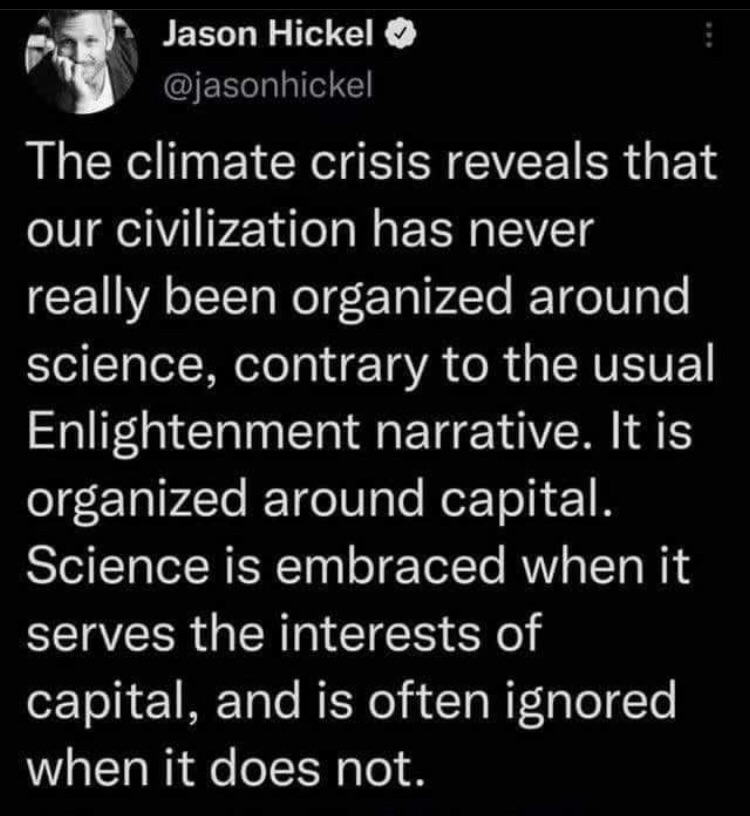
The narrative and perception on climate change mirrors that of capitalist economies in so many ways.

Trying to manufacture consent to view the issue in a way that it can be achieved at the micro level, when in fact the only success at mass scale is at the macro level.

We love to embrace scientific change if it gives our favorite influencer or podcast host something to sell and/or talk about. We love science when it finds ways to improve products and services.

But putting science to use for the masses beyond medicine has been a no go for generations.

There is more than enough money, land, and resources to change the way life is lived on planet Earth so that the way we live is more sustainable and has less negative impact on the world we live in.

But we don’t do these factual, documented, measurable things because it would negatively disrupt the capitalist system and it’s beneficiaries.

No different then kings sending the serfs to war over personal disputes with other royal families. Just on a larger scale. The more things change, the more they stay the same.

By @anarchyroll

Scientific studies just sound like the most credible thing in the world don’t they?

Not only is it scientific, but it involves studying. How can you go wrong with that combination? Unless you’re religious of course. Because then you start entering the; are their dinosaurs and dogs in heaven matrix. Which will only end in ruined dinner parties and tears.

A wise man once said that facts can be used to prove anything that’s remotely true, facts, shmacts. That wise man was of course the great philosopher Homer Simpson. In the era of 24 hour news cycles and twice a week podcast drops, scientific studies are the new facts.

What’s the difference between a scientific study and a proven fact? Well if you are trying to prove a point, win an argument, or create online content to market then the answer is nothing. But the actual difference is an important one. The difference between facts and hearsay is deep and wide, just ask a lawyer or a judge.

But if you’re trying to create content for a cable news show or it’s website, or are publishing the findings of a scientific study to make a splash to get more funding for more scientific studies, the difference between facts and hearsay is razor thin. John Oliver did a great job pointing this out on the previous season of Last Week Tonight.

Around the same time I first saw the above video, I also saw an alarming headline about medical error being the third leading cause of death in America.

It grabbed my attention, how could it not?

I sat down to write an article about it at a later date and when I went to look the article up, there was already a story challenging the study as being sensationalism over scientific. Science is not content in need of marketing, it is light in need of spreading.

However, scientific studies have had their credibility leveraged as a tool to confuse and persuade rather than educate and enlighten. Our silence and gullibility makes us culpable in this practice becoming not just commonplace but foundational in creating content for televised news in America. Television was created by product marketers for product marketers. Anything that appears on television, much like anything seen at a pro wrestling event, is for entertainment purposes only.

The problem is that was a memo that never got sent out. It is a course not taught in schools. It is a life lesson many parents don’t think to pass on. So people take what they see on the news as gospel and adjust the way they live their lives accordingly. If disposable science says the third leading cause of death is medical error, I wonder where death via scientific study error ranks.

frackishimalogo1ajclogo2
by @anarchyroll

Did you know warm water contain less oxygen?

I didn’t. Like most people when I think of what produces oxygen, I think of trees. But 70% of the Earth’s oxygen comes from the ocean, more specifically from the marine plants in the ocean.

0-95685800_1438940931_45-1-20150815

One need not be an environmentalist or a cynic to be aware that the average person doesn’t give a shit about marine phytoplankton. Even people tuned into environmental news are likely to think phytoplankton is a superfood juice fad. Perhaps because Googling marine phytoplankton brings up almost exclusively websites trying to sell the plant in powdered form.

“Save the Trees” may be easier to say and fit on a button/bumper sticker, but it is the phytoplankton that produces almost 3/4 of the oxygen. Maybe we can turn “Save the Phytoplankton” into a meme or gif.

Did you know we need oxygen to live?

It’s true, although it feels like suffocation to not have access to dank memes and social media, not having oxygen is actually suffocation.

So although we as humans have demonstrated a remarkable tolerance for pollution of the air we breathe, that tolerance is likely to be just a wee bit smaller with no air to breathe at all.

what-is-a-gmo

By @anarchyroll

Is GMO labeling important?

If it wasn’t, the companies who put GMOs in our food wouldn’t be actively and expensively trying to stop legislation mandating GMO labeling in America.

GMO labeling is the norm in 64 other countries around the world, which includes pretty much all the other industrialized ones.

There can certainly be a case made for GMOs, you know, with all the starving people in the world who don’t care if the food they get to eat is organic or GMO as long as they get to eat and not die.

But for the large percentage of the population that can think and live above the survival plain, who want to know what they are putting in their body, why all the resistance if there is nothing wrong with GMOs?

Times have changed, people literally want to know how the sausage is made these days. In the 1900s, that wasn’t the case, then again neither was equal rights for women and minorities. Times have changed.

Times have changed so much in Europe, that GMO labeling is so passé that countries are moving into the banning stage. Scotland and Germany have recently announced GMO crop bans. Meanwhile in America, we’re hoping the state of Vermont can lead the way.

Vermont? Isn’t that Bernie Sanders‘ home state? Yes, yes it is. Bernie Sanders has long been a champion of labeling GMO ingredients in food.

The resistance from GMO creators to labeling legislation tells you all you need to know about this issue. That and Monsanto is one of the largest creators of GMOs. If there is nothing to hide, why are they spending hundreds of millinos of dollars to hide? If GMOs are safe, why are Germany and Scotland banning them?

How do we or they know GMOs are safe if there are no long term studies on humans who ingest and/or are exposed to them?

And remember that in America, people just want the right to know. The battle over banning GMOs in America is a half a decade at minimum away from starting. This battle is just about the right of consumers to know if the food they are buying for themselves and their children contains GMOs.

In general, those who not only wish to suppress information from the public and spend hundreds of millions of dollars to do so, can be classified as evil and on the wrong side of history. The GMO labeling issue/debate is no different.