Posts Tagged ‘Trump’

The $900 Billion That No One Voted For

A $900 Billion Decision With Little Public Scrutiny

The U.S. House of Representatives this week approved the annual defense policy bill — the National Defense Authorization Act (NDAA) — authorizing roughly $900 billion in Pentagon spending for fiscal year 2026. The measure passed with broad bipartisan support, continuing a streak that has now lasted more than six decades.

According to reporting from CBS News and Reuters, the bill cleared the House by a 312–112 vote, once again exceeding the administration’s initial budget request and reinforcing a familiar outcome: the Pentagon’s budget grows, regardless of party control or global conditions.

Despite the scale of the authorization — one of the largest federal expenditures approved annually — the vote generated limited sustained public debate. Media coverage focused largely on procedural elements, such as troop pay increases and geopolitical provisions, rather than the broader question of why military spending has become one of the few areas of government effectively insulated from public resistance.


What the Public Actually Thinks

Public opinion data paints a far more complicated picture than congressional voting patterns suggest.

Long-term polling by Gallup shows that Americans are not clamoring for ever-higher military budgets. In 2024, only about 29 % of respondents said the United States was spending too little on national defense, while the majority believed spending was either “about right” or “too high.”

When asked more directly about budget increases beyond Pentagon requests, opposition becomes even clearer. A Data for Progress survey found that 63 % of Americans opposed increasing military spending above the requested level, including majorities of both Democrats and Republicans.

The disconnect is difficult to ignore: voters across party lines express skepticism about increased military spending, yet Congress delivers it year after year with bipartisan consensus.


A Budget That Always Goes Up

The Pentagon budget has become one of the most consistent growth mechanisms in American governance.

Wars begin, and the budget rises. Wars end, and the budget rises. Economic downturns, inflation, and public health crises — none have reversed the trend. Even in years without newly declared conflicts, defense authorizations continue to expand.

According to the Peter G. Peterson Foundation, defense spending remains the single largest category of discretionary federal spending, often rivaling or exceeding all other discretionary priorities combined.

This growth occurs with remarkably little interrogation of outcomes. While most federal programs are subjected to cost-benefit scrutiny, defense spending is treated as inherently justified — a baseline necessity rather than a policy choice.



The Military-Industrial Complex: Structure, Not Conspiracy

President Dwight D. Eisenhower’s warning about the “military-industrial complex” was not a prediction of corruption so much as a diagnosis of incentives.

Today, more than half of Pentagon discretionary spending flows directly to private defense contractors, including Lockheed Martin, RTX (Raytheon), Boeing, General Dynamics, and Northrop Grumman.

These firms spend tens of millions of dollars annually on lobbying, shaping procurement priorities and legislative outcomes in Washington.

This is not a shadowy conspiracy — it is an openly functioning system. Defense spending sustains regional economies, fuels revolving-door careers between government and industry, and anchors think tanks and policy institutions whose incentives align with budget growth.

When peace is bad for business, conflict does not need to be declared to remain profitable.


If Not Defense, Then What?

This is where the numbers stop being abstract.

$900 billion is not just a defense budget — it is a statement of national priorities.

That sum could meaningfully expand healthcare access, address student debt, fund public housing initiatives, modernize infrastructure, or strengthen climate resilience programs. These are not fringe ideas; they are perennial public demands.

Yet unlike military spending, domestic investments are always conditional. They must be negotiated, trimmed, justified, and re-justified. Defense spending, by contrast, is treated as automatic — the one area of government where growth is assumed rather than debated.

What threat, exactly, requires permanent expansion?

The United States increasingly practices defense by spending rather than defense by strategy. Budgets grow while outcomes remain unclear, conflicts multiply, and interventions persist with little accountability for long-term consequences.


America Is the Pentagon Now

At some point, the distinction between institution and identity blurs.

The Pentagon is no longer just a department — it is an economic engine, a political stabilizer, and a defining feature of American global posture. Its budget reflects not only perceived threats abroad, but a domestic system built around permanent militarization.

When Congress passes another massive Pentagon authorization that the public never meaningfully demanded, it sends a clear message: defense is not merely a priority — it is the default.

America does not simply have a military budget.
America is organized around one.

The question democracy must eventually confront is not whether defense matters. It is whether a democracy can remain responsive when its largest annual decision is effectively pre-decided.

That answer won’t come from another bipartisan vote. It will come from whether the public insists on asking why the budget always grows — and who it is really for.
From Trump’s era of spectacle to a socialist rebalancing — what the city’s next chapter might look like.


Why the Race Shook the Nation

This mayoral race wasn’t just about New York. It became a national battleground — because billions of dollars and elite players converged on it; because the ideological stakes felt existential. A socialist candidate threatened not just the local housing market or rent rolls, but the very architecture of a city that defines global finance, real estate, and ambition. The backers saw more than policy — they saw precedent.

That’s why so much was poured into Super-PACs, media attacks, and fear-mongering. Because if New York could pivot, what would that mean: for other cities? For national capital flows? The spectacle of New York wasn’t just local drama. It had become a battleground in a broader war over what cities — and society — are for.


New York did not crown Trump by accident. The towers, the tabloids, the myth of power — all reflected the city’s appetite for dominance, extraction, being bigger than the system itself. Trump’s triumph was less about him than the ecosystem he mirrored.

Then came Zohran Mamdani. Young. Muslim. The son of immigrants. Raised in Queens. A former foreclosure counselor turned labor organizer turned state assemblymember. Now the city’s mayor-elect. His campaign pitched housing as infrastructure, transit as a right, wages as dignity. No private jets. No tabloids. A different axis. Wikipedia+1

On November 4, 2025, New York turned. It elected Mamdani over Andrew Cuomo (independent) and Curtis Sliwa (Republican). The Associated Press called it at 9:34 p.m. ET. The city spoke: it opted not for spectacle, but for substance. Wikipedia+1


Who Is Mamdani?

Born in Kampala, Uganda, to Indian parents, transplanted to Queens at age seven. U.S. citizen since 2018. Foreclosure counselor. Labor organizer. Then elected to the State Assembly for Queens/Brooklyn (AD-36). A political upbringing rooted in justice, community, dignity—not empire, tabloid glitz, or extraction. Wikipedia


What He Ran On (And Why It Matters)

  • Rent freeze on rent-stabilized units + building genuinely affordable housing. Wikipedia+1
  • $30/hour citywide minimum wage. Wikipedia
  • Fare-free buses and expanded public transit access. Wikipedia+1
  • Universal childcare and public-run grocery provisions, funded by higher taxes on wealthy & corporations. Wikipedia+1

These are structural prescriptions. If the prior era whispered “growth at all costs,” this one asks: “What does it cost you just to live? And how do we fix it?”


The White House Meeting: A Moment of Symbolic Weight

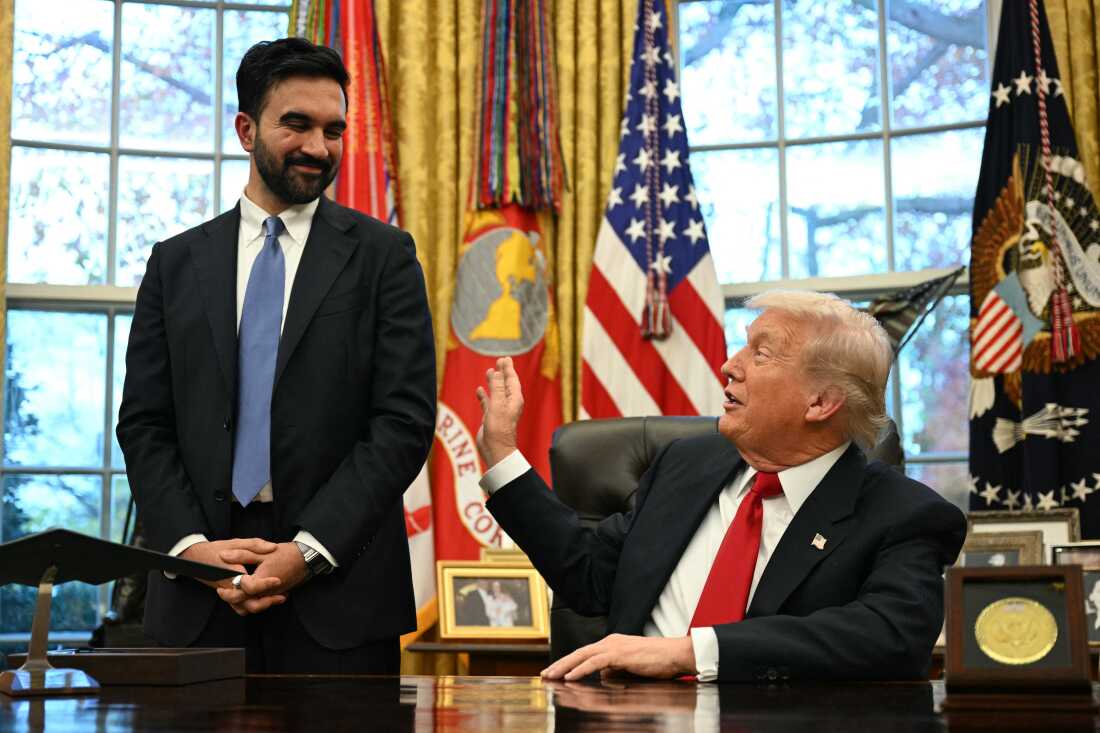
On Nov. 21, 2025 — just weeks after Mamdani’s win — he met Trump at the White House in the Oval Office. It was their first face-to-face after months of trading insults: Trump had framed Mamdani as a “communist” and threatened to pull federal funding; Mamdani had publicly called Trump a “fascist.” PBS+2The White House+2

But when cameras turned on, the posture changed — at least publicly. The meeting was “surprisingly cordial.” Trump praised Mamdani’s victory as a sign of strength; the two discussed affordability, economic security, and public safety. Trump later remarked they “agree on a lot more than I would have thought.” Vanity Fair+2PBS+2

Media outlets instantly framed the encounter as weird, symbolic — a moment where two political opposites met quietly in the same room. Some called it surreal. Others saw it as evidence the “establishment” might tolerate — or even try to co-opt — the threat represented by a socialist mayor in the world’s financial capital. Vanity Fair+2C-SPAN+2


The Swing, Not the Rupture

This isn’t a clean break. The mechanisms — capital, real estate, media — still loom. But for a moment, elected power shifted its axis. Instead of “How do we out-shine the competition?” we heard: “How do we out-serve a city?”

Because balance isn’t static. The spectacle that defined past decades will test this administration: budgets will strain, expectations balloon, the opposition circles. If Mamdani behaves like the organizer he once was, not a brand, maybe this pendulum will settle.


The Real Test — And the Larger Narrative

Free transit costs money. A $30 wage shifts markets. A rent freeze courts legal pressure. And behind it all: can governance stay grassroots in a global city when the old order is still breathing loud and heavy?

The White House meeting — the optics, the handshake, the “we agree more than you think” line — it added a layer to the story. Not a twist. A warning. A lens. Because when the world sees a socialist mayor walking into the same Oval Office as the buttoned-down president, the question becomes: Is the message containment — or accommodation?

This isn’t about whether socialism will “save” New York. It’s about whether New York can sustain a politics of belonging — when every institution around it expects performance, not belonging.

Because when New York changes, everything else listens.

Systemic Cruelty Dressed Up as Policy


Like slavery and apartheid, poverty is not natural. It is man-made and it can be overcome and eradicated by the actions of human beings. — Nelson Mandela (earth.org)


Criminalization of Survival

Across the United States, cities are treating the act of survival—sleeping, sitting, asking for help—as criminal behavior. These punitive “sit-lie” laws, camping bans, sweeps, and aggressive policing do not solve homelessness—they entrench it.

The National Homeless Law Center notes that criminalizing homelessness punishes life-sustaining activities and makes it “more difficult to escape” homelessness (homelesslaw.org). Human Rights Watch calls Los Angeles’s enforcement “cruel and ineffective,” targeting the visible poor rather than root causes (hrw.org).

And the National Alliance to End Homelessness found in a 2025 report that criminalization fails to enhance safety and instead deepens racial inequities (endhomelessness.org).


Welfare as Surveillance

What was once a safety net has become a web of surveillance and moral judgment. Welfare recipients often face drug testing, work mandates, and algorithmic gatekeeping. The state spends more money building systems to punish “fraud” than the fraud itself.

The broader trend is summed up in the concept of the criminalization of poverty—fines, anti-homeless laws, welfare policing—all disproportionately penalize people for behaviors tied to economic status (en.wikipedia.org).


Bipartisan Neglect

From Clinton’s “end of welfare as we know it,” to Republican austerity, to performative pandemic relief—both parties have abandoned structural solutions. Poverty remains a prop for campaigns, a scapegoat for policy failures.

The trajectory is clear: LBJ’s 1964 War on Poverty drastically reduced poverty, but the programs were retrenched in the decades that followed (en.wikipedia.org). As the New Yorker observed, “the retrenchment of the social-welfare state went hand in hand with the rise of the prison and policing state” (newyorker.com).


Policy as War

This isn’t side-effect cruelty—it’s intentional. Austerity is meticulously planned: sprawling military budgets and corporate bailouts while school lunches vanish, shelters shrink, and Medicaid is constantly threatened.

Anti-homeless laws that target sitting, sleeping, begging, and even sharing food are not about solving poverty—they’re about making the poor less visible (en.wikipedia.org).


Turning Cruelty into Care

Poverty isn’t inevitable—it’s policy. But if it’s made, it can be unmade.

Everyday Direct Care

  • Support mutual aid groups, solidarity kitchens, street medicine teams, and eviction defense networks.
  • Donate to or volunteer with organizations that protect civil rights for the unhoused, such as those advancing a Homeless Bill of Rights (en.wikipedia.org).
  • Choose ways to help that don’t rely on surveillance or punishment, but on trust and dignity.

Local Policy Pressure

  • Demand that local officials defund homeless sweeps and redirect funds to housing-first programs, mental health care, and tenant protections.
  • Organize for the passage of Homeless Bills of Rights in your state or city.
  • Pressure city councils and state legislatures to prioritize affordable housing budgets over police budgets.

State & National Strategy

  • Advocate for restoring and expanding War on Poverty–era programs like Head Start, expanded tax credits, and affordable housing investments.
  • Oppose laws that subject welfare recipients to invasive surveillance, drug testing, or punitive work requirements.
  • Build alliances that prioritize social infrastructure over military expansion or corporate subsidies.

This is the real choice: treat poverty as crime, or treat it as solvable. The first path guarantees endless war on the poor. The second path builds a society worth living in.


Truth Over Tribalism

Follow anarchyroll:

Wisdom Is Resistance


How manufactured distraction masks elite power grabs


“The most potent weapon in the hands of the oppressor is the mind of the oppressed.” — Steve Biko


We’re not fighting each other.

We’re being told we are.

While billionaires rig markets, write laws, and extract more than ever before, we’re fed a diet of distraction: who wore what, who said what, who to cancel, who to worship.
Culture wars and celebrity scandals dominate the headlines. Political rage becomes entertainment. Reality is replaced with performance.

Meanwhile, real decisions get made in rooms we’re not in.


Distraction is strategy.

Bread and circuses is policy.

The phrase comes from ancient Rome. Give the people food and entertainment, and they’ll ignore the empire crumbling around them.
Today’s version isn’t lions and gladiators. It’s 24/7 news cycles, viral beef, televised outrage, algorithmic dopamine, and the myth that “both sides” are the problem.

But both sides serve the same class.
The one you’re not in.


“The purpose of the modern media is to make the public passive and distracted, not informed and engaged.” – Glenn Greenwald


Who benefits from distraction?

Follow the money.

Culture wars don’t threaten capital.
They serve it.
If we’re busy hating each other, we’re not organizing. If we’re bickering about bathrooms, we’re not taxing billionaires. If we’re glued to gossip, we’re not watching the war profiteers, the surveillance state, or the bought politicians signing our futures away.

Distraction is not a side effect. It’s the point.


Manufactured chaos is cover.

Power prefers shadows.

The more noise, the less clarity.
The more conflict, the less unity.
The more fear, the more control.

Every celebrity trial, every TikTok feud, every political theater act keeps us from looking up. Keeps us consuming, not questioning. Arguing, not organizing.


“The press is not a watchdog. It’s a tool used by the powerful to manage public opinion.” – Matt Taibbi


We don’t need more sides.

We need more sight.

Start with the question: Who does this serve?
When the story goes viral, when the talking heads scream, when the rage is addictive—ask it again:
Who benefits from our attention being here?
Because the real theft isn’t always money.
Sometimes, it’s focus.


“You are being made to focus on the sideshow, while the tent burns down.” – Edward Snowden


anarchyjc.com // Truth over tribalism.
@anarchyroll_ on TikTok | @anarchyroll on Threads, X, IG, and Bluesky


The Epstein list is no longer a conspiracy theory. So why does everything still feel so silent?


📚 The Facts — No Longer Fringe

Over 170 names have now been confirmed through the release of legal documents tied to Jeffrey Epstein’s sex trafficking network. These include billionaires, celebrities, politicians, and royalty. The details are out. The timeline is established. The cover-up is ongoing.


🔦 What Do We Do With the Truth?

We now know.

Not in theory. Not through whispers or redacted documents or vague rumors.

We know — because it’s confirmed.

There was, and likely still is, a global sex trafficking network facilitated by billionaires, royalty, scientists, politicians, and financiers. Children were exploited. Victims were silenced. Powerful names were protected.


So what does it say about us?


That these are our leaders.
That this is our system.
That this was allowed to exist.

What does it say about power?
About justice?
About what we tolerate?

What kind of society protects this?
What kind of humanity forgets it?


We have been taught that truth is powerful.


That exposure leads to change.
That sunlight is the best disinfectant.

But what happens when truth lands like a stone in the ocean?
When facts come out — and are absorbed into the machine of normalcy?

What happens when justice does not follow evidence?


This isn’t a left vs. right issue.


This isn’t partisan.
This is a reflection of power.

And maybe that’s the point.
Maybe we are not meant to act on this truth.
Maybe we are only meant to know it — and feel helpless.

But that’s not enough.

We should not be okay with knowing… and doing nothing.

We should not learn of atrocities… and scroll past.

We cannot pretend that this level of coordinated abuse — and cover-up — is just another passing headline.


Some truths shouldn’t fade.


They should haunt.
They should wake us up.
They should never be allowed to settle.


🕳️

If you’ve made it this far, sit with it.
Not to be consumed by despair — but to resist forgetting.
Because forgetting is how they win.


🎬 This article was reimagined as a visual essay — watch the reel below.

@anarchyroll_

The list is real The silence is louder This is the part where we don’t look away. We don’t stop asking. We don’t stop naming. 🕳️ 🎥 Visual essay from: anarchyjc.com @anarchyroll_ #EpsteinCoverup #EliteProtection #TruthOverTribalism #epstein #digitalart

♬ Deep – Courten

📡 Follow anarchyroll across platforms for more visual essays, short-form truth, and independent, gonzo journalism-inspired writing:

📽️ TikTok: @anarchyroll_
🐤 X / Twitter: @anarchyroll
🧵 Threads: @anarchyroll
🔵 Bluesky: @anarchyroll