What happens when a society starts asking whether everything should have a price?

For most of the last century, socialism carried a particular weight in American politics. It was less a political philosophy than a warning label.
Socialism meant government control. Communism. The Soviet Union. Central planning. Bread lines. The loss of individual freedom. For generations of Americans, the argument was settled before it began.
Capitalism meant freedom. Socialism meant the opposite. But something has changed.
In 2025, New York City elected Zohran Mamdani, a self-described democratic socialist, as mayor of the nation’s largest city. He was sworn in on January 1, 2026. A political label that once made national candidates nervous had become part of a winning campaign for one of America’s most prominent political offices. Mamdani is not the beginning of this shift.
Bernie Sanders spent years making democratic socialism part of the American political conversation. Alexandria Ocasio-Cortez helped turn that conversation into a generational movement. In August 2026, progressive Democrat Abdul El-Sayed defeated establishment-backed Rep. Haley Stevens in Michigan’s Democratic Senate primary, another sign of the political left’s growing influence, although El-Sayed himself is better described as a progressive than a democratic socialist.
The left is not simply talking about socialism anymore. It is asking voters to govern with some of its ideas.
But perhaps the more interesting question is not whether America is becoming socialist. It is why socialism has become politically thinkable again.
Because Americans have been having this argument for a very long time. Sometimes, we just haven’t called it socialism.
The Things We Already Share
Imagine introducing the public library to America today.
A politician proposes building a publicly funded institution where anyone can walk inside, borrow books without paying, use computers, access the internet, attend programs, or simply sit somewhere warm. There is no profit requirement. The service exists because we have decided that access to information benefits the community.
Would we call that socialism? Probably not. We call it a library.
The same is true of fire departments. Nobody asks whether a burning house is profitable enough to justify putting it out. We decided that fire protection is a public good. So we tax ourselves to maintain the institution before anyone needs it.
The same principle applies to public schools, roads, sanitation systems, parks, public transit, and countless other institutions.
The point is not that a library is secretly socialism. It isn’t. The point is that America has never operated according to a pure market model.
We have always maintained a commons: resources, institutions, and services we collectively decide should exist for public benefit. The argument has never really been whether the commons should exist. The argument is where its boundaries should be.

America Has Been Here Before
History makes the argument more complicated.
When Franklin Roosevelt entered the White House in 1933, the United States was in the depths of the Great Depression. The federal government responded by dramatically expanding its role in American economic life.
The New Deal created programs for employment, infrastructure, financial regulation, agricultural support, and social insurance. The Social Security Act of 1935 established federal old-age benefits, unemployment insurance, and assistance for vulnerable Americans.
The United States did not become a centrally planned socialist economy. Private property remained. Private enterprise remained. Markets remained.
But Americans increasingly accepted that some economic risks were too consequential to leave entirely to individuals.
- Old age.
- Unemployment.
- Economic collapse.
The New Deal did not abolish capitalism. It put boundaries around it. That distinction matters. Capitalism and collective provision have never been mutually exclusive in the United States. The American economy has always been a hybrid.
The question has always been how much of that hybrid should belong to the market and how much to the public.
When the Market Becomes the Default Answer
For several decades, American political thought moved strongly in one direction.
Government was increasingly treated as the problem. Markets were increasingly treated as the solution.
There were good reasons for some of this. Markets can be remarkably effective. Competition can drive innovation. Private enterprise can respond quickly to demand. Profit can provide powerful incentives to create things people actually want.
Government can be slow, expensive, bureaucratic, and profoundly incompetent. None of that should be ignored because democratic socialism is having a political moment. But markets have limitations too.
A market does not ask whether something is necessary. It asks whether someone can pay for it. Those are not the same question.
A functioning housing market can coexist with millions of renters spending unsustainable portions of their income on housing. In 2023, more than 21 million U.S. renters, or 49.7% of renters, that the Census calculated, spent more than 30% of their income on housing.
A functioning healthcare market can coexist with enormous medical debt. KFF estimates that Americans owe at least $220 billion in medical debt, including approximately 14 million adults who owe more than $1,000.
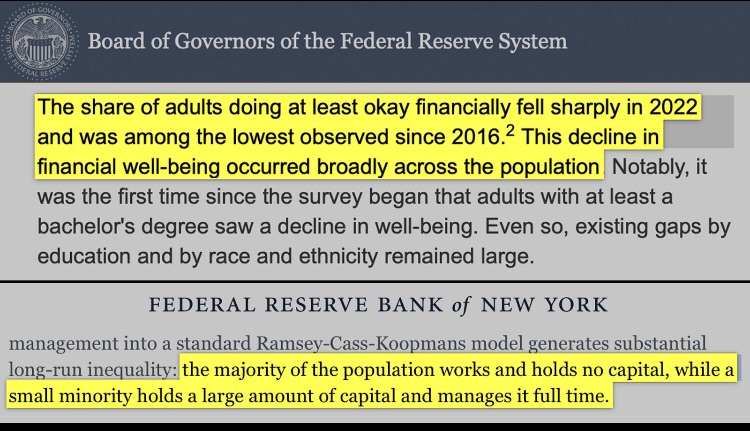
And a wealthy economy can coexist with widespread financial fragility. In the Federal Reserve’s latest household survey, 63% of adults said they could cover a hypothetical $400 emergency using cash or its equivalent. That means 37% could not. Thirteen percent said they could not cover the expense by any means.
None of those statistics proves that capitalism is inherently bad. They prove something narrower: Economic growth and economic security are not the same thing.
The Price of Being Poor
This may be where the renewed interest in democratic socialism becomes easier to understand. A market economy can feel remarkably liberating when you have the resources to navigate it.
If a service doesn’t work, buy another one. If housing becomes expensive, move. If healthcare is inadequate, find a better plan. If transportation doesn’t work, buy a car. If wages are inadequate, invest.
But those choices depend on something that isn’t distributed equally: the ability to absorb risk.
A person with savings can survive an unexpected bill. A person without savings may have to borrow.
A homeowner with substantial equity has options. A person with no assets has fewer.
A person with inherited wealth can use it as a safety net. A person without it begins an emergency from zero.
This is where arguments about capitalism can become strangely abstract. We talk about markets, incentives, GDP, productivity and efficiency. But economies are ultimately experienced by human beings.
The question isn’t simply whether the economy is growing. It is whether people can build stable lives inside it.
The Wealth Behind the Safety Net
Wealth changes the meaning of risk.
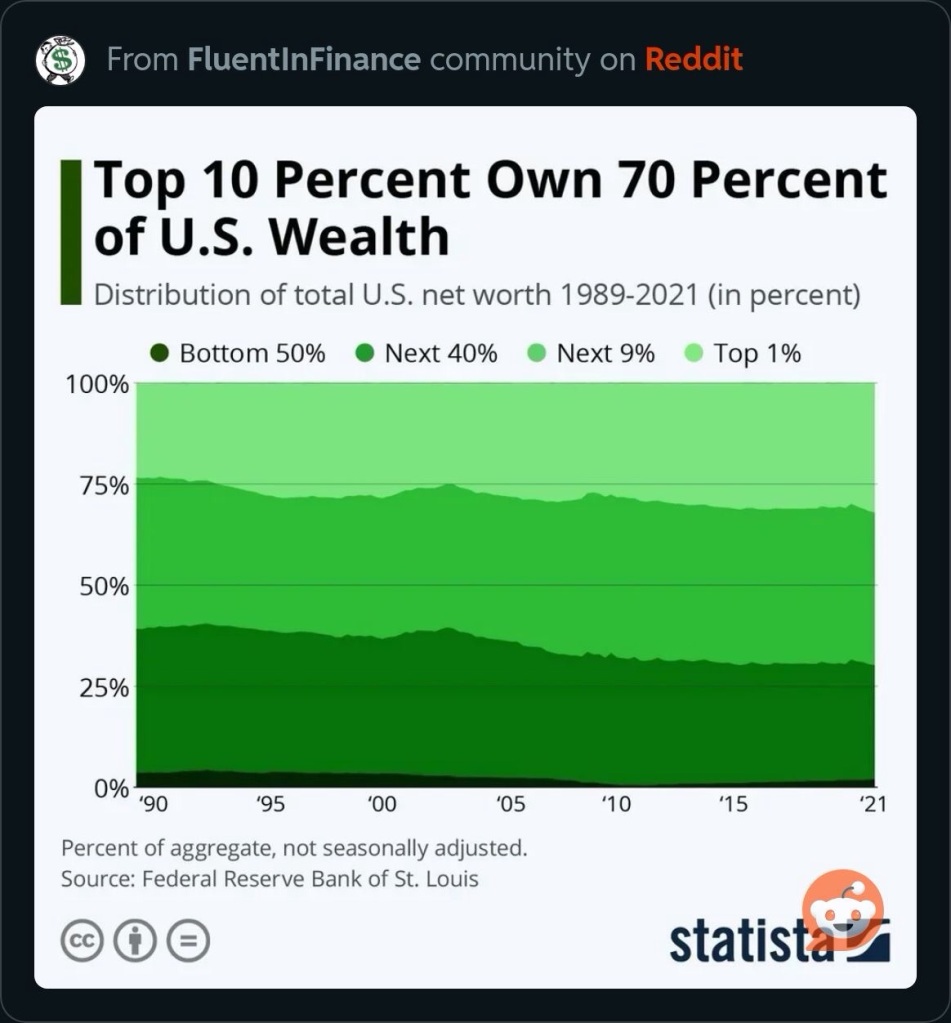
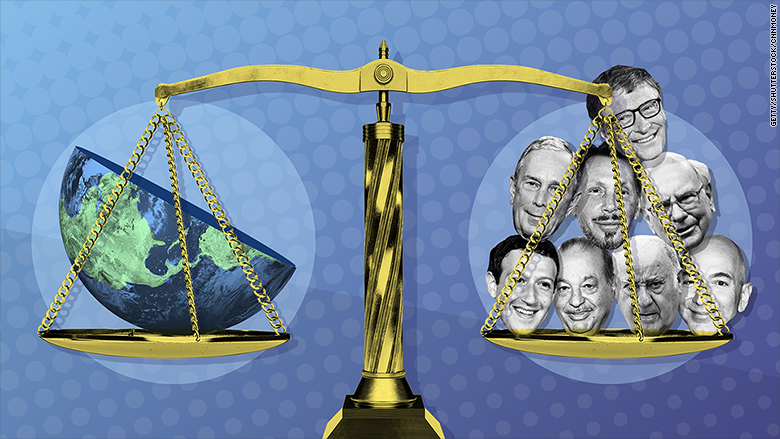
The Federal Reserve’s Distributional Financial Accounts show how concentrated household wealth remains. In the first quarter of 2026, the top 1% held roughly 31% of U.S. household wealth, while the bottom 50% held roughly 4%.
The composition matters, too. The top of the distribution holds enormous amounts of financial assets that can appreciate, generate income, and be liquidated when necessary. Households with little accumulated wealth have far less room to absorb a shock.
Income pays the bills. Wealth absorbs shocks.
Wealth buys time. It allows someone to leave a bad job, survive unemployment, help a child through school, make a down payment, absorb a medical emergency, or wait for a better opportunity. Without wealth, the same events can become existential. This is why arguments about “personal responsibility” can become incomplete.
Responsibility matters. So does the amount of room a person has to exercise it.
The Label Problem
There is another problem with the debate. Americans do not necessarily agree on what socialism means.
For some, it means public ownership of major industries. For others, it means universal healthcare.
For some, it means stronger unions, higher taxes on wealthy households, public housing, or expanded social programs. For others, it still means Soviet-style communism.
Those are not the same thing. Democratic socialism is not communism. Social democracy is not democratic socialism.
A mixed economy is not a centrally planned economy. And a public library is not evidence that the United States secretly became the Soviet Union.
These distinctions matter because political language can become so imprecise that the label replaces the argument.
There is an important warning here for the left, too. If “socialism” becomes a catch-all word for every policy someone likes, the word loses analytical meaning. If it means everything, it explains nothing.
Democratic Socialism Gets No Free Pass
Taking democratic socialism seriously does not mean giving it a free pass. Quite the opposite.
If the movement wants to govern rather than merely protest, its ideas have to survive contact with reality.
- How much should government provide?
- How much should it cost?
- Who pays?
- What happens when public institutions become inefficient?
- What happens when bureaucracy becomes its own interest group?
- How much taxation is economically sustainable?
- Where should government stop?
- What role should private enterprise continue to play?
- How do we preserve innovation?
- What happens when a public program becomes an expensive institution that no longer works very well?
Government is not inherently virtuous. Markets are not inherently virtuous.
Both are systems created and operated by human beings. Both have incentives. Both can be captured by powerful interests. Both can become inefficient. Both can produce extraordinary results under the right conditions.
The point isn’t to replace one ideology with another. It is to stop pretending that either system can answer every question.
The Argument for Capitalism
There is, of course, a serious argument on the other side. Capitalism has generated enormous increases in productivity, technological innovation, consumer abundance, and material living standards. Markets coordinate millions of individual decisions without requiring a central authority to determine what people should produce or consume.
Government intervention can solve problems, but it can also create new ones. Regulation can become bureaucratic. Public programs can become inefficient. Taxation can distort incentives. Politicians can distribute resources according to political incentives rather than social needs.
Some problems attributed to capitalism may actually be failures of policy: restrictive zoning, regulatory capture, insufficient housing construction, monopolistic behavior, or poorly designed government programs.
There is also a legitimate philosophical argument that individuals should retain responsibility for some of life’s risks rather than transferring every risk to the state. That argument deserves to be taken seriously.
But it leaves us with another question: How much individual responsibility is reasonable when the consequences of failure can be catastrophic?
Democratic Socialism Meets Reality
This is where Zohran Mamdani becomes more useful than a political symbol.
His administration is now attempting to turn some of the ideas that defined his campaign into municipal policy. Housing is one example.
Mamdani’s administration has proposed creating 200,000 affordable homes over the next decade, with nearly $5 billion in planned investment over two years. It has also proposed a city-backed housing insurance program intended to reduce insurance costs for affordable and rent-stabilized housing.
His fiscal approach offers another test. The proposed FY2027 executive budget totals $124.7 billion. The administration says it closed a $12 billion inherited budget gap through savings, new revenue, and state partnership while avoiding property-tax increases and preserving long-term reserves.
These are not proof that democratic socialism works. They are not proof that it doesn’t. They are something more useful: a test.
If the movement wants to move from ideology to governance, voters now have the opportunity to evaluate what happens when those ideas encounter budgets, bureaucracy, housing markets, competing priorities, and the practical limits of municipal government.
That is how political ideas should ultimately be judged. Not by the label. By the results.

The Real Political Argument
Maybe this is why the current debate feels different from the old Cold War argument.
The question being asked by many voters isn’t necessarily: “Do you want socialism?”
It is: “Why can’t I afford to live?”
Why is housing so expensive? Why does healthcare threaten financial stability? Why can full-time employment still leave someone economically insecure? Why does an economy capable of producing extraordinary wealth struggle to give ordinary people enough room to absorb an ordinary emergency?
Those questions existed before Bernie Sanders. They existed before Alexandria Ocasio-Cortez. They existed before Zohran Mamdani.
Perhaps the political movement isn’t creating the questions. Perhaps the questions are creating the movement.
We should be careful with that conclusion. Political momentum has many causes, and economic insecurity is not the only possible explanation. But the connection is difficult to ignore.
Gallup’s 2025 polling found that Americans overall still viewed capitalism more favorably than socialism. Among Democrats, however, the balance had flipped: 66% viewed socialism favorably compared with 42% who viewed capitalism favorably.
That is not a socialist revolution. It is something more interesting.
A political constituency is becoming less convinced that the existing economic system deserves to be treated as the unquestioned default.
The Politics of the Commons
The argument over socialism may therefore be less about socialism than we think.
It may be about something much older: What do we owe one another?
Every society answers that question whether it admits it or not. We decide that children deserve education. We decide that roads should exist even when individual roads aren’t profitable. We decide that fires should be extinguished regardless of the homeowner’s income. We decide that libraries should lend books without charging by the page.
During the New Deal, we decided that old age and unemployment should not be entirely private risks. We have repeatedly decided that some things are too important to leave entirely to the market.
The disagreement is over where we draw the line. And that line is never permanent.
- It moved during the Progressive Era.
- It moved during the New Deal.
- It moved during the Great Society.
- It moved during the neoliberal turn of the late twentieth century.
And perhaps it is moving again. That doesn’t necessarily mean America is becoming socialist. It may mean Americans are reconsidering what they believe the market is actually for.
Markets are extraordinarily useful tools. But tools have purposes. A hammer is excellent at driving a nail. It is terrible at putting out a fire.
Perhaps the question confronting American politics isn’t whether we should choose capitalism or socialism. Perhaps it is whether we’ve spent so long treating the market as the answer that we’ve forgotten to ask what question we’re actually trying to solve.
That is the politics of the commons.