Posts Tagged ‘america’


From Trump’s era of spectacle to a socialist rebalancing — what the city’s next chapter might look like.


Why the Race Shook the Nation

This mayoral race wasn’t just about New York. It became a national battleground — because billions of dollars and elite players converged on it; because the ideological stakes felt existential. A socialist candidate threatened not just the local housing market or rent rolls, but the very architecture of a city that defines global finance, real estate, and ambition. The backers saw more than policy — they saw precedent.

That’s why so much was poured into Super-PACs, media attacks, and fear-mongering. Because if New York could pivot, what would that mean: for other cities? For national capital flows? The spectacle of New York wasn’t just local drama. It had become a battleground in a broader war over what cities — and society — are for.


New York did not crown Trump by accident. The towers, the tabloids, the myth of power — all reflected the city’s appetite for dominance, extraction, being bigger than the system itself. Trump’s triumph was less about him than the ecosystem he mirrored.

Then came Zohran Mamdani. Young. Muslim. The son of immigrants. Raised in Queens. A former foreclosure counselor turned labor organizer turned state assemblymember. Now the city’s mayor-elect. His campaign pitched housing as infrastructure, transit as a right, wages as dignity. No private jets. No tabloids. A different axis. Wikipedia+1

On November 4, 2025, New York turned. It elected Mamdani over Andrew Cuomo (independent) and Curtis Sliwa (Republican). The Associated Press called it at 9:34 p.m. ET. The city spoke: it opted not for spectacle, but for substance. Wikipedia+1


Who Is Mamdani?

Born in Kampala, Uganda, to Indian parents, transplanted to Queens at age seven. U.S. citizen since 2018. Foreclosure counselor. Labor organizer. Then elected to the State Assembly for Queens/Brooklyn (AD-36). A political upbringing rooted in justice, community, dignity—not empire, tabloid glitz, or extraction. Wikipedia


What He Ran On (And Why It Matters)

  • Rent freeze on rent-stabilized units + building genuinely affordable housing. Wikipedia+1
  • $30/hour citywide minimum wage. Wikipedia
  • Fare-free buses and expanded public transit access. Wikipedia+1
  • Universal childcare and public-run grocery provisions, funded by higher taxes on wealthy & corporations. Wikipedia+1

These are structural prescriptions. If the prior era whispered “growth at all costs,” this one asks: “What does it cost you just to live? And how do we fix it?”


The White House Meeting: A Moment of Symbolic Weight

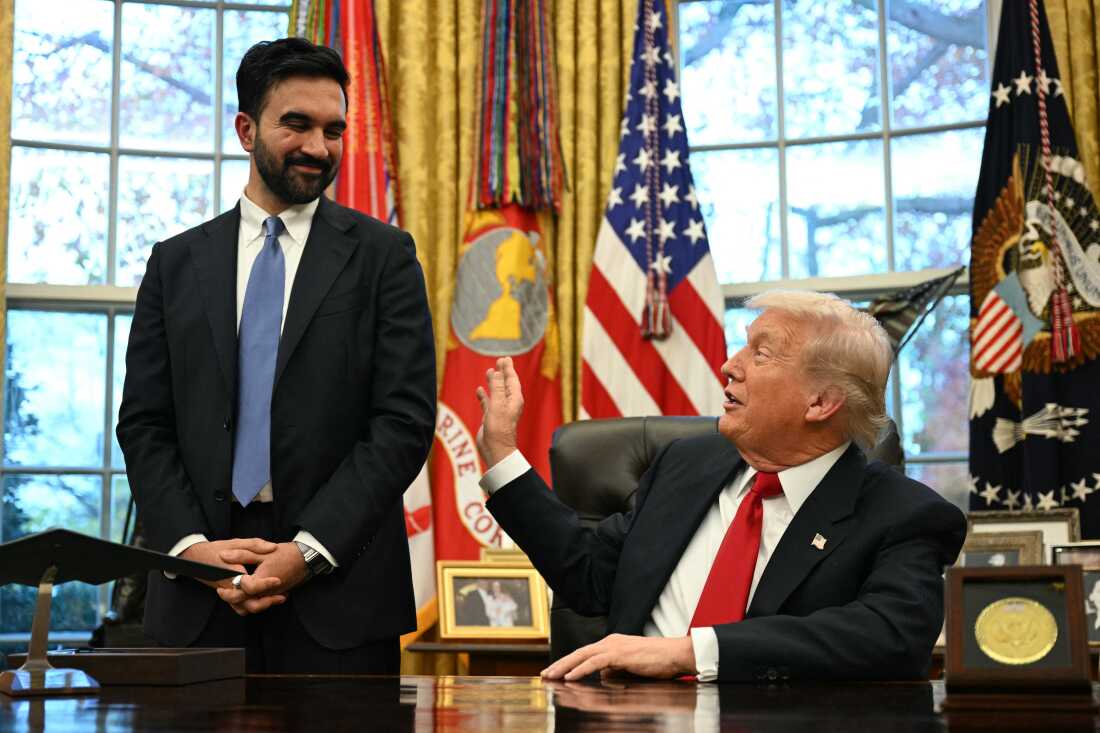
On Nov. 21, 2025 — just weeks after Mamdani’s win — he met Trump at the White House in the Oval Office. It was their first face-to-face after months of trading insults: Trump had framed Mamdani as a “communist” and threatened to pull federal funding; Mamdani had publicly called Trump a “fascist.” PBS+2The White House+2

But when cameras turned on, the posture changed — at least publicly. The meeting was “surprisingly cordial.” Trump praised Mamdani’s victory as a sign of strength; the two discussed affordability, economic security, and public safety. Trump later remarked they “agree on a lot more than I would have thought.” Vanity Fair+2PBS+2

Media outlets instantly framed the encounter as weird, symbolic — a moment where two political opposites met quietly in the same room. Some called it surreal. Others saw it as evidence the “establishment” might tolerate — or even try to co-opt — the threat represented by a socialist mayor in the world’s financial capital. Vanity Fair+2C-SPAN+2


The Swing, Not the Rupture

This isn’t a clean break. The mechanisms — capital, real estate, media — still loom. But for a moment, elected power shifted its axis. Instead of “How do we out-shine the competition?” we heard: “How do we out-serve a city?”

Because balance isn’t static. The spectacle that defined past decades will test this administration: budgets will strain, expectations balloon, the opposition circles. If Mamdani behaves like the organizer he once was, not a brand, maybe this pendulum will settle.


The Real Test — And the Larger Narrative

Free transit costs money. A $30 wage shifts markets. A rent freeze courts legal pressure. And behind it all: can governance stay grassroots in a global city when the old order is still breathing loud and heavy?

The White House meeting — the optics, the handshake, the “we agree more than you think” line — it added a layer to the story. Not a twist. A warning. A lens. Because when the world sees a socialist mayor walking into the same Oval Office as the buttoned-down president, the question becomes: Is the message containment — or accommodation?

This isn’t about whether socialism will “save” New York. It’s about whether New York can sustain a politics of belonging — when every institution around it expects performance, not belonging.

Because when New York changes, everything else listens.


We’ve just been through another moment: Charlie Kirk dead, an American provocateur murdered during a public event.

Immediately, the gears of outrage, social media spectacle, and moral posturing started turning. But underneath the noise, ask yourself: how much of what’s going on is politics as usual? And how much is a vivid distraction from what really holds power in this country?

“If I see a Black pilot, I’m going to be like, boy, I hope he’s qualified.” — The Charlie Kirk Show, January 23, 2024 The Guardian


The Spectacle & Response

If you scroll through social media or listen to pundits, a few things become crystal:

  • Charlie Kirk has been more than “just another right-wing podcaster”; for many on the Right, he is being elevated to martyr, symbol, hero. This is intentional. It fuels identity, animus, and grievance.
  • Meanwhile, the Left is also practicing its version of virtue displays: denunciations, calls for “free speech,” arguments over who is more morally responsible. Sometimes these are sincere; often they are performative.

Then there’s the machinery of suppression/support. Jimmy Kimmel gets pulled off the air indefinitely for his remarks about the killing. Platforms scramble. Lawmakers issue statements. Some people are fired, suspended, disowned for social media posts judged too flippant, too critical, too celebratory (or even just insufficiently mournful).

“You will never live in a society when you have an armed citizenry and you won’t have a single gun death. That is nonsense. It’s drivel. But I am — I think it’s worth it.” — Charlie Kirk


Lost in the Frenzy: What Actually Matters

While we lock into tribal alignment over “Is X more to blame?” or “Did Y censor free speech?”, real decisions continue to be made elsewhere—decisions that hurt or help ordinary lives.

  • Income inequality: Since 1980, the bottom 90% of U.S. earners have seen incomes rise ~36%, while the top 1% shot up ~162% and the top 0.1% exploded by ~301%.
  • Wage stagnation: Median weekly earnings for full-time workers in mid-2025 are ~$1,196. For women, it’s ~$1,078. Adjusted for inflation, most wages haven’t moved much in decades.
  • Medical debt: 40% of adults report bills they can’t pay. Roughly 20 million Americans owe medical debt, totaling at least $220 billion.
  • Bankruptcies: 2024 saw over 517,000 filings, up 14% from the year before. Medical bills remain a top driver.
  • Life expectancy: Americans in the wealthiest counties live about 7–10 years longer than those in the poorest. Poverty literally shortens life.

These are not abstractions. They are the ground we stand on, and they’re being ignored while we fight over who disrespected whose memory.

“Happening all the time in urban America, prowling Blacks go around for fun to go target white people, that’s a fact. It’s happening more and more.” — The Charlie Kirk Show, May 19, 2023 The Guardian


The Trap of Left vs Right

This is the pattern: tragedy or provocation → political polarization → spectacle → distraction. And the Left vs Right framing helps elites on both sides:

  • Right-wing media gets a martyr, a rallying cry, an excuse to push further culture war rhetoric.
  • Left-wing media and centrist commentators get to critique, outraged, safe inside their media bubbles, while pointing fingers.
  • Neither side is forced to substantially challenge the power structures: the economic inequality, corporate control of media, tech platform power, the role of political money.

“Keep America free … You should be allowed to say outrageous things … There’s ugly speech. There’s gross speech. There’s evil speech. And all of it’s protected by the First Amendment.” — earlier in 2025, in remarks pushing back against limits on free speech. The Santa Barbara Independent


Class War, Not Culture War

Here’s what we lose when class war is displaced:

  • People who could be allies don’t realize their shared stakes. Someone working a low-wage job and voting for the Right may still suffer under the same rent inflation, the same healthcare inaccessibility as someone voting for the Left. But because symbols and culture dominate, they are told to hate each other instead.
  • Policies that could improve life—universal health care, affordable housing, stronger unions, more equitable taxation, campaign finance reform—are sidelined as too “political” or unsexy amid culture war spectacle.
  • Elites (corporations, wealthy donors, political insiders, media conglomerates) are mostly unaffected by the noise. Their power increases because scandal, outrage, fear allow for more regulation of dissent (or selective enforcement), more control over narrative, and more justification for reinforcing the “security” apparatus.

“America was at its peak when we halted immigration for 40 years and we dropped our foreign-born percentage to its lowest level ever. We should be unafraid to do that.” — The Charlie Kirk Show, August 22, 2025 The Guardian


What We Should Be Looking Up At

If we want to shift the ground, here’s what it means to look up not sideways:

  • Hold powerful institutions accountable: Big tech, media conglomerates, regulatory agencies, secret lobbying networks.
  • Shift public focus to material conditions: how many people cannot afford medical care; how many are one paycheck from eviction; how wealth is concentrated.
  • Build movements oriented around economic justice, not just identity or ideology. Worker organizing, co-ops, mutual aid, housing justice.
  • Demolish or weaken the structures that enforce class inequality: tax loopholes, corporate welfare, deregulated finance, and campaign finance that amplifies elite voices.

“If we would have said that Joy Reid and Michelle Obama and Sheila Jackson Lee and Ketanji Brown Jackson were affirmative action picks, we would have been called racists. Now they’re coming out and they’re saying it for us … You do not have the brain processing power to otherwise be taken really seriously. You had to go steal a white person’s slot to go be taken somewhat seriously.” — The Charlie Kirk Show, July 13, 2023 The Guardian


Defend free speech. Don’t confuse theater with truth. Don’t let the spectacle steal the stage from power.


Culture war is a powerful machine. It divides communities, drains energy into rage, and channels anger toward the wrong targets—often toward each other. Meanwhile, the people who really control the levers of economic power, of media control, of policy-making, carry on largely unchallenged.

The class war may not feel dramatic; it may feel slower, like moving tectonic plates. But its consequences are far deeper and more pervasive than the latest outrage.

And if we don’t shift our attention, the cycle will keep repeating: event → sides drawn up → outraged tweets and show cancellations → temporary appeasement → next event. Without meaningful structural change, nothing really gets better for most people.


The system breaks us, then sells us pills.

They tell us it’s a personal failing. That anxiety is a chemical imbalance. That depression is a genetic curse. That burnout is solved with resilience. But look around: the conditions that feed this crisis are man-made.

“Doctors … argue that chronic stress, stemming from social problems such as financial distress, racism, and poor working conditions, is a key driver of mental health issues.”The Guardian


We work longer hours for less pay. We doomscroll through endless cycles of bad news and empty distraction. We spend more time isolated in front of glowing screens than in human connection. The pressure is relentless—engineered to keep us consuming, competing, and collapsing.

“About one in four American adults suffers from a diagnosable mental disorder in a given year, and one in ten will suffer from a depressive illness, such as major depression or bipolar disorder.”Johns Hopkins–derived data


And just when we break, they offer us a fix. Not by changing the system—but by medicalizing our despair. Big Pharma has turned misery into a trillion-dollar market. Antidepressant prescriptions keep climbing. ADHD meds are at record highs. Anti-anxiety pills sell like candy. And yet, rates of suicide, loneliness, and mental illness are higher than ever.

“In 2020, 20.3% of adults had received any mental-health treatment in the past 12 months, including 16.5% who had taken prescription medication for their mental health.”CDC

“Today, a full fourth of U.S. women are on antidepressants.”KevinMD / Harvard Health


This isn’t healing—it’s management. Profitable management. The more the machine grinds us down, the more pills they can sell us to function well enough to keep serving the machine. It’s a cycle of extraction: from our labor, our attention, and now our very psychology.

“The monthly antidepressant dispensing rate for females ages 12–17 surged 129.6% from March 2020 onward compared with beforehand.”University of Michigan study in Pediatrics


None of this denies that meds can help. But let’s be clear: the crisis isn’t random. It’s not just “in our heads.” It’s the direct product of an economy built on overwork, digital isolation, and engineered anxiety. A society where meaning is stripped down to productivity, and hope is marketed back to us in capsules.

“Despite a significant rise in mental-health awareness and treatment … mental-health conditions are worsening. Suicide rates have increased by 30% since 2000, and nearly one-third of adults report symptoms of depression or anxiety.”Time

“Between 1999 and 2022, antidepressant-related overdose deaths climbed; in 2022, there were 5,863 overdoses—comparable to heroin overdose deaths that same year.”The Guardian


The mental health crisis wasn’t an accident. It was manufactured. And the ones cashing in are the same ones who built the conditions that broke us.

Wisdom is Resistance. Truth Over Tribalism.


Systemic Cruelty Dressed Up as Policy


Like slavery and apartheid, poverty is not natural. It is man-made and it can be overcome and eradicated by the actions of human beings. — Nelson Mandela (earth.org)


Criminalization of Survival

Across the United States, cities are treating the act of survival—sleeping, sitting, asking for help—as criminal behavior. These punitive “sit-lie” laws, camping bans, sweeps, and aggressive policing do not solve homelessness—they entrench it.

The National Homeless Law Center notes that criminalizing homelessness punishes life-sustaining activities and makes it “more difficult to escape” homelessness (homelesslaw.org). Human Rights Watch calls Los Angeles’s enforcement “cruel and ineffective,” targeting the visible poor rather than root causes (hrw.org).

And the National Alliance to End Homelessness found in a 2025 report that criminalization fails to enhance safety and instead deepens racial inequities (endhomelessness.org).


Welfare as Surveillance

What was once a safety net has become a web of surveillance and moral judgment. Welfare recipients often face drug testing, work mandates, and algorithmic gatekeeping. The state spends more money building systems to punish “fraud” than the fraud itself.

The broader trend is summed up in the concept of the criminalization of poverty—fines, anti-homeless laws, welfare policing—all disproportionately penalize people for behaviors tied to economic status (en.wikipedia.org).


Bipartisan Neglect

From Clinton’s “end of welfare as we know it,” to Republican austerity, to performative pandemic relief—both parties have abandoned structural solutions. Poverty remains a prop for campaigns, a scapegoat for policy failures.

The trajectory is clear: LBJ’s 1964 War on Poverty drastically reduced poverty, but the programs were retrenched in the decades that followed (en.wikipedia.org). As the New Yorker observed, “the retrenchment of the social-welfare state went hand in hand with the rise of the prison and policing state” (newyorker.com).


Policy as War

This isn’t side-effect cruelty—it’s intentional. Austerity is meticulously planned: sprawling military budgets and corporate bailouts while school lunches vanish, shelters shrink, and Medicaid is constantly threatened.

Anti-homeless laws that target sitting, sleeping, begging, and even sharing food are not about solving poverty—they’re about making the poor less visible (en.wikipedia.org).


Turning Cruelty into Care

Poverty isn’t inevitable—it’s policy. But if it’s made, it can be unmade.

Everyday Direct Care

  • Support mutual aid groups, solidarity kitchens, street medicine teams, and eviction defense networks.
  • Donate to or volunteer with organizations that protect civil rights for the unhoused, such as those advancing a Homeless Bill of Rights (en.wikipedia.org).
  • Choose ways to help that don’t rely on surveillance or punishment, but on trust and dignity.

Local Policy Pressure

  • Demand that local officials defund homeless sweeps and redirect funds to housing-first programs, mental health care, and tenant protections.
  • Organize for the passage of Homeless Bills of Rights in your state or city.
  • Pressure city councils and state legislatures to prioritize affordable housing budgets over police budgets.

State & National Strategy

  • Advocate for restoring and expanding War on Poverty–era programs like Head Start, expanded tax credits, and affordable housing investments.
  • Oppose laws that subject welfare recipients to invasive surveillance, drug testing, or punitive work requirements.
  • Build alliances that prioritize social infrastructure over military expansion or corporate subsidies.

This is the real choice: treat poverty as crime, or treat it as solvable. The first path guarantees endless war on the poor. The second path builds a society worth living in.


Truth Over Tribalism

Follow anarchyroll:

Wisdom Is Resistance


How manufactured distraction masks elite power grabs


“The most potent weapon in the hands of the oppressor is the mind of the oppressed.” — Steve Biko


We’re not fighting each other.

We’re being told we are.

While billionaires rig markets, write laws, and extract more than ever before, we’re fed a diet of distraction: who wore what, who said what, who to cancel, who to worship.
Culture wars and celebrity scandals dominate the headlines. Political rage becomes entertainment. Reality is replaced with performance.

Meanwhile, real decisions get made in rooms we’re not in.


Distraction is strategy.

Bread and circuses is policy.

The phrase comes from ancient Rome. Give the people food and entertainment, and they’ll ignore the empire crumbling around them.
Today’s version isn’t lions and gladiators. It’s 24/7 news cycles, viral beef, televised outrage, algorithmic dopamine, and the myth that “both sides” are the problem.

But both sides serve the same class.
The one you’re not in.


“The purpose of the modern media is to make the public passive and distracted, not informed and engaged.” – Glenn Greenwald


Who benefits from distraction?

Follow the money.

Culture wars don’t threaten capital.
They serve it.
If we’re busy hating each other, we’re not organizing. If we’re bickering about bathrooms, we’re not taxing billionaires. If we’re glued to gossip, we’re not watching the war profiteers, the surveillance state, or the bought politicians signing our futures away.

Distraction is not a side effect. It’s the point.


Manufactured chaos is cover.

Power prefers shadows.

The more noise, the less clarity.
The more conflict, the less unity.
The more fear, the more control.

Every celebrity trial, every TikTok feud, every political theater act keeps us from looking up. Keeps us consuming, not questioning. Arguing, not organizing.


“The press is not a watchdog. It’s a tool used by the powerful to manage public opinion.” – Matt Taibbi


We don’t need more sides.

We need more sight.

Start with the question: Who does this serve?
When the story goes viral, when the talking heads scream, when the rage is addictive—ask it again:
Who benefits from our attention being here?
Because the real theft isn’t always money.
Sometimes, it’s focus.


“You are being made to focus on the sideshow, while the tent burns down.” – Edward Snowden


anarchyjc.com // Truth over tribalism.
@anarchyroll_ on TikTok | @anarchyroll on Threads, X, IG, and Bluesky