

Posts Tagged ‘facebook’


What happens when the most powerful institutions in society become experts at shaping attention itself?

For most of human history, power was relatively easy to recognize.

Kings controlled armies. Governments controlled laws. Corporations controlled resources. Media organizations controlled information. The centers of influence were visible.

Today, influence is becoming harder to see.

It arrives through recommendation engines, notifications, search results, personalized feeds, and algorithms that quietly decide what appears in front of us each day.

Glenn Greenwald famously argues that the greatest power of the state is not controlling what people think, but controlling the actual information they are allowed to see.

That distinction matters.

Most people imagine propaganda as something obvious—a government ministry, a state broadcaster, or a censor with a red pen. But modern influence rarely works that way. Instead, it emerges through systems designed to maximize engagement, collect behavioral data, and compete relentlessly for human attention.

The result is something new in human history: a world where billions of people interact daily with platforms that continuously study, predict, and increasingly shape human behavior.

Not necessarily because anyone designed a grand conspiracy. But because influence itself has become profitable. And profitable systems tend to expand.


The Most Valuable Commodity on Earth

Oil powered the industrial age. Data powers the digital age.

Every click, scroll, pause, search, purchase, and interaction leaves a trail behind. Individually, these actions seem insignificant. Collectively, they create a remarkably detailed portrait of who we are, what captures our attention, what triggers our emotions, and what keeps us engaged.

Consider what happens during a typical day. A smartphone records location data. A search engine records questions. An online retailer records purchases and browsing habits. Social media platforms record likes, shares, comments, watch time, and scrolling behavior.

Individually, these data points appear trivial. Together, they form a behavioral profile of extraordinary depth.

For the largest technology companies, this information has become one of the most valuable resources on Earth. The longer we stay engaged, the more advertisements can be shown. The more advertisements that can be shown, the more revenue can be generated.

At first glance, this appears to be a simple business model. But once engagement becomes the primary objective, the incentives begin to change. The goal is no longer merely to understand behavior. The goal becomes predicting it and eventually shaping it.


When the Experiment Was Real

For years, critics warned that social media platforms possessed extraordinary power to influence human behavior.

Then, in 2014, Facebook demonstrated it.

Researchers working with the company altered the news feeds of hundreds of thousands of users without their knowledge. Some users were shown slightly more positive content. Others were shown slightly more negative content. The objective was to determine whether changes in information exposure would influence emotional expression.

The results suggested they would.

Users exposed to more negative content tended to post more negatively themselves. Users exposed to more positive content tended to post more positively.

The study became controversial after it became public, largely because participants had not given informed consent. But the larger implication received less attention.

The significance was not that Facebook conducted the experiment. The significance was that Facebook possessed the capability to conduct it.

A platform used by hundreds of millions of people had demonstrated that adjusting information flows could produce measurable changes in behavior.

The experiment was small. The implications were enormous.


Behavioral Futures

In her work on surveillance capitalism, Shoshana Zuboff details how tech monopolies no longer merely predict human behavior but actively seek to modify it for corporate profit.

The Facebook experiment offered a glimpse into a much larger economic model.

For decades, businesses have studied consumer behavior to predict purchasing decisions. Digital platforms expanded that process dramatically. Every interaction became measurable. Every preference became data. Every behavior became another signal that could be collected, analyzed, and monetized.

Prediction gradually evolved into optimization. Optimization gradually evolved into influence.

Not because engineers necessarily wished to manipulate people, but because engagement was rewarded. The system followed the incentives placed before it. And over time, optimization itself became a form of behavioral engineering.


The Day the Curtain Moved

If Facebook’s emotional contagion experiment revealed the capability, Cambridge Analytica revealed the potential.

The scandal exploded into public view in 2018 after reports revealed that data from millions of Facebook users had been harvested and used to build psychological profiles. The controversy centered on elections. But elections were only part of the story.

The larger revelation was that modern digital platforms had created the infrastructure for highly personalized persuasion.

Different people could receive different messages. Different fears could be activated. Different motivations could be targeted.

Not at the level of demographics. At the level of individuals.

Cambridge Analytica did not invent these capabilities. It exposed them.

For many people, it was the first glimpse into a world where persuasion itself had become increasingly automated, data-driven, and personalized. The curtain moved just enough for the public to see the machinery behind it.


Manufacturing Reality

Tech ethicist Tristan Harris frequently warns that modern technology is no longer just competing for our attention; it is competing for absolute control over it.

That competition for attention shapes nearly every aspect of the modern digital experience.

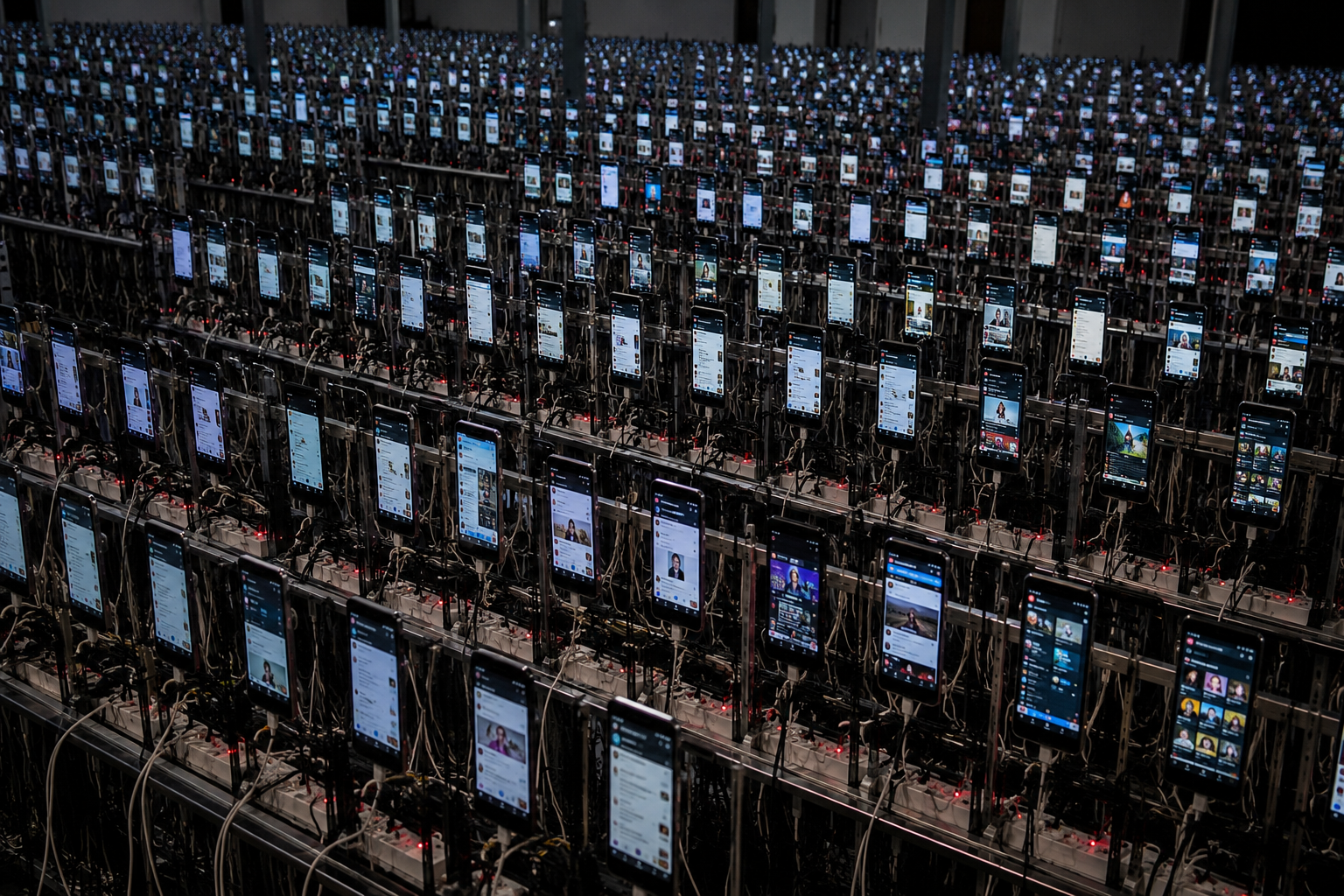
Consider TikTok’s recommendation engine. The platform became famous not because users carefully selected what they wanted to watch, but because the algorithm became exceptionally good at predicting what would hold attention. A few seconds of watch time, a pause, a replay, or a swipe can rapidly reshape the content that follows.

Within minutes, two people opening the same app for the first time may find themselves in entirely different information environments.

A similar dynamic has fueled years of debate around YouTube’s recommendation system. Researchers and former employees have questioned whether engagement-driven recommendations can gradually push users toward increasingly sensational content. The platform’s goal is straightforward: keep people watching.

Yet emotionally charged content often performs exceptionally well.

Conflict performs well. Outrage performs well.

The recommendation system may not intend to create polarization, but it can amplify polarization when polarization proves engaging. The result is not a single shared reality. It is millions of individualized realities.

Two people can open the same app at the same moment and encounter different headlines, different narratives, different fears, and different priorities. Both may believe they are seeing an accurate reflection of reality.

In truth, they are seeing a filtered version of reality assembled through algorithms designed to maximize engagement.


The Invisible Architecture

The Twitter Files reignited debates about censorship, content moderation, and government influence. Reasonable people continue to disagree about many of the conclusions.

But one observation emerged clearly: the modern information ecosystem is far more interconnected than most people realize.

Government agencies communicate with platforms. Researchers communicate with platforms. Journalists communicate with platforms. NGOs communicate with platforms. Political actors communicate with platforms.

Influence no longer flows through simple hierarchies. It flows through networks.

The public often imagines information control as a top-down process directed by a single institution. The reality appears considerably more complex.

Multiple actors, pursuing different objectives, interact within a sprawling ecosystem that helps determine which information gains visibility and which disappears from view.

No single organization controls the entire system. Yet the system itself remains extraordinarily powerful.

Because influence does not require centralized control. It only requires aligned incentives.


The Influence Ecosystem

Viewed individually, Facebook’s emotional contagion experiment, Cambridge Analytica, and the Twitter Files appear to be separate stories. Together, they reveal a broader pattern.

Facebook demonstrated that exposure to information can influence behavior.

Cambridge Analytica demonstrated that behavioral data can be used for highly personalized persuasion.

The Twitter Files demonstrated how networks of institutions increasingly shape information environments.

Consider how most people now experience major events. Elections, wars, public health emergencies, and social movements increasingly arrive through algorithmically ranked feeds rather than direct observation. Most people encounter reality through recommendations, trending topics, suggested videos, and curated posts.

The information may be accurate, inaccurate, or somewhere in between. But the experience is increasingly mediated. Three separate stories. One emerging reality.

Attention has become a strategic resource. And the institutions that understand it best possess extraordinary influence over public perception.


The New Architecture of Power

“The smart way to keep people passive and obedient is to strictly limit the spectrum of acceptable opinion, but allow very lively debate within that spectrum…” – Noam Chomsky

For much of history, accomplishing that required editors, gatekeepers, and institutions.

Today, portions of the process can be automated. Not through conspiracy. Not through ideology. But through optimization.

Algorithms shape visibility. Visibility shapes attention. Attention shapes belief. Belief shapes behavior. Behavior shapes history.

Previous generations worried about who owned the factories. Today, we may need to ask who owns the systems that shape perception itself. Because power no longer depends solely on controlling land, resources, or industry. Increasingly, power belongs to those who can guide attention.

And in an age of influence machines, attention may be the most valuable form of power ever created.


copypasteimage-2
By @anarchyroll

Do social media platforms or the people running them have a responsibility to the public or to the republic? Is it in the nature of the services to spread modern-day propaganda which has been repackaged as fake news? Are these mediums a cause for negative events or are they simply mirrors and microphones? Are they bringing the worst out of people and society? Or are they just the biggest magnifying glass in the history of the species?

Are these services really that much different from the mediums that came before them? Radio and television have the exact same purpose as social media services…..to sell ads and the information about the people who consume them.

There is no moral compass at play with Facebook, with Twitter, especially with Google or Instagram or Snapchat. They are capitalist enterprises with one reason for existing, to make money. So if one or all of the companies get offered a lot of money from a foreign country to run political ads during a presidential campaign, why wouldn’t they take the money and put the content on their platform?

Oh, the information was blatantly false? It was straight up propaganda from a foreign government? Yeah okay but, they paid up front. Money talks. In America the Supreme Court has literally said money equals speech.

If anyone thinks Facebook or Google has a moral compass or conscious, try and find out exactly what they’re doing with all that personal metadata they mine from everyone who uses their services and/or apps.

It is not just a little too late to have the “ so social media companies have a responsibility” argument. That ship sailed once the collective population decided we didn’t want our phones to be phones anymore. Once the companies realized they were able to tap into our collective dopamine addictions by turning what used to be a portable audio communicator into a slot machine that can fit into a skinny jeans pocket, responsibility went right out the window.

2017-08-03-uscapitol-ljdoyle-017-1-

Do casinos have a responsibility to their guests other than making them enjoy losing their wages? Of course not, the whole business model is built around taking money out of people’s pockets and into the casino safe. Well social media is the casino and our attention and personal information is the cash.

On top of all that, Facebook (which owns Instagram), Twitter, and Snapchat are publicly traded companies. So quite literally, their only responsibility is to maximize profits for their shareholders. Their collective interest in the health of democracy only goes as far as the stock market opening and closing on time.

Americans love social media. We also love seeing powerful people get yelled at in public by elected officials. Dogs and ponies are adorable, who wouldn’t want to see a whole show of them? Well we got the best of both worlds last week when lawyers representing the big social media players went to capitol hill and got a verbal spanking from some very angry public officials.

It was modern American politics personified. Verbal spankings, non answers, legislation proposed but not supported, visual aide charts, legal jargon, and pledges to do better in the future. The vitriol directed at social media is just a reflection of our collective anger at ourselves. We’re angry for thinking social media would be a tool for good and not just a tool to make money.

We’re angry at ourselves for being so readily fooled by fake news that we’re all to easily manipulated into believing are the real thing. We’re angry at ourselves because we thought the internet, and the web 2.0 that social media represents would make us more informed and more united. Instead it’s deepened our divide and by putting our preexisting confirmation biases on technological steroids.

Our elected officials can yell at high-priced lawyers all they want. Public berating is much easier than putting regulations into place. It’s easier for Facebook and Twitter to higher more lobbyists than more moderators to discern what is being put on their platforms, by whom, and for what purpose. It’s easier to apologize later than to do the right thing in the moments of choice. We know this. That’s why we’re not angry at social media for what happened during the 2016 election season, we’re angry at ourselves.


ssrlogo2

by @anarchyroll
7/3/2014

Social network sounds so much more appealing than electronic social emotional psychological experiment platform.

It was recently revealed that in 2012, Facebook manipulated the news feeds of just under 700,000 users, in order to measure the effects the news feed changes, on the mood(s) of the user(s).

The exact number of users who were unknowingly experimented on is 689,003. The exact amount of time was one week. Facebook showed less (than) positive posts from both friends and publication providers. Facebook did not get the consent of the users to do this experiment.

Facebook has both apologized, and offered no apologies for conducting this unauthorized psychological experiment.

Me personally, I find something like this to be disgusting and despicable. This is also a great learning lesson on a variety of levels. Let’s focus on how the results of the experiment show what social conditioning is.

Social conditioning is how we learn to think, perceive, and act through the media (movies, television, music, magazines, newspapers, social media websites/platforms, etc).

Facebook proved to themselves and to the world that social conditioning is a very real, very applicable, very effective social-emotional concept. Social conditioning shapes all of us, myself very much included. Facebook itself can be considered one big social conditioning machine.

It was also learned in the experiment that emotions are contagious. That people can in mass be manipulated to feel happier or sadder. What are the implications of this? What other large companies have performed experiments like this in the past? In the present?

I’m not going to bring this article down the conspiracy theory rabbit hole. There are simply questions worth asking of ourselves internally as well as the external world around us. How much of what we think and feel is rooted in our own personal identity, integrity, character, and principles? How much of our identity, values, and consent has been manufactured?

Think about it. Be aware of it.

What is “it”? It in this case would be the non material aspects of what makes you up as a person. Your thoughts, feelings, and so on. Do you think, perceive, and act based on what you internally believe? Or are you being so manipulated by the world around you that you have no identity that isn’t a corporate brand or group think produced? No one is above being asked that question, especially not yours truly.

Think about it. Be aware of it.


MM@C4Logo1ajclogo2

by @anarchyroll
5/15/2014

$19 billion is a lot of money to pay for a country let a lone an app. An app that is not mainstream. An app that has as much competition as any. Google searching “WhatsApp’s purpose” will yield some funny results. Certainly not what I was expecting. Not exactly a murderer’s row of technology literature heavyweights weighing in. There are as many obscure blog posts as weighing in from the likes of CNET and The Verge. What is WhatsApp’s purpose?

  1. A way to communicate internationally without the traditional international communication charges
  2. Emojis! Emojis! Emojis!
  3. The result of electronic cross breeding between instant messanger services and social media
  4. The pinnacle means of mediated by communication for generations of children raised on either mediated communication or awkwardness

WhatsApp offers everything offered by Facebook, Instagram, Vine, KIK, and Snapchat offer in one package. You can rehearse and revise audio, video, text, emoji, and all of the above within one interaction. Because, why put yourself on the line in the face of the limit of your comfort zone and knowing of what to do, when you can simple trade audio clips and modified smiley faces instead of having an eye contact to eye contact conversation.

I have talked to men and women, boys and girls, young and old about WhatsApp. The only people who have used it have used it to avoid international charges while on vacation. People in the US on work visas told me they used it to communicate to family back home, also to avoid international charges.

But then I talked to a couple of high schoolers who basically only used WhatsApp to communicate with everyone they weren’t related to. I asked them the following questions;

  • why don’t you just text?
  • doesn’t data cost more than calls and texts?
  • why don’t you use the litany of other messenger services?

I learned several things by asking these questions.

  1. It is important to talk to young people
  2. Parents could control their children by the mere threat of taking away internet use
  3. People really are social creatures
  4. There’s a lot of free WIFI in white America
  5. An increasing number of people don’t know how to communicate without it being mediated by technology or mind altering substances.

The value is in that data used is just data used. It isn’t text messages that their parents could look up. The vast supply of emojis could replace words, sentences, and entire sentiments. Emojis could equal code, for, anything. That is very valuable to younger generations who only know mediated communication. They’re brave only while drunk, stoned, rolling, or tripping or all of the above all before the age of 21. Unable to be to make eye contact without threat of punishment. Unable to focus without pills.

The entire social network experience condensed into an instant messaging chat window. The ability to practice and edit every piece of communication that goes out. Why have a conversation when you can instantly exchange audio clips? Why talk about hooking up or drinking while under age when you can send one of a thousand smiley face variations that only you and the other person know the meaning of for this interaction? Why ever use Facebook again when your parents, grandparents, employers, and exes are looking on? With WhatsApp all the stuff that made social networks fun five years ago are born again, the only people invited to the party are the people you personally send invites to turn the one on one exchange into a group chat.

There is of course, nothing wrong with wanting a completely personalized social network experience fused with instant messaging. There is nothing wrong with teens using emojis to get high and get laid since teens have been getting high and getting laid in secret using code since the roaring twenties. I worry about the need for mediated communication. The need to rehearse and edit a simple exchange of thoughts and desires. Not a preference to have communication done that way, but not knowing how to communicate competently any other way.

The inequality gap is being matched by a social competence gap. A widening gap of shyness in contact with people outside of one’s childhood collective, and experiences outside of one’s comfort zone aren’t even being seen, because more and more people are spending their lives looking down at their smart phone(s). The beautiful people of course do fine for themselves since they are constantly reminded how genetically superior they are. The rich folk are reminded they have been bred for success and can not just communicate but dictate to anyone and everyone by proxy to their parents’ bank accounts. But those in the middle or lower are looking at screens and not interacting with the physical, unless they’re riding the Molly go round. The rest use thin veils of sarcasm, impatience, and boredom to mask the fear beaming out of their eyes and creating stink lines around their entire being. A fear of not know who they are, how to act, or what they want without regurgitation of media.

Everything they know comes from a screen. Their ideas of style and substance. Photoshop and Pro Tools. Everything they experience is slickly produced at corporate level, so why wouldn’t their communications be the same way? There’s purpose and value in WhatsApp, it’s just that neither  have matured or gone mainstream yet, much like the audience they are coveting. For demographics raised on the paradigm of always being able to hit backspace or restart, WhatsApp may just be the future of communication.

MM@C4Logo1ajclogo2


by @anarchyroll
3/12/2014

I used to be an antisocial type. I can still remember my friend Sam’s girlfriend at the time nagging me nonstop until I created a My Space account in 2006. I did it to get her to stop asking me about it, but I am glad she did.

Antisocial is just a modern, glossy word for coward. Too scared to put oneself on the line outside of their comfort zone in front of strangers for fear of being judged or exposed as something other than the image they have crafted of themselves in their own mind/ego.

My social muscles were undeveloped. I am still catching up to my peers all these years later. Making new friends, business contacts, and romantic partners has been at a minimum half again as hard as it is for the average able minded person. Social media has helped with this. It is like giving someone a digital business card for your personal life. That is what I always enjoyed about social media and still do.

I started making friends late, I started dating late, I joined My Space late, I joined Facebook late, I joined Twitter late. I joined Instagram the day it became available for Android. I had a friend who introduced me to Instagram at her house one night after her Oscar’s party. I scrolled through it on her iPhone and remember talking about how the app looked like the future of social media. She agreed, saying she barely used Facebook anymore after getting on Instagram when it was still #iPhoneonly.

It turns out we were both right, and weren’t nearly the only people thinking those thoughts. Social media is now completely dominated by pictures and video aka photography. If you aren’t actively taking and posting pics and videos on your social media account(s) you have already been left behind and are merely a bystander rather than a producer in the social media world whether you know it or not, whether you like it or not.

The social stars are  Instagram, Tumblr, Snapchat, Vine, Flickr, Pinterest, and the latest and greatest darling of the World Wide Web 2.0, Imgur. I thought Imgur was merely the Reddit GIF maker/host but it turns out they are much more. Bloomberg/Businessweek wouldn’t do a story about them if they weren’t.

77 million unique visitors per day uploading 1.5 million image files while spending an average of 10 minutes on the site when they stop by. Those numbers mean they’re the current HBIC in social media and may be next on the queue to be bought by Yahoo. Imgur is pronounced Imager. There’s no A in there for the same reason so many apps end in just R instead of ER. Imgur is also ground zero for cats taking over the internet in the last two years along with YouTube.

The evolution of social media from text to visual images and video was inevitable. As we went from newspaper to radio to movies/television. Social media becoming dominated by pics & video is also being mirrored in SMS. As text messages are already a relic in the era of Snapchat, KIK, and WhatsApp. Human beings prefer visual stimuli and that is why animated emoticons shall inherit the Earth.
