


What happens when the most powerful institutions in society become experts at shaping attention itself?
For most of human history, power was relatively easy to recognize.
Kings controlled armies. Governments controlled laws. Corporations controlled resources. Media organizations controlled information. The centers of influence were visible.
Today, influence is becoming harder to see.
It arrives through recommendation engines, notifications, search results, personalized feeds, and algorithms that quietly decide what appears in front of us each day.
Glenn Greenwald famously argues that the greatest power of the state is not controlling what people think, but controlling the actual information they are allowed to see.
That distinction matters.
Most people imagine propaganda as something obvious—a government ministry, a state broadcaster, or a censor with a red pen. But modern influence rarely works that way. Instead, it emerges through systems designed to maximize engagement, collect behavioral data, and compete relentlessly for human attention.
The result is something new in human history: a world where billions of people interact daily with platforms that continuously study, predict, and increasingly shape human behavior.
Not necessarily because anyone designed a grand conspiracy. But because influence itself has become profitable. And profitable systems tend to expand.
The Most Valuable Commodity on Earth
Oil powered the industrial age. Data powers the digital age.
Every click, scroll, pause, search, purchase, and interaction leaves a trail behind. Individually, these actions seem insignificant. Collectively, they create a remarkably detailed portrait of who we are, what captures our attention, what triggers our emotions, and what keeps us engaged.
Consider what happens during a typical day. A smartphone records location data. A search engine records questions. An online retailer records purchases and browsing habits. Social media platforms record likes, shares, comments, watch time, and scrolling behavior.
Individually, these data points appear trivial. Together, they form a behavioral profile of extraordinary depth.
For the largest technology companies, this information has become one of the most valuable resources on Earth. The longer we stay engaged, the more advertisements can be shown. The more advertisements that can be shown, the more revenue can be generated.
At first glance, this appears to be a simple business model. But once engagement becomes the primary objective, the incentives begin to change. The goal is no longer merely to understand behavior. The goal becomes predicting it and eventually shaping it.
When the Experiment Was Real
For years, critics warned that social media platforms possessed extraordinary power to influence human behavior.
Then, in 2014, Facebook demonstrated it.
Researchers working with the company altered the news feeds of hundreds of thousands of users without their knowledge. Some users were shown slightly more positive content. Others were shown slightly more negative content. The objective was to determine whether changes in information exposure would influence emotional expression.
The results suggested they would.
Users exposed to more negative content tended to post more negatively themselves. Users exposed to more positive content tended to post more positively.
The study became controversial after it became public, largely because participants had not given informed consent. But the larger implication received less attention.
The significance was not that Facebook conducted the experiment. The significance was that Facebook possessed the capability to conduct it.
A platform used by hundreds of millions of people had demonstrated that adjusting information flows could produce measurable changes in behavior.
The experiment was small. The implications were enormous.
Behavioral Futures
In her work on surveillance capitalism, Shoshana Zuboff details how tech monopolies no longer merely predict human behavior but actively seek to modify it for corporate profit.
The Facebook experiment offered a glimpse into a much larger economic model.
For decades, businesses have studied consumer behavior to predict purchasing decisions. Digital platforms expanded that process dramatically. Every interaction became measurable. Every preference became data. Every behavior became another signal that could be collected, analyzed, and monetized.
Prediction gradually evolved into optimization. Optimization gradually evolved into influence.
Not because engineers necessarily wished to manipulate people, but because engagement was rewarded. The system followed the incentives placed before it. And over time, optimization itself became a form of behavioral engineering.
The Day the Curtain Moved
If Facebook’s emotional contagion experiment revealed the capability, Cambridge Analytica revealed the potential.
The scandal exploded into public view in 2018 after reports revealed that data from millions of Facebook users had been harvested and used to build psychological profiles. The controversy centered on elections. But elections were only part of the story.
The larger revelation was that modern digital platforms had created the infrastructure for highly personalized persuasion.
Different people could receive different messages. Different fears could be activated. Different motivations could be targeted.
Not at the level of demographics. At the level of individuals.
Cambridge Analytica did not invent these capabilities. It exposed them.
For many people, it was the first glimpse into a world where persuasion itself had become increasingly automated, data-driven, and personalized. The curtain moved just enough for the public to see the machinery behind it.
Manufacturing Reality
Tech ethicist Tristan Harris frequently warns that modern technology is no longer just competing for our attention; it is competing for absolute control over it.
That competition for attention shapes nearly every aspect of the modern digital experience.
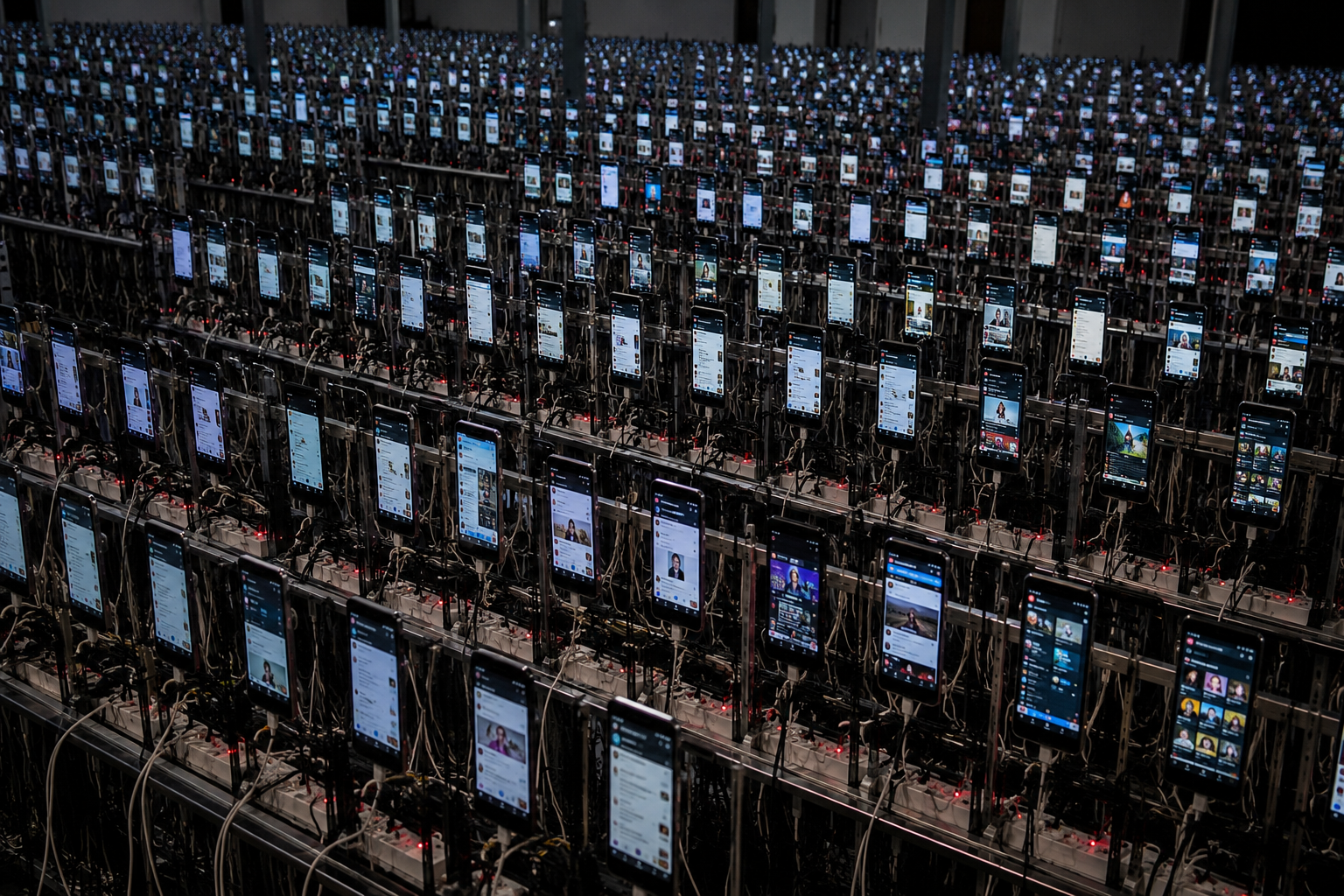
Consider TikTok’s recommendation engine. The platform became famous not because users carefully selected what they wanted to watch, but because the algorithm became exceptionally good at predicting what would hold attention. A few seconds of watch time, a pause, a replay, or a swipe can rapidly reshape the content that follows.
Within minutes, two people opening the same app for the first time may find themselves in entirely different information environments.
A similar dynamic has fueled years of debate around YouTube’s recommendation system. Researchers and former employees have questioned whether engagement-driven recommendations can gradually push users toward increasingly sensational content. The platform’s goal is straightforward: keep people watching.
Yet emotionally charged content often performs exceptionally well.
Conflict performs well. Outrage performs well.
The recommendation system may not intend to create polarization, but it can amplify polarization when polarization proves engaging. The result is not a single shared reality. It is millions of individualized realities.
Two people can open the same app at the same moment and encounter different headlines, different narratives, different fears, and different priorities. Both may believe they are seeing an accurate reflection of reality.
In truth, they are seeing a filtered version of reality assembled through algorithms designed to maximize engagement.
The Invisible Architecture
The Twitter Files reignited debates about censorship, content moderation, and government influence. Reasonable people continue to disagree about many of the conclusions.
But one observation emerged clearly: the modern information ecosystem is far more interconnected than most people realize.
Government agencies communicate with platforms. Researchers communicate with platforms. Journalists communicate with platforms. NGOs communicate with platforms. Political actors communicate with platforms.
Influence no longer flows through simple hierarchies. It flows through networks.
The public often imagines information control as a top-down process directed by a single institution. The reality appears considerably more complex.
Multiple actors, pursuing different objectives, interact within a sprawling ecosystem that helps determine which information gains visibility and which disappears from view.
No single organization controls the entire system. Yet the system itself remains extraordinarily powerful.
Because influence does not require centralized control. It only requires aligned incentives.
The Influence Ecosystem
Viewed individually, Facebook’s emotional contagion experiment, Cambridge Analytica, and the Twitter Files appear to be separate stories. Together, they reveal a broader pattern.
Facebook demonstrated that exposure to information can influence behavior.
Cambridge Analytica demonstrated that behavioral data can be used for highly personalized persuasion.
The Twitter Files demonstrated how networks of institutions increasingly shape information environments.
Consider how most people now experience major events. Elections, wars, public health emergencies, and social movements increasingly arrive through algorithmically ranked feeds rather than direct observation. Most people encounter reality through recommendations, trending topics, suggested videos, and curated posts.
The information may be accurate, inaccurate, or somewhere in between. But the experience is increasingly mediated. Three separate stories. One emerging reality.
Attention has become a strategic resource. And the institutions that understand it best possess extraordinary influence over public perception.
The New Architecture of Power
“The smart way to keep people passive and obedient is to strictly limit the spectrum of acceptable opinion, but allow very lively debate within that spectrum…” – Noam Chomsky
For much of history, accomplishing that required editors, gatekeepers, and institutions.
Today, portions of the process can be automated. Not through conspiracy. Not through ideology. But through optimization.
Algorithms shape visibility. Visibility shapes attention. Attention shapes belief. Belief shapes behavior. Behavior shapes history.
Previous generations worried about who owned the factories. Today, we may need to ask who owns the systems that shape perception itself. Because power no longer depends solely on controlling land, resources, or industry. Increasingly, power belongs to those who can guide attention.
And in an age of influence machines, attention may be the most valuable form of power ever created.




 Anarchy Journal Constitutional