Posts Tagged ‘capitalism’

Systemic Cruelty Dressed Up as Policy


Like slavery and apartheid, poverty is not natural. It is man-made and it can be overcome and eradicated by the actions of human beings. — Nelson Mandela (earth.org)


Criminalization of Survival

Across the United States, cities are treating the act of survival—sleeping, sitting, asking for help—as criminal behavior. These punitive “sit-lie” laws, camping bans, sweeps, and aggressive policing do not solve homelessness—they entrench it.

The National Homeless Law Center notes that criminalizing homelessness punishes life-sustaining activities and makes it “more difficult to escape” homelessness (homelesslaw.org). Human Rights Watch calls Los Angeles’s enforcement “cruel and ineffective,” targeting the visible poor rather than root causes (hrw.org).

And the National Alliance to End Homelessness found in a 2025 report that criminalization fails to enhance safety and instead deepens racial inequities (endhomelessness.org).


Welfare as Surveillance

What was once a safety net has become a web of surveillance and moral judgment. Welfare recipients often face drug testing, work mandates, and algorithmic gatekeeping. The state spends more money building systems to punish “fraud” than the fraud itself.

The broader trend is summed up in the concept of the criminalization of poverty—fines, anti-homeless laws, welfare policing—all disproportionately penalize people for behaviors tied to economic status (en.wikipedia.org).


Bipartisan Neglect

From Clinton’s “end of welfare as we know it,” to Republican austerity, to performative pandemic relief—both parties have abandoned structural solutions. Poverty remains a prop for campaigns, a scapegoat for policy failures.

The trajectory is clear: LBJ’s 1964 War on Poverty drastically reduced poverty, but the programs were retrenched in the decades that followed (en.wikipedia.org). As the New Yorker observed, “the retrenchment of the social-welfare state went hand in hand with the rise of the prison and policing state” (newyorker.com).


Policy as War

This isn’t side-effect cruelty—it’s intentional. Austerity is meticulously planned: sprawling military budgets and corporate bailouts while school lunches vanish, shelters shrink, and Medicaid is constantly threatened.

Anti-homeless laws that target sitting, sleeping, begging, and even sharing food are not about solving poverty—they’re about making the poor less visible (en.wikipedia.org).


Turning Cruelty into Care

Poverty isn’t inevitable—it’s policy. But if it’s made, it can be unmade.

Everyday Direct Care

  • Support mutual aid groups, solidarity kitchens, street medicine teams, and eviction defense networks.
  • Donate to or volunteer with organizations that protect civil rights for the unhoused, such as those advancing a Homeless Bill of Rights (en.wikipedia.org).
  • Choose ways to help that don’t rely on surveillance or punishment, but on trust and dignity.

Local Policy Pressure

  • Demand that local officials defund homeless sweeps and redirect funds to housing-first programs, mental health care, and tenant protections.
  • Organize for the passage of Homeless Bills of Rights in your state or city.
  • Pressure city councils and state legislatures to prioritize affordable housing budgets over police budgets.

State & National Strategy

  • Advocate for restoring and expanding War on Poverty–era programs like Head Start, expanded tax credits, and affordable housing investments.
  • Oppose laws that subject welfare recipients to invasive surveillance, drug testing, or punitive work requirements.
  • Build alliances that prioritize social infrastructure over military expansion or corporate subsidies.

This is the real choice: treat poverty as crime, or treat it as solvable. The first path guarantees endless war on the poor. The second path builds a society worth living in.


Truth Over Tribalism

Follow anarchyroll:

Wisdom Is Resistance


How Hustle Culture Masks Wage Stagnation and Serves the System That Exploits Us


“If you just work harder, you’ll make it.”
That’s the lie. That’s the scam.

We’ve been sold a fantasy of upward mobility that depends not on policy, fairness, or collective progress, but on our willingness to self-destruct in the name of ambition. Hustle culture tells us that success is just a matter of willpower. Wake up earlier. Grind longer. Outwork everyone. Sleep less. Want it more.

Meanwhile, corporations rake in record profits. Wages flatline. Healthcare, housing, and higher education become luxury items. But you? You’re still thinking it’s your fault.

Let’s pull back the curtain.


Hustle Culture Is Corporate Propaganda

Productivity influencers. 5AM club bros. “No days off” as a flex.

This isn’t just personal ambition — it’s been industrialized. We’re encouraged to track every breath, stack habits, bullet-journal our burnout, and turn our identities into brands. This isn’t motivation. It’s manipulation.

By reframing overwork as a virtue, the system turns our exhaustion into a badge of honor. You’re not supposed to question why you have to hustle this hard just to survive. You’re just supposed to optimize better.


Productivity Went Up — Wages Did Not

Since 1979, worker productivity in the U.S. has risen by more than 60%. But hourly wages? Up only about 17%. Where did the gains go? Straight into the hands of shareholders, executives, and the asset-owning class.

You’ve probably felt it. Working longer hours just to keep up. Side hustles becoming lifelines. And still, rent rises faster than your paycheck. It’s not laziness. It’s a rigged game.

📊 From 1979 to 2020, U.S. productivity grew 61.8% while hourly pay rose just 17.5%.Economic Policy Institute

Hustle culture isn’t closing the gap. It’s hiding it.


Burnout Isn’t a Personal Failure

Internalized capitalism teaches us to equate self-worth with output. When we feel overwhelmed, we don’t blame the system — we blame ourselves.

But the exhaustion isn’t a bug. It’s the feature.

We’ve been taught that if we feel burned out, we just need better time management. A better planner. A better morning routine. We keep trying to fix the machine — when the problem is that we’re not machines at all.

“You are not lazy, unmotivated, or stuck. After years of living in survival mode, you are exhausted. There is a difference.” — Nedra Glover Tawwab


The Scam Serves Power

There’s a reason hustle culture has been monetized and weaponized by the very systems profiting off your labor.

Big Tech sells you productivity tools. Influencers push affiliate codes for morning journals and nootropics. Employers glorify “passion” to justify unpaid overtime. Gig apps track your every second. Even rest has been turned into another thing to optimize.

The more exhausted you are, the less likely you are to resist. The scam isn’t just psychological — it’s strategic.


Opting Out Is the First Step

Quiet quitting. Labor strikes. The rise of “lazy girl jobs.” These are signals of something deeper — a refusal to keep feeding a system that only takes.

We don’t need to hustle harder. We need to stop normalizing a world where burnout is inevitable, and survival is treated like success.

Stop optimizing. Start organizing.
The system is broken — not you.


anarchyroll presents

Anarchy Journal Constitutional
☯ Wisdom is Resistance | ∞ Truth Over Tribalism


🎬 Scroll-Friendly Version
This article was reimagined as a visual essay — watch the reel below.

@anarchyroll_

The productivity scam is working. We hustle, they profit. This isn’t about success. It’s about survival. Visual essay by @anarchyroll ☯️ Wisdom is Resistance 🗞 anarchyjc.com #burnout #hustleculture #productivityscam #visualessay #anarchyroll

♬ Apocalypse – Alex From Space

📡 Follow anarchyroll across platforms for more visual essays, short-form truth, and independent, gonzo journalism-inspired writing:

📽️ TikTok: @anarchyroll_
📷 Instagram: @anarchyroll
🐤 X / Twitter: @anarchyroll
🧵 Threads: @anarchyroll
🔵 Bluesky: @anarchyroll


Busyness to escapism is a vicious circle and a trap. 

Either can be confused with purpose which is dangerous. Put together, they’re deadly for one’s spirit and steroids for one’s ego. 

Busyness is not productivity or discipline it is avoidance and anxiety put into physical action. Keep busy to avoid _______________.

Stay busy long enough and you need an escape. A treat. A vacation. Some me time. Some self-care. Candy, carbs, social media scrolling, video games, sex, drugs, binge-watching, a drink, a smoke, a weekend getaway, and so on. It’s all the same. 

I’m burned out from being busy but I still need to avoid __________________ so I need to take/do my favorite ____________ so I can feel ______________.


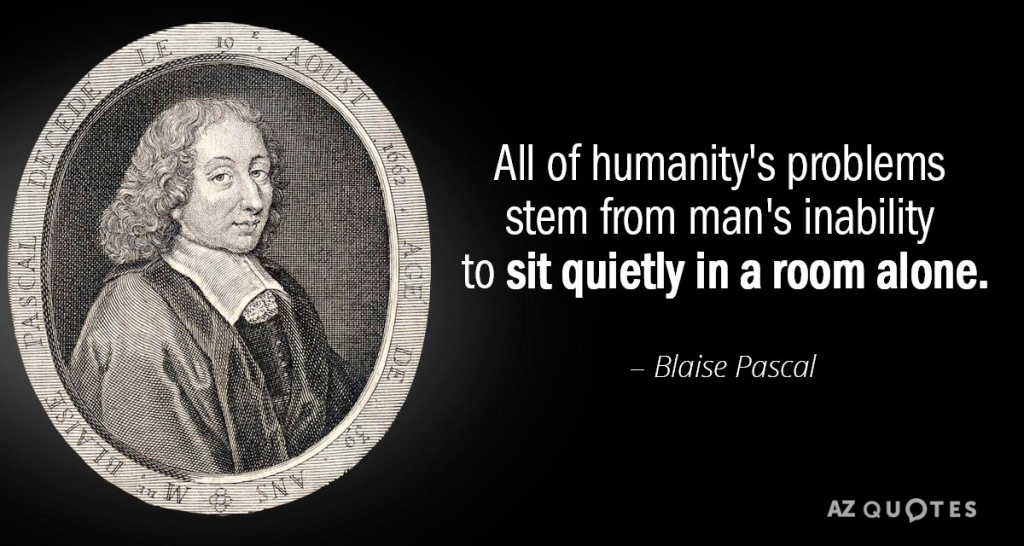
“All of humanity’s problems stem from man’s inability to sit quietly in a room alone.” – Blaise Pascal


A meditation and journaling practice are the simple answers here. Getting one’s thoughts out of their head by writing them onto paper, helps to clear the mind for a meditation practice to help detach and observe one’s thoughts mindfully while focusing on an anchor like one’s breath or body. 

But life isn’t simple and people aren’t simple. From a detached, safe, secure, bird’s eye view things may seem simple and easy. But life is not lived from a Goodyear blimp angle looking down. We’re in the trenches daily, minute to minute, breath to breath, trying to do our best with what we have. 

To stay busy long enough to earn an escape via entertainment is what many in first-world, capitalist-controlled countries, are incessantly conditioned to believe is what makes for a good life. Carrot and stick. Cheese in the maze. Do your job, earn your treat. Create shareholder value, have a pizza party.

However mental health is declining exponentially with every passing generation. Depression, burnout, and loneliness increased as consistently as the US Stock Market over the past century. Much like economics in America, a small percentage are doing very well while the vast majority suffer due to systemic failure. 


Therefore things like meditation, journaling, yoga, philosophy study, heavy weight training, nature bathing, cold exposure, deep breathing exercises, light therapies, legalized cannabis and hallucinogens, etc. all exponentially move from the fringe to the mainstream with every passing generation. Why? To counteract the systemic failures forced upon them, by the prior generations that seem to become exponentially more; fearful, greedy, and angry with each modicum of increased control and longevity they gain.

What do all the listed above, formerly; fringe, new-age, woo-woo, alternative, holistic, organic, practices have in common? They get a person present, focused, out of their head and into the present moment. Out of the delusion of the undue stress modernity thrusts upon them ad infinitum and into their physical bodies while detaching from their mind activity. They cultivate mental-emotional space, which can help put one in a space of non-doing and non-attachment. 

Cultivating that inner space, between stimulus and response, is how we break the vicious circle of busyness to escapism. Many great philosophers and spiritual teachers of the past and present have talked about this. Alan Watts, Ram Dass, Wayne Dyer, Eckhart Tolle, Wim Hof, Tim Ferriss, Ryan Holiday, Mark Manson, etc. 

Breaking that cycle, getting out of or avoiding that trap; is how one builds, one conscious choice at a time, a purpose-driven life. And a purpose-driven life doesn’t mean one tries to save the world or become a monk living on a mountain, or a motivational speaker. It simply means you live your life for you on your terms.

You have the space to get to know yourself, deeply and fully. You can determine your actual values, your actual morals, your actual wants, and your actual needs rather than the ones externally assigned and forced upon you. Then you assemble your ideal life step by step, action by action, choice by choice, day by day. Then, the real work of living begins. 

Is there a difference between societal norms and cultural norms?

Have either of those changed in the past generation (20 years)?

How about the past half century?

Living at home with one’s parents into adulthood used to be akin to the scarlet letter. At least for men. A forehead tattoo with a capital L for the child, and there parents.

Go to school, get a job, get married, have kids, retire, die…

Millennials and Gen Z went to school, more than any other generation in history. Millennials and Gen Z got jobs. Yet more of us are living at home with our parents than ever before.

Nearly half of adults under 30? That’s a lot of lazy freeloaders. Or is it something else?

Are the most educated generations of men and women in history failing the system or is the system failing them? Are they failing society or is society failing them? Are they failing culture or is culture failing them?

Wages hadn’t kept up with productivity for half a century before the pandemic and the historic aftershocks of inflation. How many mind fucks can developing brains take before they’re permanently fried?

Both my parents are dead, so I’m happy to hear so many people 18-29 have living parents that they can live with. But I have a feeling they would rather leave the nest if they didn’t have to choose between rent and eating.

An upside to living at home is that it gives more time for organizing.

The empirical data on this issue seems to keep moving in one direction. Capitalist bootlickers will gaslight and deny saying that unemployment and the stock market are doing better than ever. As if either of those things has anything to do with suffering and quality of life for actual human beings.

Every year, every election cycle, every generation the rank and file seem to be asked to take less, do more, have less, save more, enjoy less, suffer more, think less, feel less, be less so that those with the most can have that much more.

Is this sustainable? Is this ethical? Is this tolerable? Is this how it’s always been? Is this how it will always be?

What is the stock market? A central marketplace to buy and sell stock. The NYSE dates back to 1792. It was likely never explicitly stated that it’s a private club. Because of the term publicly traded company, many people probably assume the public interest is being served or that the stock exchange is a public place. It is not.

10% of the populated owns nearly 93% of the stock market. As the late, great George Carlin used to say “it’s a big club, and you ain’t in it”.

10% of the population…wow, and the government gave them how much bailout money in 2008?

I wonder how the public could have benefited from that money? Healthcare, pot hole repair, college debt forgiveness, homeless sheltering, food banks, community gardens, jobs programs, etc. But that’s going into fantasy land. A fantasy where the rich don’t get richer.

Is there a middle ground where the poor don’t have to get poorer?

It is something to see so much data and evidence pile up that America is living in a capitalist controlled oligarchy. The illusion of direct democracy fades for all but the heavily propagandized. Unfortunately the heavily propagandized is still the majority of the civilian population of America.

The evidence of that fact shows up every election season. Red vs blue, republicans vs democrats, neighbor vs neighbor. Tribalism weaponized to keep the unwashed masses fighting amongst themselves rather than looking upwards and their oppressors.

That third parties are still relegated to joke status because the duopoly has people convinced lock, stock, and barrel that they need to vote between the lesser of two evils OR ELSE, is also really something to behold every election season.

How many billions need to be spent on war and corporate welfare each year before something changes? Is there a number? Is there a flash point? Is there a turning point? Do we as a people have it in us?

It is easier to just get by. Take less and be lead. Settle on the sidelines and complain through small talk or comment sections.

However, it is also getting harder to deny reality. Even in a time of compounding misinformation and infinite propaganda, a study that shows that 10% own 93% of the stock market comes out. The same stock market that is used by every mainstream news source as the indicator of whether the economy is doing good or bad for the whole country.

So if 10% are doing good we’re all doing good? No. But every news anchor and every politician in America talks about how good or bad the economy is doing based on how the stock market is doing. So what does it mean if the stock market is doing good, 10% of the population are doing good, the media and politicians all in unison say we are doing good as a whole, but the vast majority are experiencing the toughest times of the past century?